




Bangladesh is at a political crossroads. On February 12, the South Asian country is scheduled to hold a national election alongside a referendum on institutional reforms proposed in the July Charter, a reform package aimed at establishing stronger checks and balances among key state institutions. The vote will mark the country’s first return to competitive polling since 2024 student-led protests ended fifteen years of increasingly autocratic rule under Sheikh Hasina. This is certainly a momentous occasion, but Bangladesh still faces significant questions about its political reconfiguration, internal security, economic outlook, and foreign policy that may not be answered via the ballot box alone.
Political Uncertainty
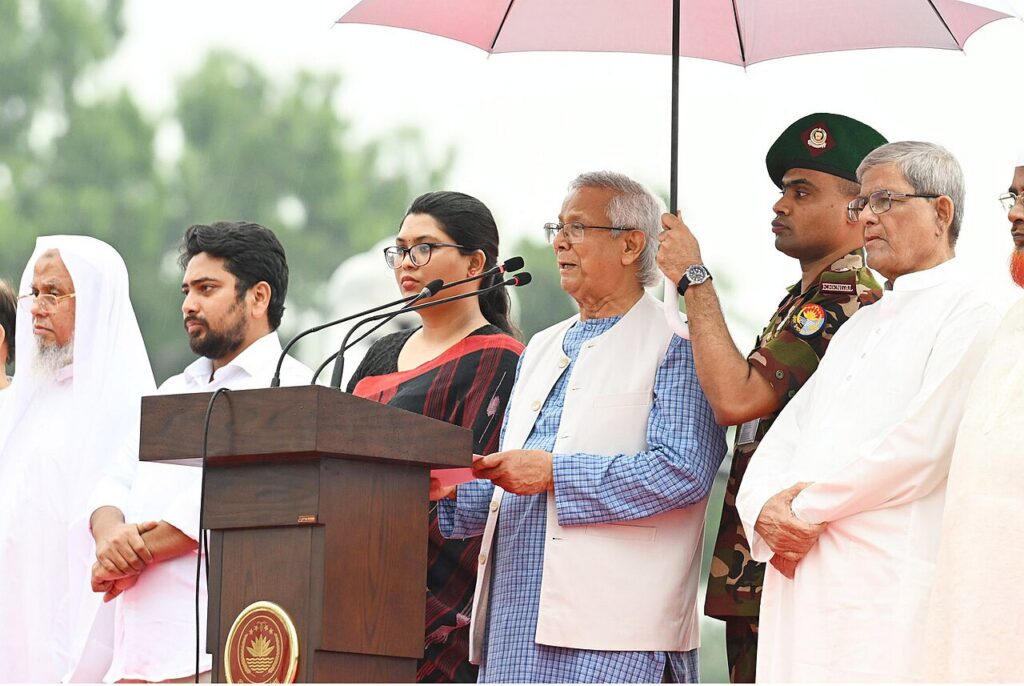
Since August 2024, the interim government led by Chief Adviser Muhammad Yunus, operating with the army’s backing, has overseen a transition marked by institutional fragility, weak law enforcement, and contested authority. With a population nearing 180 million and a median age of about 26, Bangladesh enters the 2026 polls with a generation of voters who became eligible after 2008 and have never experienced a genuinely competitive national vote. The 2008 election remains the last broadly accepted benchmark: the 2014 and 2024 elections were marked by opposition boycotts, while the 2018 election, although formally contested, was marred by systematic vote rigging that secured repeated victories for Sheikh Hasina’s Awami League (AL). Consequently, Bangladesh approaches the election with over 127 million eligible voters, but with limited clarity about how they will express political preferences after years in which participation was rendered inconsequential. Overseas voting for the previously-excluded Bangladeshi diaspora further expands and complicates the electoral calculus.
Furthermore, the political order is undergoing a significant reconfiguration. Hasina’s AL is not participating in the electoral process, as a provisional ban has been imposed pending investigations into the party’s role in the 2024 violence. There is strong resistance to the party’s reintegration into mainstream politics, particularly among leaders of the 2024 student protests, due to its association with widespread repression and killings in 2024. In this changing landscape, the Bangladesh Nationalist Party (BNP)—the AL’s principal rival for decades—has moved to the center of electoral politics, especially with the return of its chairperson, Tarique Rahman, after seventeen years of self-imposed exile in London, helping to consolidate the party’s internal ranks. At the same time, an alliance between Jamaat-e-Islami, the country’s leading Islamist party, and the youth-led National Citizen Party (NCP), which seeks to channel the political legacy of the July 2024 uprising, along with smaller like-minded actors, could mount a serious electoral challenge to the BNP. However, the NCP’s participation in an Islamist-dominated coalition has both fragmented the party internally and constrained its ability to aggregate a unified youth vote.
Surveys show the BNP in the lead, but the gap is closing. Hence, the Jamaat–NCP alliance may emerge as a formidable challenger, testing whether the BNP’s long electoral experience can withstand the momentum of this newly-formed coalition. For Jamaat, the election marks a rare opportunity to move beyond its traditional role as a power broker and, for the first time, lead a coalition as an independent pole in national electoral politics. Even without formally contesting, the AL’s long-standing strongholds in some constituencies mean its loyal voters could still influence margins and affect the final outcome.
“Bangladesh still faces significant questions about its political reconfiguration, internal security, economic outlook, and foreign policy that may not be answered via the ballot box alone.”
Persistent Insecurity
Having entered office without a clear timeline or defined political mandate, the interim government soon came under strong pressure, especially from the BNP, to hold early elections. The polls are now taking place amid heightened security risks. The AL has called for an election boycott, and there are strong indications that the party may resort to violence to sabotage the polls. While many AL leaders are either in exile abroad or behind bars, the party’s entrenched networks across the country remain active and capable of coercive signaling. This dynamic intensified in November 2025, following the death penalty verdict against Hasina over the 2024 mass killings, as AL-linked mobilization escalated into shutdowns and arson attacks on public infrastructure. These domestic tensions have been further inflamed by Hasina, self-exiled in India, who continues to issue inflammatory messages targeting Bangladesh, reinforcing perceptions of Indian interference in the country’s domestic politics.
The post-Hasina domestic political terrain has been consistently volatile. Factional competition among political actors jockeying for position in a reconfigured landscape has already translated into sustained and often lethal violence, particularly at the local level, where patronage networks are being renegotiated. According to a recent Transparency International Bangladesh (TIB) study, Bangladesh experienced roughly 600 incidents of political violence nationwide between August 2024 and December 2025, resulting in at least 158 deaths and more than 7,000 injuries. This violence was associated with struggles over control of local institutions and revenue-generating activities, with BNP leaders or activists linked to more than 90 percent of recorded incidents. Misinformation further accelerates these dynamics by transforming localized incidents into wider mobilizations framed around communal harmony or media freedom. These unresolved patterns suggest that Bangladesh is entering the election cycle without having addressed the structural sources of political violence and social fracture.
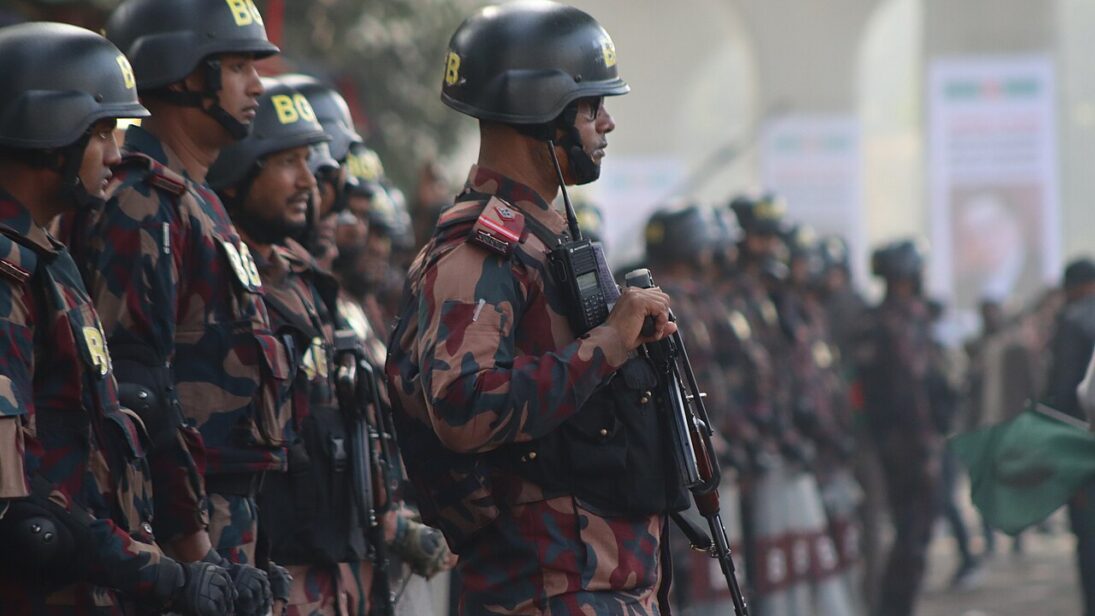
Moreover, the reopening of electoral competition is unfolding in a deteriorating security environment, where the central challenge to holding a peaceful election on February 12 is the maintenance of law and order. In response, the interim government has announced the deployment of nearly 900,000 personnel drawn from the police, armed forces, and paramilitary agencies, supported by expanded surveillance measures such as drones and body-worn cameras. Whether this extensive deployment translates into effective control on the ground remains the ultimate test of the interim government’s capacity to manage the electoral process. Furthermore, the military’s de facto role as the central security guarantor, despite formally operating in aid to the civil power, means that its continued deployment and institutional weight will be decisive in shaping the overall electoral environment, especially amid fragile policing and unresolved legacies of security-sector politicization.
Geopolitical Landscape
Bangladesh’s upcoming election will be closely watched around the world, not least because its political stability will directly shape regional security and economic connectivity in South and Southeast Asia. The country already hosts more than one million Rohingya refugees from Myanmar, whose prolonged displacement has become a persistent governance and security challenge; renewed violence in Myanmar has driven up to 200,000 additional Rohingya into Bangladesh during 2024–2025. The absence of a strong and stable government in Dhaka would weaken border control and refugee governance, leaving the Myanmar–Bangladesh frontier fragile and open to continued displacement and cross-border violence.
The February election is likely to also shape how external actors assess opportunity and engagement in the post-election period. The United States will likely pursue a transactional approach focused on trade, supply-chain resilience, and targeted security cooperation, alongside humanitarian assistance aimed primarily at preventing further deterioration of the refugee situation. China, by contrast, is expected to continue business as usual through fast and visible economic initiatives while expanding its strategic footprint, including deeper defense engagement and potential sales of advanced military platforms such as fighter aircraft.
India, in particular, faces a sharp diplomatic challenge after the collapse of longtime ally Sheikh Hasina significantly reduced New Delhi’s leverage in Bangladesh. Recognizing this reality, India appears to be quietly laying the groundwork for a post-election reset, reaching out to the BNP and, through back-channel contacts, to Jamaat. Any incoming government in Dhaka is likely to pursue a pragmatic relationship with New Delhi centered on trade and connectivity rather than open contestation. Efforts at normalization, however, remain constrained by New Delhi’s continued hosting of the convicted former leader, which carries reputational costs in Bangladesh and beyond, particularly in relation to democratic accountability. The fragility of the relationship is evident in how issue-specific disputes, such as the recent controversy involving cricketer Mustafizur Rahman, escalate and politicize bilateral ties in the absence of trust.
Following the election, Bangladesh is likely to pursue a pragmatic relationship focused on trade, cross-border security cooperation, and renewed engagement on unresolved issues such as transboundary water sharing. At the same time, building on the nationalist momentum generated by the July uprising, the next government is likely to seek greater strategic autonomy by expanding partnerships with a wider range of global actors and moving away from the Hasina-era pattern of deference to Indian strategic priorities.
“If the election proceeds credibly, it can deliver a government with a clear electoral mandate to consolidate political authority, reduce uncertainty, improve law and order, restore investor and public confidence, and pursue a more coherent foreign policy.”
Looking Ahead
This election is not only about who governs Bangladesh, but whether the incoming government can restore political stability and economic confidence after years of turbulence under a personalist and corruption-prone regime. The country’s economy is recovering but remains below its pre-pandemic trajectory, with GDP growth projected in the mid-4 percent range in 2026 and inflation still above 8 percent, continuing to erode living standards and domestic consumption. Private investment and employment growth have been sluggish, with weak investor confidence closely linked to political uncertainty. At the same time, Bangladesh is approaching graduation from Least Developed Country (LDC) status in November 2026, a milestone that brings significant risks alongside opportunity. The anticipated loss of preferential market access and concessional financing could expose the economy to sharper global competition unless productivity gains are secured and improved trade arrangements are negotiated. Under these conditions, sustained political stability and predictable economic policymaking will be critical to stabilizing investment expectations and managing a smooth transition to the post-LDC era.
Taken together, these economic and political constraints shed light on what elections in Bangladesh can realistically resolve and what they cannot. If the election proceeds credibly, it can deliver a government with a clear electoral mandate to consolidate political authority, reduce uncertainty, improve law and order, restore investor and public confidence, and pursue a more coherent foreign policy. With the referendum associated with the July Charter likely to gain popular approval, reflecting widespread fatigue with authoritarian rule, the incoming government will face strong pressure to incorporate these reforms. Failure to do so would risk renewed popular mobilization and political instability.
At the same time, elections cannot deliver immediate reconciliation or an overnight end to political violence: grievances accumulated over fifteen years of Hasina’s personalist rule, deep polarization among political actors, and the persistence of coercive pressure groups will not disappear through a single vote. The next government will therefore be tested on its ability to rebuild weakened state institutions, implement long-delayed reforms, and restore trust at home and abroad, making the election less a solution in itself than an opening for potential stabilization.
Views expressed are the author’s own and do not necessarily reflect the positions of South Asian Voices, the Stimson Center, or our supporters.
Also Read: Bangladesh in 2025: The Political Game Over Elections and the Battle for Democratic Credibility
***
Image 1: Wasiul Bahar via Wikimedia Commons
Image 2: Press Information Department of Bangladesh via Wikimedia Commons


