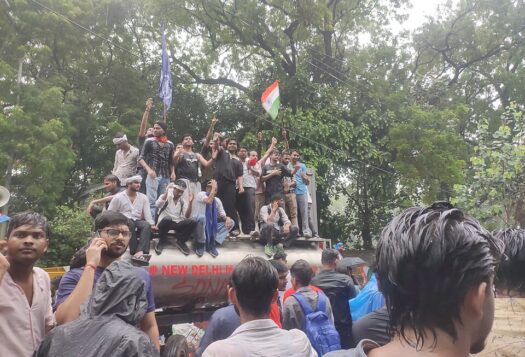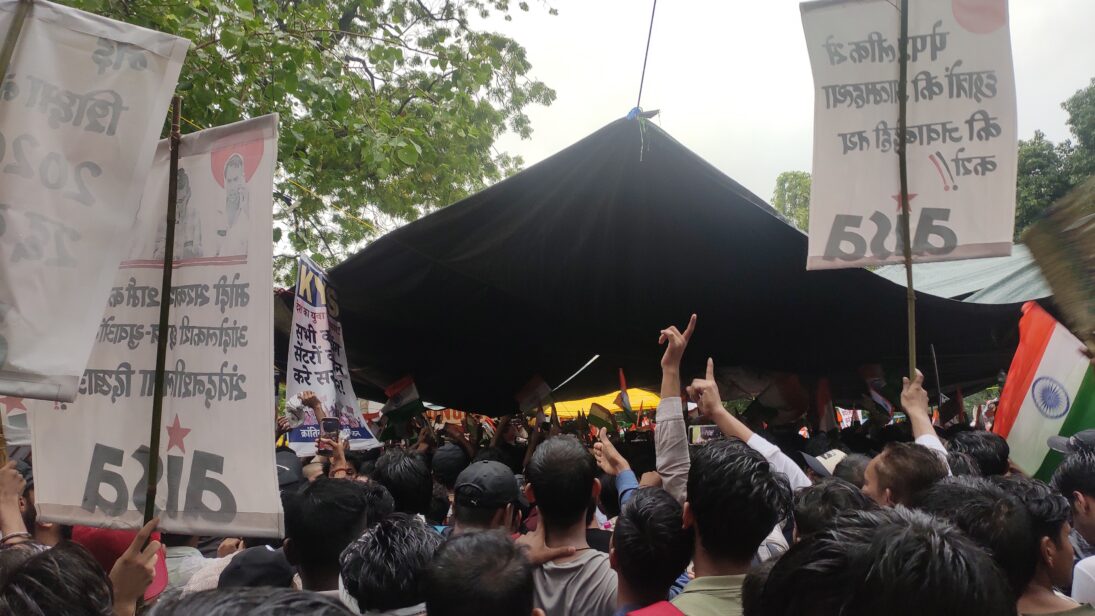
On July 25, protests in Delhi led by the satirically named Cockroach Janta Party (CJP) forced the resignation of India’s federal cabinet minister for education, Dharmendra Pradhan, after weeks of demonstrations over a leaked national medical college entrance examination (known as NEET). The protest movement, born in May after the Chief Justice of India likened unemployed youth to “cockroaches,” had assembled some 22 million online followers and a national street presence in barely two months.
This unprecedented outcome makes it the most successful protest movement of the Modi era by far, reinforcing the national and international media’s tendency to frame such protest movements as a verdict on Modi, the Bharatiya Janata Party (BJP), and their dominance at the center since 2014. But the meaning of any nationwide movement in India lives in the interaction between the central and state levels. Read from the states up, the CJP protests tell a more unsettling story than the Delhi-centric one: Youth disaffection in India is systemic, rather than a merely partisan grievance. While this may seem like a domestic rather than international event, examining the structural conditions underpinning the protests highlights significant interconnected challenges that will shape India’s macroeconomic and political outlook for years to come.
Memes Are Not Enough Anymore
The CJP’s skeleton, especially outside Delhi, was largely supplied by the established student unions of the left. In Bihar, it was the All India Students’ Association that marched on Patna’s Lok Bhavan and took the water cannon; in Tamil Nadu, Kerala, and Bengal, it was the Students’ Federation of India and the Democratic Youth Federation of India that turned a viral hashtag into sit-ins and road blockades. Their cadre and discipline are what a two-month-old movement does not have, and whose symbols now travel with it. The left parties’ determination to capitalize on the chance to win over an entire generation—including those who have been raised with a revulsion towards the left—has created dilemmas for all other political parties, including those opposed to the BJP.
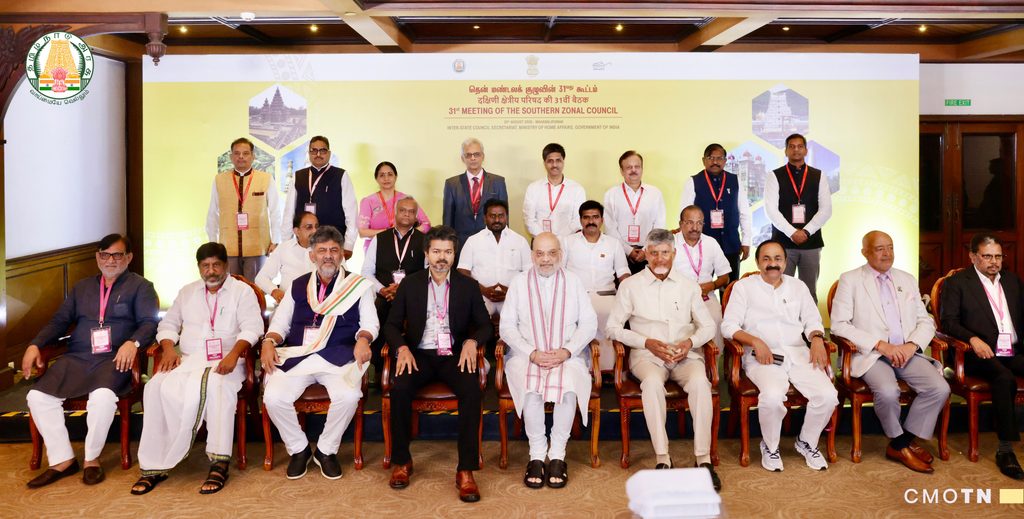
The best showcase of this is Tamil Nadu, India’s second-largest state economy. Its government is led by the Tamilaga Vettri Kazhagam (TVK), which swept to power as the anti-establishment enemy of both the BJP and the DMK shortly before the protests. Despite the near-identical nature of the TVK and student protesters’ demands of Delhi—returning control over university admissions exams to the state—the TVK’s Chief Minister, C. Joseph Vijay, who also holds the Home Ministry (i.e. law enforcement and internal security) portfolio, oversaw a confrontational police response to protests.
The Tamil Nadu protests did not end when Pradhan resigned and the CJP called off its movement; Tamil Nadu’s students, largely organized by the left, continued to organize to abolish NEET. On August 17, weeks after things had cooled off in Delhi, Vijay’s government issued a directive to college principals, directing them to coordinate with police and district administration to prevent students from joining these left-student-union-led protests. The directive was withdrawn two days later after significant backlash from the left parties whose support in the legislative assembly was essential to the TVK government’s survival.
Meanwhile, next door in the state of Kerala, a Congress-led government also critical of the center’s policies initially also saw clashes between police and left-led student protesters campaigning for the resignation of the center’s education minister. But unlike Tamil Nadu, the protests wound down along with those in Delhi, and on July 31, the Kerala government announced that it would withdraw all cases associated with the NEET solidarity demonstrations.
Rather than thinking of the protests that swept India this summer as the ‘CJP protests,’ these cases show that it is far more useful to consider them ‘anti-NEET protests,’ whose makeup varied significantly depending on where in the country one was.
In Tamil Nadu, the TVK, formally launched only two years earlier by its charismatic movie-star founder Vijay, had swept its way into power by appealing to the anxieties and disaffections of young people, heavily relying on digital channels. Opposition to NEET had been one of Vijay’s signature issues, but the left’s long history of student organization and its mastery of protest mobilization were threatening to capture this core electoral segment away from the TVK and its underdeveloped ground game. In Kerala, by contrast, the ruling Congress Party’s student wing joined the student protest movement, and, although slightly late to the party, managed to ensure that the left had not monopolized them at their expense.
For all their differences on ideological grounds, structurally, the TVK and BJP were in the same position. In Delhi, the BJP’s formidable youth support had been built up over the years through an extremely well-organized and well-resourced digital media strategy, rather than more traditional forms of organization. During a previous set of student and farmer protests, one Delhi University student named Gautam Singh went viral in March 2025, dubbed ‘Modi’s number one fan’ by the media for the depth of his fervor defending the government. Importantly, there is no evidence that Singh had ever been a member of the BJP’s student or youth wings. But by February 2026, Singh’s social media videos had turned sharply critical, and in July he was present and outspoken at the CJP protests.
Rather than thinking of the protests that swept India this summer as the ‘CJP protests,’ these cases show that it is far more useful to consider them ‘anti-NEET protests,’ whose makeup varied significantly depending on where in the country one was. What they have in common is a combination of emergent online ‘flash mob’ style mobilization and old-fashioned organizers from long-standing student groups.
Globalize Your Exports, Localize Your Political Economy
The size and success of the Indian student movement in 2026 invites comparisons with the youth uprisings that toppled governments in Sri Lanka in 2022, Bangladesh in 2024, and Nepal in 2025, or the unsuccessful but destabilizing protests by the Pakistan Tehreek-e-Insaf (PTI) in 2024. In each of these cases, regional wars—Ukraine from 2022-onwards and Iran in 2026—led to spikes in food and energy prices and to faltering growth, crushing the rising expectations of vast numbers of young people entering, or about to enter, the workforce.
But unlike India, these countries were experiencing not merely slowing growth, but spiraling macroeconomic crises: collapsing currencies, exhausted reserves, shortages, and sovereign balance sheets exposed to global markets. In each case, a feedback loop created regime-ending conditions. Political instability spooked foreign creditors, which hurt currency and bond prices, which shut the government out of credit and drove it towards the International Monetary Fund; the resulting austerity usually deepened unrest.
India, having experienced the combination of serious political instability and diplomatic dilemmas in the 1960s and 1970s from the collision of a youth bulge and commodity ‘super cycles,’ has consistently treated food security, energy security, and fiscal sustainability as core national security goals ever since. The result was that it avoided the combination of shortages and balance-of-payments crises that crippled most of the rest of South Asia from 2022 onwards. India has relentlessly pursued coal, renewable energy, nuclear power and discounted Russian oil bought with rupees to make sure it is not at the mercy of global markets.
Just as significantly, Indian sovereign debt is far more structurally insulated from global markets than that of its neighbors. The government issues no dollar-denominated Eurobonds, and foreign exposure to its debt is small and held almost entirely onshore. Bond markets did not react to the Cockroach protests, just as they did not react to the anti-Citizenship Amendment Act protests of 2019–20 or the year-long farmers’ movement. Far from being punished during this period, India was upgraded by S&P in 2025 to BBB, its first ratings rise in eighteen years. In contrast, Pakistan’s international dollar bonds reacted violently to Imran Khan’s arrest, the PTI ouster, and IMF-deal jeopardy; credit default swaps (CDS) spiked from around 5 per cent pre-ouster to a 12,388-basis-point peak in November 2023, while dollar bond yields spiked past 100 per cent.
While the firewall between domestic politics and global markets is good for both India’s sovereignty and its stability, it also blunts the forcing function that could drive positive change. The question remains whether the domestic political system, both at the center and in many states, is responsive enough to address the fastest-growing segment of the population, or if it will continue to delay and defer, while hemorrhaging the legitimacy it has accumulated over decades.
Keeping the Youth in Line, Forever?
The retreat of ruling parties across India in the face of the anti-NEET movement has led many to hope that young people now have the numbers and the confidence to force the kind of change that India needs to thrive. The CJP’s stated ambition to become a permanent structural channel for youth grievance to the political system without becoming a political party is a novel element, and its implications potentially cut against the left as much as for it.
The structural and demographic challenges beneath the protesters’ grievances are tightening from two directions at once. India’s labor force is still expanding faster than the economy generates formal jobs, so each year’s cohort of educated entrants meets a narrower opportunity than it was promised—the engine of the credential-anxiety and exam-obsession the CJP channels. But at the same time, fertility has fallen below replacement, raising the prospect that India’s demographic dividend closes before per-capita incomes clear the middle-income band. In other words, there is a very good chance that the world’s most populous country will grow old before it grows rich.
The risk in India is not so much one-party authoritarian rule forever […] Rather, the risk is the conversion of a structural grievance into a structural exclusion.
These are problems that every future government in New Delhi will face, regardless of ideology, but the menu of options will be shaped by the current government’s emerging practices in the present, which are far more sophisticated than tear gas and baton charges, or university expulsions.
The first is digital access. India is in the advanced stages of legislating age-verification requirements for social media under data-protection rules that reach full force over the coming year. What makes this more consequential in India than elsewhere is Aadhaar, a biometric identity system that covers almost the entire population from birth, which renders online age-verification enforceable in a way most democracies cannot technically achieve. Although the stated purpose is child safety, the same architecture that verifies a user’s age can tie political organizing on social media to a verified national identity—and the incentive to restrict the ability of young adults to organize, or even inform themselves politically, is something that is likely to grow.
The second is electoral access. The state-by-state ‘Special Intensive Revision,’ which began in June 2025, has, in addition to purging millions of existing voters, created ever more significant administrative barriers for first-time voters and those moving away from home, including students and migrant jobseekers. Any government that reads young people as a potentially hostile bloc has every incentive to do nothing to lower those barriers.
The risk in India is not so much one-party authoritarian rule forever; the scale, complexity, and sheer friction of collective life in India make that kind of control unsustainable. Rather, the risk is the conversion of a structural grievance into a structural exclusion. Over two or three electoral cycles, such practices, if established, would hollow out the political system’s legitimacy, setting it up for the kind of convulsion that brought down Sheikh Hasina’s government in Bangladesh, even without macroeconomic catastrophe.
Of course, none of this is inevitable. The experiences of millions of young people in taking on and triumphing over the powers that will be personally and collectively meaningful, generating optimism and trust. The hope is that this positive charge in the system’s power banks is used wisely to sustain constructive collective problem-solving through the enormous challenges that lie ahead.
Views expressed are the author’s own and do not necessarily reflect the positions of South Asian Voices, the Stimson Center, or our supporters.
Also Read: SAV Q&A with Vijaita Singh: Protests, Politics, and Reform in Today’s India
***
Image 1: Sumita Roy Dutta via Wikimedia