Editor’s Note: This is the first part of a two-part conversation with Avinash Paliwal. Read the second part here.
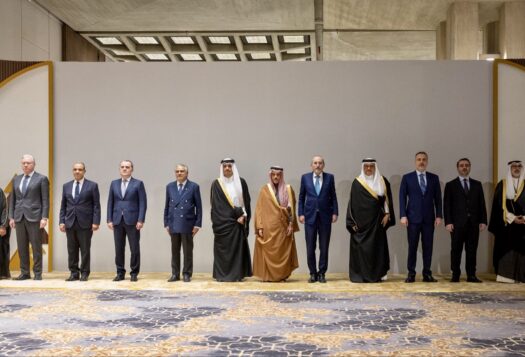
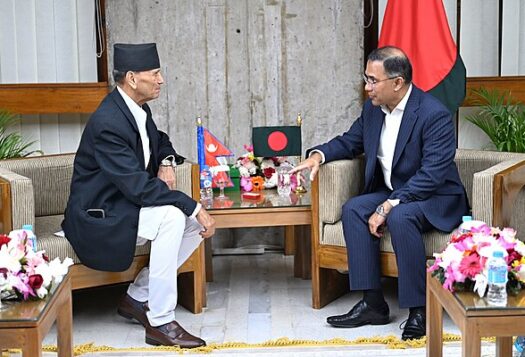
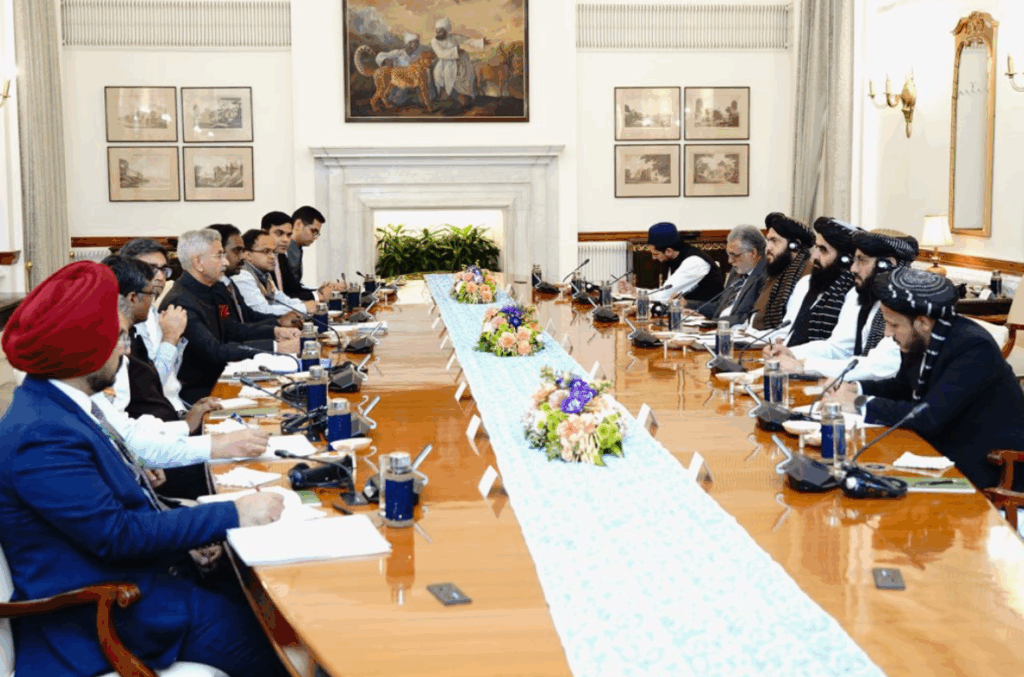
In a high-profile sign of the reversal of a decades-old policy, India for the first time hosted a Taliban official on its soil, with Foreign Minister Amir Khan Muttaqi visiting the country in October 2025. To make sense of this development, South Asian Voices spoke with Dr. Avinash Paliwal on October 29 about growing India-Taliban engagement and its implications for regional dynamics, including the India-Pakistan-Afghanistan triangle. Dr. Paliwal is Reader in International Relations at the School of Oriental and African Studies, an expert on the international relations of South Asia, and the author of two books on India’s outlook towards its neighborhood, such as on India-Afghanistan ties and—most recently—India’s “near east.”
Help us make sense of recent India-Afghanistan developments. We saw the Muttaqi visit, but not just that. For those of us who have worked on the India-Afghanistan relationship or South Asia more broadly, there has been a dizzying amount of official diplomatic engagement between India and the Taliban regime since late last year and the beginning of this year. What do you make of this rapid transformation?
Let me first deal with the what and why, and there are two points to make here. First, the contact has been going on for quite some time. Yes, in terms of what we see of official visits, there has been a steady uptick in overt diplomatic engagement between India and Afghanistan, such as the visit of Indian official J.P. Singh to Kabul in November 2024. But that is the tip of the iceberg.
The dizziness of media focus on this bilateral in recent weeks betrays what is effectively a very slow but steady uptick in communication, engagement, and understanding between the two sides. I can say confidently that about a couple of months after India vacated Kabul in August 2021, New Delhi took a very clear decision that we need to go back and reestablish. And in fact, that decision to close the embassy in August 2021 itself was considered, especially within the security establishment in New Delhi, a wrong choice. They felt that they could have stayed and kept the mission going, even with shoestring resources, perhaps the way the Chinese or the Russians had kept presences. Because that would have made India stand out from the West, which was leaving in a really dramatic and brutal manner at that point.
The technical mission that came into being over the years had practically taken on the job of an embassy already. So, what you’re seeing today, the Muttaqi visit and the handshake with Jaishankar, is basically the “coming out of the closet” in a diplomatic sense of a bilateral contact that had already been going on for a while.
Second, in terms of the why of it, it is important to note that this conversation is liberated from the debate that we have been having about “interests versus values.” Interests and values are not disconnected; they’re intertwined. But there’s a clear security strategic rationale to this particular relationship. In my view, going fully public with the relationship and unapologetically doing so is what really stands out in terms of this particular moment with Muttaqi visiting.
While this is a strategically powered relationship, the timing of it could in some senses have been determined by the recent crisis that happened between India and Pakistan, where India felt that now is perhaps the time to really up the ante when it comes to its relationship with the Taliban. Perhaps also because the Afghanistan-Pakistan relationship has been turbulent in the past few years.
“The dizziness of media focus on this bilateral in recent weeks betrays what is effectively a very slow but steady uptick in communication, engagement, and understanding between the two sides.”
How do India’s domestic politics play into New Delhi’s engagement with the Taliban? Does the Indian government appear constrained at all by domestic constituencies who might oppose such engagement?
The short answer to that is no. The pushback is coming from both the liberal segment of Indian society and the conservative segment, but it’s not a pushback that would translate into revisiting a policy. In all likelihood, the Indian government is thinking: look, it’s just a visit. Fine, there are a few awkward visuals around it. Maybe they’ll tamp down on such visuals and the next visit will not be televised the way this one was, but that’s about it.
To be sure, India does not find the brand of Islam being practiced and preached by the Taliban savory. The gender apartheid—and I think that’s a fair term to use—that the Taliban practices is not something that resonates with Indian society, even though Indian society has its own issues when it comes to gender politics and practice. But what we are seeing in Afghanistan is a very violent extreme. You saw that debate play out very openly during the Muttaqi visit when Indian female journalists were not allowed to enter the compound of the Afghan embassy, which was taken over by the Taliban. They strongly protested and then the Taliban had to budge by doing a second more inclusive press conference.
But the visit of Muttaqi to Deoband is an interesting decision. Now, Delhi has often used channels in Deoband historically to engage in a sort of religious outreach to the Taliban. When Muttaqi visited the seminary, this was not surprising insofar as this channel existed. It had existed for a long time. In fact, if you look at the narrative coming from some of the more conciliatory voices in the Indian establishment throughout the two decades of the war led by the United States and NATO, it was like, “look, we can use Deoband.” And secretly they did.
But this is not just some spies talking at an operational or tactical level; that happens too. But there is deeper thought being given to the fact that New Delhi needs to find a connect with this movement that goes beyond just tactical geopolitics and the security partnership, to be able to work with it for a long period of time.
That visit to Deoband shows me that India and the Taliban are in it for the long term. However distasteful it might be, however paradoxical it might be given the fact that India itself has taken a very strong Hindu right nationalist expression of politics. In some senses, it shows a very ruthless decision to use values of a very extreme kind to lubricate the strategic logics at play.
What then are the drivers and objectives of this engagement for both New Delhi and Kabul? And what will this relationship mean operationally?
Let’s first unpack the fairly straightforward shared objectives that the two sides have, and then we can come to the other things that they each desire. The shared objective is to build pressure on Rawalpindi. That’s the fundamental politics of this relationship at this point in time. When the values are not there, something else binds them. This is the most powerful factor, the geopolitical factor—putting pressure on Pakistan. Now, from an Indian perspective, this pressure could be considered militarily peripheral. Talking to the Taliban and enabling the Taliban in different shapes and forms is not “crunch time” in a security sense for Pakistan’s national security calculus, but it increases the cost if they have to concentrate resources on both fronts. And this is a moment when both the fronts are active for Pakistan. Historically, there have been few moments since 1947 when both the eastern and the western fronts were alive for Pakistan—today is one of those moments.
There is also an optical aspect to it—just the fact that the Indians are there, dealing with a regime which they considered anathema till 2021, at least in official discourse. I remember when I was doing the research for my book, I would pose the question, “why don’t you talk to the Taliban? There’s a logic there.” It was considered a no go.
But things have changed. The pressure of optics, and the symbolism of it are important. It can make Pakistan take decisions and do things which it otherwise would not. Especially after Operation Sindoor when Pakistan considers any and all domestic militant actors being supported openly or secretly by the Indians, this dynamic feeds into their security anxiety. For Kabul too, they want to make sure that they have this relationship going for precisely the same reason; it allows them to negotiate better with Pakistan. I’m not privy to the fine print of the negotiations in Istanbul, but I’m confident that the fact that Muttaqi was meeting with the Indians gave a certain degree of leverage to Kabul in its negotiations with Rawalpindi. It might not be direct leverage, but it conditions the atmosphere of that conversation, and this is something that is not lost on Kabul.
In terms of what the two countries might desire separately, from New Delhi’s perspective, there’s also a defensive element to this relationship. There are long memories in New Delhi, as we all know, of the IC 814 hijacking in 1999. I think the memory of that event has gone down considerably in 2025, perhaps, but I remember that still being a defining sort of institutional artefact about a decade ago when I was doing research. So, the fact that you were not present in your own neighborhood, didn’t have a diplomatic presence, didn’t have much of an intelligence presence, didn’t have any leverage or equity on the ground in Kandahar in 1999, is something that is not acceptable to the Indian policymaker today. And the counterterrorism risks and threats that emerge from Afghanistan, which are uniquely Indian, are also not lost upon India’s security bureaucracy.
If you look at some of the arrests and charge sheets that the National Investigative Agency (NIA) of India has mounted in the past months and years, there are Islamic State Khorasan Province (ISKP) elements, whether it’s in the southern parts of India or elsewhere, there has been an Afghan connection. These elements didn’t belong to or were associated with the Taliban, but they were with ISKP on Afghan soil. This is something that, again, is not lost on India, and they want to make sure that they have an intelligence sharing channel with the Taliban regime; effective or not, consistent or not, sustained or not. All that is contingent on various factors, but you need to have a presence over there. Of course, all this is couched in humanitarian terms, in geoeconomic terms. But in my personal view, that’s all gravy. The meat of the relationship is geopolitics, the security politics.
For the Taliban specifically, apart from putting pressure on Pakistan, they desperately need to increase their international diplomatic network. The West is coy about engagement at a diplomatic level. There are channels, whether it’s Doha or through other Middle Eastern or Gulf countries, but they’re not on the ground. And honestly, apart from being distracted by the Russia-Ukraine war and the Israel-Gaza conflict, there’s also a lot of trauma in the West about how they fought that two-decade war in Afghanistan, and how they lost it and how they left it. This is a trauma which is not being talked about much but Afghanistan, at least in a British context, is not a positive story even today. So, the West does not want to engage.
You already have the Chinese and the Russians and the Pakistanis and others engaging with the Taliban in different shapes and forms. If they can increase the diplomatic network to include India, which is an important regional power, even if it’s not official diplomatic recognition, it’s good. The Taliban are pragmatic about that, they recognize India does not want to pursue full diplomatic recognition.
A key point is that diplomatic engagement also brings in money. It’s a resource-scarce regime. It’s a regime that is just about able to paper over its own internal differences. It’s not collapsing into a civil war yet and that risk of intra-fighting in the Taliban is actively debated, but it can happen. But if they get aid, get money for whatever they want to do, that’s something. The Taliban know that India has had a developmental footprint, whether it was building the Salma Dam or the parliament building before. If they can leverage that side of India’s developmental footprint, for whatever purpose, I think that is again another win for Taliban.
We don’t have gives and takes explicitly listed as of now, barring the humanitarian bit. But that’s something which we should expect the two sides to be talking about more and more and probably delivering on in the next year or two.
“The shared objective is to build pressure on Rawalpindi. That’s the fundamental politics of this relationship at this point in time.”
Looking ahead, how will this relationship evolve over time? What does it mean for regional dynamics, say the India-Pakistan-Afghanistan triangle?
How this plays out in the region is where I would urge caution, despite the shared interest or need or desire for the two sides to put pressure on Pakistan. I do not think the Taliban will fight India’s wars and I don’t think India will fight the Taliban’s wars. And I think both sides acutely understand that. Each can enable the other, but they do not expect the other to fight at a time and place and in a way of the other’s choice.
Let’s take a hypothetical scenario. Tomorrow, hostilities get reignited between India and Pakistan, which is quite likely. It’s a matter of when, not if, at this point. Do not expect the Taliban to use that particular window to up the kinetic ante on the other side. It can happen for independent reasons, but the Taliban will not do that vis-à-vis Pakistan because it suits the Indians.
Same for India—India is not going to pick up active hostilities with Pakistan because the Taliban want India to do that. Even in terms of the defense partnership, there will be limits. I don’t think India will be empowering the Taliban. The Taliban has no air cover, no air power projection, no air defense. I don’t foresee India anytime soon providing air defense mechanisms for Afghanistan to deal with Pakistani jets and drones coming into their territory routinely. That would be a serious escalation. At least right now, I don’t see evidence for that, though that could change. For now, the trust between the two sides is not of that caliber.
So, this is where I would urge caution—this is an important realignment happening, but this is not a restructuring of the balance of power that we are seeing. The structures are still the same. Pakistan is much more powerful than Afghanistan. And Pakistan can withstand Indian pressure militarily with active Chinese support. That fundamental reality is not changing. Of course, operationally between India and Pakistan, things change, but not when you bring the third party involved in this one.
However, there are other aspects to watch here. For one, how does Rawalpindi deal with risk in this environment? If it feels too cornered by both its neighbors, then it might take decisions which are not optimal, especially during active conflict moments. It increases the risk of regional confrontation happening sooner and in a much more escalatory environment. And it does not help regional stability.
Views expressed are the interviewee’s own and do not necessarily reflect the positions of South Asian Voices, the Stimson Center, or our supporters.
Also Read: Can Conditional Engagement Spur Reform in the Taliban’s Afghanistan?
***
Image 1: Dr. S. Jaishankar via X
Image 2: Dr. S. Jaishankar via X