After more than two decades as a frontline state in the Global War on Terror, Pakistan continues to face a complex and adaptive threat landscape. Militant outfits affiliated with the Tehreek-e-Taliban Pakistan (TTP), the Baloch insurgency, and the Islamic State Khorasan Province (ISKP) have regenerated and evolved, positioning themselves to exploit Pakistan’s vulnerabilities in the post U.S.- withdrawal era. The escalating surge in militant violence—marked by attacks such as last month’s suicide bombing at a Balochistan National Party-Mengal rally, alongside attacks on the Federal Constabulary headquarters in Bannu and Quetta—has spurred a forceful military response from Pakistan. This has included actions such as the resumption of Operation Sarbakaf in Bajaur, and airstrikes in Kabul targeting TTP leadership, triggering deadly border clashes with Afghanistan only a few days ago. 2024 was one of the deadliest years in Pakistan’s recent history, with a 70 percent surge in militant attacks compared to the year prior, propelling Pakistan to second place on the Global Terrorism Index. And the violence has continued unabated into 2025.
However, these numbers capture only part of Pakistan’s security crisis. The militant violence is further exacerbated by overlapping governance and geopolitical challenges, including federal-provincial disputes over military operations, the detention of activists, mass protests, and stalled negotiations between local peace councils and militants. This escalating crisis demands adaptive security strategies that learn from past failures, alongside reforms in security policies that rebuild trust between state institutions and local communities, and restore cooperation with neighboring states. In its fight against militancy and terrorism, Pakistan would have to develop tailored approaches to each group—the TTP’s religious insurgency blended with elements of Pashtun nationalism, the BLA’s ethno-nationalist movement, and ISKP’s transnational agenda—rather than a one-size-fits-all security response.
“The militant violence is further exacerbated by overlapping governance and geopolitical challenges, including federal-provincial disputes over military operations, the detention of activists, mass protests, and stalled negotiations between local peace councils and militants.”
Pakistan’s Security Crisis in Context
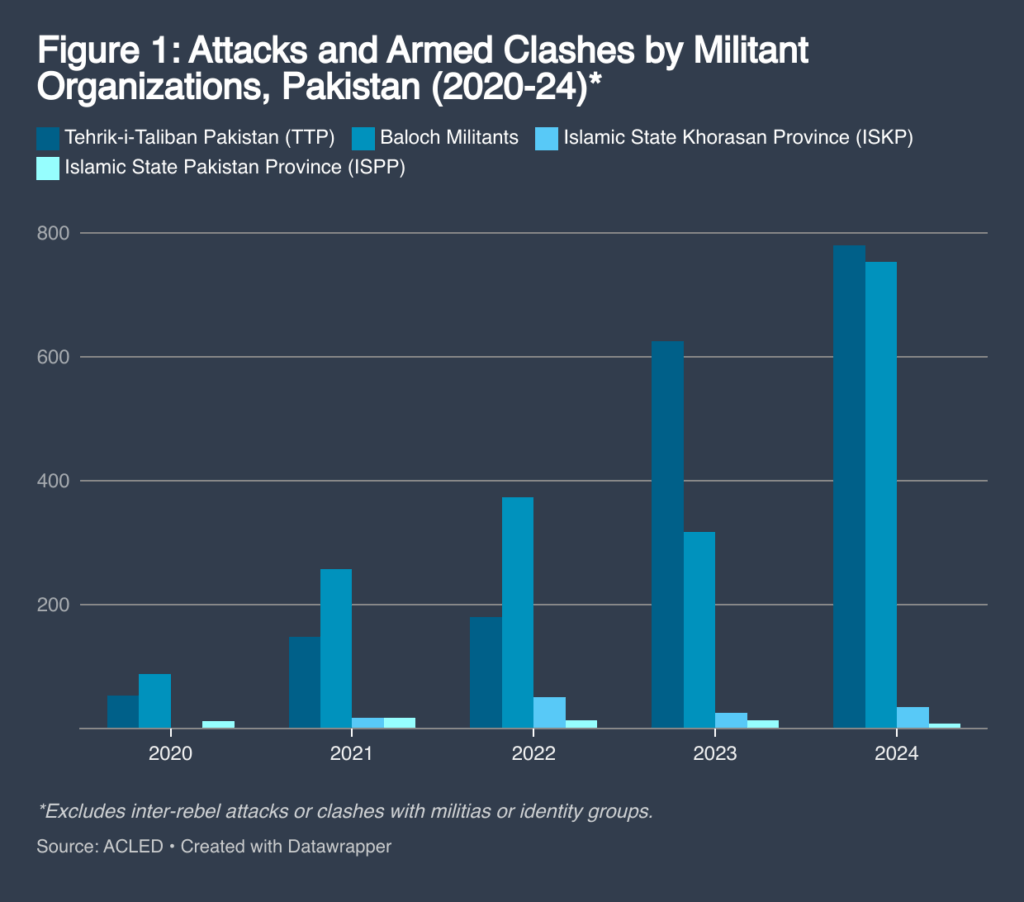
Since the U.S. withdrawal and subsequent Taliban takeover of Afghanistan in August 2021, Pakistan has experienced a devastating resurgence in militant violence, with three groups dominating the post-2021 landscape. Figure 1 shows the general trajectory of the most active militant groups in Pakistan, based on Armed Conflict Location & Event Data Project (ACLED) data capturing armed clashes with state forces and violence against civilians between 2020-2024. Both TTP and Baloch militants escalated operations from relatively low levels in 2020 (53 and 83 events, respectively) to peaks of 775 and 748 in 2024. ISKP’s activity fluctuated, peaking at around 50 events in 2022, while Islamic State-Pakistan Province (ISPP) remained minimal throughout. Collectively, the violent resurgence does not merely a represent a return to past threats, but rather, an evolution of three distinct militant movements that have adapted their strategies, expanded their operational scope, and deepened their impact on Pakistan’s landscape.
Dealing with the Deadly Trifecta: TTP, BLA, and ISKP
The TTP, BLA, and ISKP are three distinct types of militant groups, each exploiting Pakistan’s security vulnerabilities with distinct ideologies, objectives, and tactics to advance their agendas.
The TTP is the deadliest terrorist organization in Pakistan, with 6,000-6,500 fighters operating in the Afghanistan-Pakistan region. Its resurgence is tied to both organizational restructuring and the Taliban’s return to power in Afghanistan, which facilitated prisoner releases, offered safe havens, and provided ideological solidarity. Since 2018, under Noor Wali Mehsud’s leadership, the TTP has successfully consolidated several militant factions, well over 70 per sources, balancing centralized command with decentralized operations via smaller and flexible units. The group has also deliberately shifted away from indiscriminate targeting of civilians to rebrand its image and garner public support as a defender of the Pashtun nation. Moreover, the TTP has become adept at information warfare on social media as a recruitment tool. Further, recent analysis of TTP’s martyrdom commemorative materials reveals evolving operational patterns: Dera Ismail Khan, situated at the intersection of three provinces, appears to have re-emerged as a key operational hub, while Afghanistan-based TTP casualties largely originate from KP. Additionally, in 2025, the TTP announced its Al-Khandaq spring offensive, expanding operations beyond traditional strongholds to areas like Chitral, Pishin, and southern Punjab. These tactics and operational patterns suggest a stronger TTP foothold in the country and signify the scale of the new challenge that TTP presents to the Pakistani state.
The BLA represents an ethno-nationalist insurgency that has transformed from a tribal resistance movement into a sophisticated militant organization with broader appeal and increasingly lethal tactics. The broader insurgency has strengthened due to the formation of the Baloch Raaji Aajohi Sangar (BRAS) coalition, while Pakistan alleges that the BLA receives external support from both India and Afghanistan. The group operates through a network structure comprising specialized sub-groups, including the Majeed Brigade suicide unit, intelligence and media cells, and training camps. This structure has enabled coordinated high-impact attacks such as the Jaffar Express hijacking in March this year, and Operation Herof (Black storm) by the BLA-Jeeyand faction in 2024, alongside the deployment of female suicide bombers. BLA also strategically targets Chinese investments, while extensively using social media to justify their actions, such as having suicide bombers explain their motivations and characterize the China-Pakistan Economic Corridor (CPEC) as a neo-colonial venture. While earlier Baloch insurgencies were tribally-centered and geographically limited, today’s movement draws from younger, middle-class, non-tribal demographics. Critically, the March announcement by BRAS of the formation of the Baloch National Army (BNA) indicates the transformation of the movement into a conventional force, which could raise the stakes for Pakistan’s security.
ISKP, identified as one of Islamic State’s deadliest affiliates in the 2025 U.S. Annual Threat Assessment, represents a transnational jihadist threat with operational space in Afghanistan as well as Pakistan’s borderlands. Unlike traditional insurgencies, ISKP adheres to Islamic State’s decentralized model, complicating Pakistan’s counterterrorism efforts. Post U.S.-withdrawal, ISKP has focused on targeted assassinations of political and religious leaders, while expanding operations into states like Uzbekistan, Tajikistan, Iran, and Russia. Alongside the less active ISSP, ISKP maintains a presence in Khyber Pakhtunkhwa and Balochistan. However, its activities in Pakistan are complicated by strategic rivalries with the Afghan Taliban, the TTP, as well as with Baloch militants. These rivalries can lead to outbidding behavior escalating violence, as groups compete for dominance, further destabilizing the region. In 2024 and 2025, Pakistan launched targeted operations against ISKP, including: uncovering a 48-member external operations cell in 2024; capturing the Kabul attack airport mastermind Mohammad Sharifullah (“Jafar”) in March this year; and arresting propagandist Abu Yasir At‑Turki in June. Though ISKP activities have been constrained in 2025, its decentralized network and cross-national nodes remain a persistent concern for Pakistan.
While Pakistan faced multiple militant threats during 2007-2014, today’s landscape features more evolved actors operating in an environment where Pakistan has diminished resources and reduced international support. This complex, multi-layered crisis demands a fundamentally reimagined security paradigm—one that confronts not only the tactical manifestations of extremism and militancy, but directly addresses the legitimacy deficit that contributes to their survival and continued potency.
Breaking the Cycle of Crisis: Tailored Approaches to the Militant Trifecta
Pakistan stands at a critical inflection point. The human toll from this violence has been staggering, with civilians and security forces bearing the brunt of escalating militant attacks that threaten not only internal stability, but Pakistan’s regional relations and the consensus needed for sustained counterterrorism. To effectively counter the TTP, BLA, and ISKP, Pakistan needs tailored, evidence-based operational strategies that address each group’s distinct characteristics and learn from past successes and failures.
The TTP, a religiously-motivated group that opportunistically exploits Pashtun nationalism, requires a multi-pronged military strategy. Military operations should focus on: disrupting the group’s leadership through precision strikes against provincial emirs and department heads; severing communication channels between the central leadership and district-level commanders; and degrading its media capabilities. The resurgence of Dera Ismail Khan as an operational hub—given its position at the intersection of Khyber Pakhtunkhwa (KP), Punjab, and Balochistan—demands closer inter-provincial coordination to preempt militant movement across administrative boundaries. With TTP cells now documented in at least 15 KP districts and their expansion into Chitral, Pakistan needs to increase its security and civilian presence in these peripheral zones. Additionally, given the TTP’s invocation of Pashtun nationalism, updating counter-narratives is essential to blunt the group’s resonance with local communities. Conditional and society-backed negotiations should be reserved only for moderates demonstrating genuine commitment to laying down arms. The failure of previous peace deals, including the 2022 ceasefire that collapsed within months, underscores the need for limited and targeted military pressure to precede any negotiation attempts. Future effective counterterrorism cooperation in KP still requires overcoming notable political obstacles, given recent tensions between the PTI-led KP provincial government and the federal government over military operations. Establishing formal consultation mechanisms between Islamabad, provincial leadership, and security forces is essential to operationalize the unified response required to counter TTP.
Addressing the BLA-led ethnonationalist Baloch insurgency requires broader political strategies that encompass socioeconomic reforms, resource distribution, grievance remediation, and meaningful Baloch inclusion. This approach—centered on political negotiations and genuine power-sharing, with selective targeting reserved for extreme elements—may prove more effective than purely militarized responses. Military priorities should include targeted, intelligence-based actions to: protect critical infrastructure, especially CPEC projects and gas installations; dismantle specialized militant units such as the Majeed Brigade through surgical operations; and intercept weapons supply routes from alleged external sources. However, since Baloch militants consider CPEC to be extractive and exploitative, military responses should avoid further alienating local communities. To regain the trust of local people, the focus should be on: integrating Baloch personnel into security forces, enforcing hiring quotas in public sector jobs, implementing revenue-sharing mechanisms between provincial and district governments, and avoiding heavy-handed security cordons around Chinese projects that further alienate local populations.
ISKP, with its Salafist ideology and transnational ambitions and connections, requires sustained, coordinated pressure from Pakistan and regional states. Effective counter-measures could include: continuous high-value target elimination, focusing on media operatives, financial facilitators, and recruiters; systematic disruption of the group’s external support, particularly handlers based in Turkey and cryptocurrency funding channels; and degradation of the al-Azaim Foundation, which produces multilingual propaganda content. Pakistan should also continue coordinating with regional and international partners on joint operations to target ISKP operatives as well as to disrupt the group’s virtual planning network that enables remote attack coordination. Finally, despite establishing the Pakistan Crypto Council in March, the growing use of untraceable cryptocurrency-based financing by groups like ISKP represents a critical blind spot that Pakistan should address through enhanced blockchain analytics capabilities and specialized investigation teams.
Governance, Grievances, and the Path Forward
Violent extremism often finds fertile ground where governance failures and unaddressed grievances persist. Going forward, establishing transparent grievance redressal mechanisms in conflict zones—particularly in Balochistan and former Federally Administered Tribal Areas (FATA)—will be critical. The recently approved National Prevention of Violent Extremism Policy offers promising directions with its “5-R” approach (Revisit, Reach Out, Reduce, Reinforce, and Reintegrate). However, implementation needs to be civilian-led rather than military-dominated, in close partnership with local political parties to build trust with communities. In parallel, independent media, human rights organizations, and advocacy groups should be engaged as partners, rather than adversaries, in countering extremism. Concrete trust-building measures could include the release of detained civil society activists, ending harassment of non-government organizations, and establishing mechanisms to investigate security force misconduct.
“Pakistan cannot achieve its counterterrorism goals alone. As the country navigates a complex neighborhood, further complicated by the April Pahalgam terrorist attack, a balanced approach rooted in regional cooperation may yield more sustainable outcomes.”
Creating protected civic spaces—both physical and digital—where citizens can discuss grievances without fear of retribution may help release societal tensions. Civil society forums with diverse stakeholders, for example, can provide feedback on security policy implementation; however, military trials for civilians and broad cybercrime laws should be reconsidered in favor of pursuing accountability through civilian courts. Similarly, Pakistan’s information warfare strategy would benefit from a pivot from reactionary to proactive high-quality messaging that builds state legitimacy by involving grassroots local influencers and community figures.
Nonetheless, Pakistan cannot achieve its counterterrorism goals alone. As the country navigates a complex neighborhood, further complicated by the April Pahalgam terrorist attack, a balanced approach rooted in regional cooperation may yield more sustainable outcomes. With Afghanistan, Pakistan may achieve more by leveraging multilateral pressure through China, Russia, and Central Asian states than by pursuing the bilateral confrontation tool that it has in recent days. Trade and economic integration offer concrete leverage for security cooperation: revitalizing the Afghanistan-Pakistan Transit Trade Agreement (APTTA) and pursuing Central Asian trade corridors, for example, could generate new economic incentives for security cooperation, transforming adversarial relationships or structural dependencies into mutually beneficial partnerships. Specifically, linking trade and economic gains to security benchmarks would provide tangible incentives for sustained cooperation.
Views expressed are the author’s own and do not necessarily reflect the positions of South Asian Voices, the Stimson Center, or our supporters.
Also Read: U.S. Designation of BLA as Terror Outfit: A Win for Pakistan, but Not a Panacea
***
Image 1: VoA via Wikimedia Commons
Image 2: Government of Pakistan via X