August 5 marked one year since the fall of the Sheikh Hasina-led Awami League (AL) government in Dhaka. In the twelve months since, under an interim government (IG) with Muhammad Yunus as Chief Advisor, Bangladesh’s legacy political parties including the Bangladesh Nationalist Party (BNP) and the Jamaat-e-Islami (JeI), earlier repressed under Hasina, have focused on reclaiming the formal political space. While these parties support the IG’s push to re-order Bangladesh’s domestic and foreign policies, Yunus’ delays in implementing reforms, his initial refusal to commit to elections by the end of 2025, and accusations against him of political partisanship towards emergent political forces like the student-led National Citizen Party have complicated Bangladesh’s political transition. From the Indian perspective, the current political dispensation in Dhaka is pursuing a foreign policy without the characteristic consideration of New Delhi’s geopolitical interests that was evident under the AL.
Dhaka’s geopolitical shift seems to be driven by the domestic political imperative to distinguish the IG’s foreign policy from the AL’s real and perceived pro-India legacy. As a consequence of these domestic debates across the border, the Indian government too has been forced to change course, from expanding avenues of cooperation with Bangladesh in the Hasina era, to reasserting geopolitical redlines under Yunus. Just today, for instance, India imposed additional restrictions on imports of jute products through land routes from Bangladesh. The AL’s politics were built on nationalist and secular foundations, drawing on founder Sheikh Mujibur Rahman’s role in the movement for independence from Pakistan and an aversion to Islamist parties like the JeI. But with the JeI’s re-entry into formal politics and a revival of ties with Pakistan under the interim government, New Delhi has been left to navigate tough terrain in its ties with a once closely aligned partner in an increasingly polarized neighborhood.
Security Concerns
One of the key drivers of the changed New Delhi-Dhaka dynamic in the past year has been Indian security concerns over Bangladesh’s growing ties with Pakistan and China. On April 18 this year, Bangladesh and Pakistan held their first foreign office consultation in a decade and a half. Earlier in the year, Pakistan had sent a high-level intelligence delegation to Bangladesh led by its now-National Security Advisor, which was reciprocated by a rare visit of a senior Bangladeshi general to Pakistan. To New Delhi, these developments signaled Pakistan’s re-entry into India’s security calculus through Bangladesh, disrupting its “de-hyphenation” with Islamabad.
One of the key drivers of the changed New Delhi-Dhaka dynamic in the past year has been Indian security concerns over Bangladesh’s growing ties with Pakistan and China.
Further, a day after the Pahalgam terror attack on April 22, Bangladesh conducted “Akash Bijoy 2025,” its most expansive military exercise in recent years that Yunus emphasized was essential for the country’s preparedness amidst conflict. A few days later, as India was considering military options against Pakistan, a Yunus aide remarked that Bangladesh should occupy India’s Northeastern states if it attacked Pakistan. This added fuel to the fire that was set off by Yunus’ own reference to India’s Northeast and Bangladesh as the “only guardian of the [Indian] ocean” during a roundtable discussion in Beijing in March. These comments heightened New Delhi’s strategic sensitivities over its northeastern frontier with Bangladesh and China and generated fresh concerns about its so-called “Chicken’s Neck,” the strategic strip of land connecting the mainland to the northeast and vulnerable to intrusion. Thus, even though the IG distanced itself from Yunus’ aide’s remarks, India increased security along its border with Bangladesh by conducting a field exercise beginning May 4.
Unlike Yunus, Hasina had “ensured that economic cooperation with China never undermined Dhaka’s relationship with New Delhi,” as former Bangladeshi diplomat Wahiduzzaman Noor maintains. This sensitivity enabled Hasina to oversee China’s emergence as Bangladesh’s largest trade partner without crossing New Delhi’s redlines. However, Yunus’ messaging on foreign policy and the first ever China-Pakistan-Bangladesh trilateral summit on June 19 have introduced more friction into the New Delhi-Dhaka bilateral. Even though the IG refuted claims of a trilateral alliance, New Delhi seems to have taken special note of it and the forum’s potential to bolster the joint China-Pakistan threat that has historically animated India’s security landscape.
Economic Fallout
For Bangladesh, this new foreign policy orientation is independent of its relationship with India, with whom Dhaka desires good ties “based on fairness and equity.” However, for New Delhi, Yunus’ geopolitical choices have forced India to reassert leverage over Dhaka to influence its actions, particularly through the withdrawal of economic incentives and special privileges. For instance, after the IG’s fresh restrictions on yarn imports from India through land ports to protect local industries, India retaliated by ending a trans-shipment facility it had extended for Bangladeshi exports to third states in 2020. India initially attributed this decision to commercial reasons, but subsequent Indian statements revealed the political logic of the move. Similarly, eight days after the interim government banned the Awami League from formal political activities, India restricted the import of Bangladeshi garments to the Kolkata and Mumbai sea-ports.
The restrictions had unforeseen impacts on Bangladesh’s ready-made garment sector, for which India is one of the fastest growing markets. Since about 93 percent of these shipments arrive via land ports at the India-Bangladesh border, the restrictions represent a significant non-tariff barrier for Bangladeshi exporters. Indian government sources told the media that these measures were a response to Dhaka imposing similar barriers on Indian yarn and rice; the bilateral trade relationship would now be on “reciprocal terms.” Unlike the India-Pakistan relationship (where trade is virtually non-existent) or the India-China relationship (where India’s trade deficit is approaching $100 billion), New Delhi holds significant economic leverage over Dhaka. Thus, these Indian moves were meant to be coercive or to at least issue a warning to Bangladesh.

Water as a New Challenge
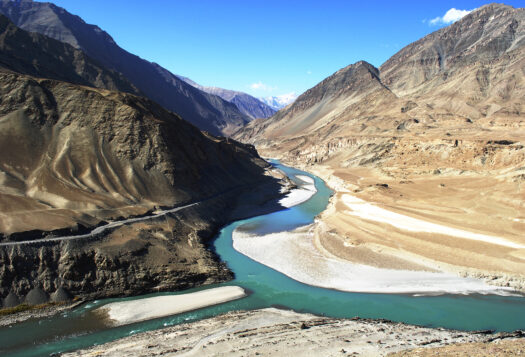
New developments in the India-Pakistan dynamic over the past few months are directly affecting core aspects of the New Delhi-Dhaka relationship, particularly with regard to water. For instance, as the India-Bangladesh Joint Water Commission continues to meet to discuss the upcoming expiry of the Ganges Waters Treaty (GWT) in December 2026, India’s suspension of the Indus Waters Treaty (IWT) with Pakistan in late April has triggered new concerns in Bangladesh over the use of water as a “weapon.”
Similar to the reasoning for the need for reform of the IWT, India has already communicated its increased developmental needs to Bangladesh, which necessitates a renegotiation of the GWT. India’s latest demands reportedly include an additional 35,000 cusecs for the Kolkata Port Trust’s feeder canal during lean season. While New Delhi was prepared to extend the GWT for another 30 years, the IWT development with Pakistan now appears to have influenced the Indian position on the GWT. Moreover, the IG’s ability to accommodate India’s demands may be limited, even if negotiating in good faith, given its unelected nature and the potential for political pushback. However, regardless of the technical merits of any understanding on water between India and Bangladesh, the process risks politicization from the ongoing geopolitical tensions.
Future Roadblocks and Recommendations
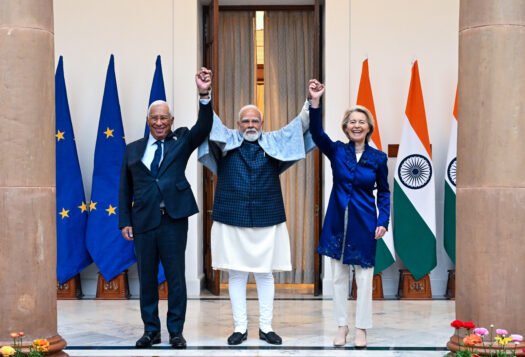
Despite everything, both India and Bangladesh evidently remain committed to resolving issues bilaterally through “constructive dialogue.” Even when Modi and Yunus met for the first time on April 4 on the sidelines of the BIMSTEC Summit, India’s read-out from the meeting reiterated the importance of discussions “in the interest of their long standing and mutually beneficial bilateral relationship.”
Since the source of distrust remains at the political level, both New Delhi and Dhaka would have to invest in fresh avenues of political and diplomatic interaction to address core short- and long-term issues, and to prevent them from turning into structural impediments. Issues such as Hasina’s continued stay in India and her public statements against the IG, as well as India’s concerns over the security of Bangladeshi Hindus, can be mitigated in good faith. And there is some evidence to suggest that both sides have tried. For instance, last September, Yunus asserted that “if India wants to keep [Hasina] until the time Bangladesh wants her back, the condition would be that she has to keep quiet.” That December, India’s foreign secretary acknowledged in a parliamentary briefing that Hasina’s comments criticizing the IG were a challenge to bilateral ties and stated that India did not endorse her remarks. However, both Hasina’s continued rhetoric and the IG’s formal request for extradition have removed scope for immediate reconciliation on the issue.
Since the source of distrust remains at the political level, both New Delhi and Dhaka would have to invest in fresh avenues of political and diplomatic interaction to address core short- and long-term issues, and to prevent them from turning into structural impediments.
Under Hasina, India and Bangladesh could work around historical disputes and leverage increased political trust to manage them. However, under the IG, the trend has reversed—deepening political distrust has increased the risk of new friction in bilateral ties and regional geopolitics.
India’s concerns vis-à-vis Bangladesh-Pakistan ties in particular are more challenging to address since the original locus of India’s insecurity does not lie in Dhaka, but Islamabad. And the recent India-Pakistan crisis has only exacerbated these concerns. Beyond the IG, any future elected government in Dhaka will arguably downplay or disagree with India’s concerns, ascribing Dhaka’s relationship with Islamabad to Bangladesh’s independent foreign policy. Should there be a BNP-led government, past precedent would indicate an inherent interest in nourishing ties with Pakistan. This is a dynamic that New Delhi would have to watch and prepare for.
Additionally, being fresh out of a clash that New Delhi viewed as fighting a China-Pakistan nexus has likely brought home to New Delhi the increasing salience and agency of Beijing in South Asian conflicts. Thus, despite the thaw in India-China ties in recent months, growing Bangladesh-China relations would still have New Delhi upping readiness at the border. Overall, New Delhi and Dhaka can look to at best manage, not resolve, the fallout from Bangladesh’s ties with Pakistan and China.
A potential silver lining for the bilateral may be that the BNP would arguably have more space to engage India now if it comes to power. The AL’s exit has likely diluted the BNP’s historic compulsions to combine its pro-Pakistan character with an overt anti-India disposition and the party has recognized India’s economic importance for Bangladesh. New Delhi too has shown willingness to reach out to the BNP to try and forge a new relationship ahead of its potential return. Thus, before the elections, and at this critical stage in Bangladesh’s political transition, the neighbors should look to clear the slate, setting the relationship up for success when the next government takes power in Dhaka.
Views expressed are the author’s own and do not necessarily reflect the positions of South Asian Voices, the Stimson Center, or our supporters.
Also Read: One Year after the Revolution: Reform, Reconciliation, and the Road Ahead for Bangladesh
***
Image 1: Narendra Modi via X
Image 2: Wikimedia Commons via GetArchive