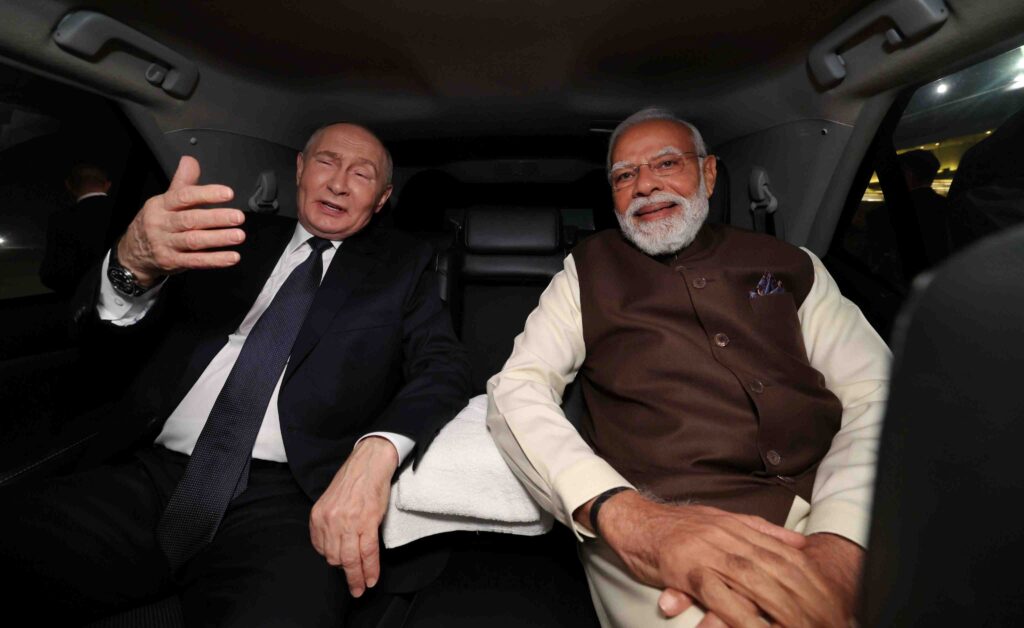
Russian President Vladimir Putin’s visit to New Delhi in December 2025 came at a time of growing momentum in India-Russia relations marked by restored political contacts and rekindled economic connections. After a period of uncertainty and hiatus in 2022 and 2023, the bilateral partnership appears back on track, with progress in traditional domains and attempts to diversify avenues of cooperation. Despite these developments, it remains uncertain whether the intense summitry will yield a lasting effect on the relationship and whether the two countries will be able to navigate geopolitical bottlenecks in the long term.
Resilient Relations
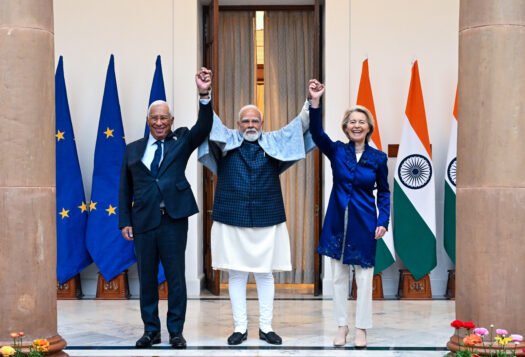
From the perspective of Russian foreign policy, India has arguably ticked all the boxes since February 2022. For one, New Delhi has displayed neutrality towards the war in Ukraine, remaining “on the side of peace” yet steering clear of any overt critique of Russian actions. As evident from Prime Minister Narendra Modi’s interactions with Putin over the past four years, the Indian leader has consistently stressed the importance of ending the war. However, the friendly delivery of this message has enabled the preservation of close diplomatic ties. India’s successful balancing act has also paved the way for deepening ties with the European Union, culminating in the trade and security agreements signed at the India-EU summit in January 2026.
Secondly, India has proved a critical partner in keeping the Russian economy running in the face of Western sanctions. While “playing by the rules” imposed on Russia, New Delhi has not shunned economic connections and has remained open to exploiting loopholes in the sanctions regime. This stance explains why Indian imports of Russian oil have boomed since 2022 despite various Western measures, including the “price cap” and blacklists of Russian tankers. In recent months, fresh U.S. sanctions against the two largest Russian oil companies, Lukoil and Rosneft, have significantly hampered trade—particularly given the latter’s exposure to the Indian market—and compelled Indian refineries to cut down their imports from Russia. However, even these restrictions have not completely halted Russian crude exports to India. Sensing that their trade requires diversification, New Delhi and Moscow have advanced a range of initiatives through their bilateral economic cooperation program, including greater market access for Indian companies, improved payment mechanisms, and streamlined investments in sectors such as agriculture, pharmaceuticals, maritime transport, mining, and high technology.
“After a period of uncertainty and hiatus in 2022 and 2023, the bilateral partnership appears back on track, with progress in traditional domains and attempts to diversify avenues of cooperation.”
Thirdly, following a lull in 2022 and 2023, New Delhi has reengaged with Russia in the key area of bilateral ties: defense. The two countries have not signed any new large-scale contracts, but Russia has moved to fulfil a host of previously signed deals. Notably, despite facing significant supply chain disruptions, including the shortage of key components such as gas turbines, Russia delivered two Project 11356 stealth frigates to the Indian Navy in December 2024 and July 2025, respectively. Additionally, New Delhi and Moscow have struck a number of MoUs, including on the joint development of Pantsir air defense and gun systems, and are in talks regarding new deals on the procurement of additional S-400 surface-to-air missile systems, Su-57 aircraft, and other platforms. However, the prospects for such contracts remain in question due to sanctions against the Russian military-industrial complex and Russia’s involvement in the war in Ukraine, which have both constrained supplies to its foreign partners. Furthermore, over the past decade, India has consistently shifted away from purchasing Russian military equipment, favoring other partners such as the United States, France, and Israel, in an attempt to avoid reliance on a single arms supplier.
Apart from arms deals, another symbol of recovery in defense cooperation is the resumption of regular bilateral military exercises. The INDRA drill, the most prominent tri-service exercise between India and Russia, was deferred in 2022, 2023 and 2024. Over these three years, military drills were limited to ad-hoc engagements such as the PASSEX exercise in the Bay of Bengal in November 2023 or the Maritime Partnership Exercise (MPX) in the Gulf of Finland in July 2024, along with other interactions at multilateral drills. This low level of engagement stood in stark contrast to the status of the political relationship and the historic role of defense cooperation between the countries. It could also not be explained solely by Moscow’s preoccupation with the war in Ukraine, given Russia’s consistent engagement with China in a series of bilateral drills and joint naval and aerial patrols covering various zones of the Indo-Pacific with growing coordination and maneuvering complexity. This lag was likely rather a reflection of India’s initial reluctance to engage in any substantial security-related initiatives with Russia amid the Russia-Ukraine war—an approach that was evidently reconsidered following Modi’s visit to Moscow in July 2024.
In February 2025, presumably in anticipation of the bilateral summit later in the year, New Delhi and Moscow signed a Reciprocal Exchange of Logistics (RELOS) agreement, though it remains to be seen how it will be operationalized. 2025 also saw renewed engagement between the Indian and Russian Armed Forces, with the INDRA exercise returning to the agenda. In March and April 2025, the Indian and Russian navies conducted joint maneuvers involving a harbor phase at Chennai and a sea phase in the Bay of Bengal. In October 2025, the two armies held a joint training exercise under the aegis of INDRA in Rajasthan, focusing on counter-terrorism operations and modern warfare scenarios. Finally, in December 2025, the Indian Air Force (IAF) hosted the exercise “AviaIndra,” which aimed to “enhance mutual understanding and aerospace synergy.” Taken together, this gradual resumption of military-to-military engagement signals a positive trajectory for the bilateral relationship following several years of drift.
Persistent Challenges
However, serious obstacles to the bilateral relationship remain. Donald Trump’s return to the U.S. presidency and his outreach to Moscow initially sent a positive signal to New Delhi, creating the impression that U.S. pressure on India related to its ties with Russia would subside. However, the lack of progress in U.S.-Russia talks to end the war in Ukraine led the Trump administration to link tariffs against India to Russian oil purchases, putting India in the firing line of U.S. measures against Russia.
The China factor also represents a challenge for India-Russia relations. Although the opening of lines of communication with the United States has theoretically granted Moscow more leeway vis-à-vis China, Russia has not turned its back on Beijing. In fact, the extensive military and political coordination between China and Russia, intended to act in concert against the United States and its allies in the Indo-Pacific, has endured irrespective of renewed Moscow-Washington dialogue. Importantly, Russia’s military and diplomatic backing of Chinese plans for the Indo-Pacific diverges from Indian interests. Despite New Delhi’s best efforts to bridge the gap with Moscow, their respective perceptions of and outlooks for the Indo-Pacific have remained at odds, leaving them with limited options for regional collaboration. Nevertheless, Russia-China engagement comes with its own limitations, and Moscow often incorporates “regional hedging” into its Indo-Pacific approach, so Russia will likely continue to value strategic partnerships with regional powers like India.
“While the India-Russia bilateral relationship has weathered external shocks over the past four years and appears robust in light of intensified bilateral contacts and enduring connections in defense and energy, the partnership appears to lack solid, novel drivers for the long haul.”
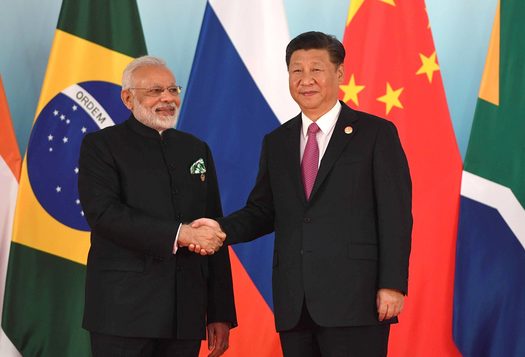
Against the backdrop of new twists and turns in U.S. foreign policy and the normalization of India-China ties, Moscow has set its sights on reviving the Russia-India-China troika. Leaving aside the optics of the Tianjin summit, where the three leaders briefly gathered for an informal conversation, there has been scant evidence of the return of the format. While both Moscow and Beijing would favor closer trilateral cooperation with India, New Delhi has remained noncommittal about this idea as it attempts to walk a tightrope in its relations with the United States, China, and Russia.
Even within BRICS, Moscow has failed to secure sufficient support from New Delhi for its initiatives. Many of the Russian proposals put forward during its chairmanship in 2024 have so far floundered, with none being taken forward during Brazil’s 2025 presidency. Despite the general unified opposition to Trump’s foreign policy, other member states, including India, have not shown much enthusiasm for specific ideas involving a new cross-border payments system, a BRICS investment platform, or a BRICS Clear depositary and securities trade settlement system. Recent reporting suggests that the Reserve Bank of India has recommended linking the digital currencies of the BRICS members, but this proposal will require further discussion and coordination, especially given New Delhi’s official stance of not pursuing de-dollarization. Similarly, India has responded with caution to any attempts to inject security into the BRICS grouping, as demonstrated by New Delhi’s decision not to join the BRICS Plus naval exercise held off the coast of South Africa from January 9 to January 16, 2026. While Russia has largely come to terms with China’s leading role in the grouping, viewing it as an enabler of financial and technological settlements that offer an alternative to U.S.-led institutions, India remains wary of any solutions that could provide Beijing with political or economic leverage. The underlying difference in the Russian and Indian perception of BRICS remains the same: Moscow views it as a conduit to an anti-Western world order, while New Delhi instead champions a non-Western one.
Gaps also persist on South Asian affairs: the key concern for India has been Russia’s stance vis-à-vis the China-Pakistan nexus. Although Moscow has traditionally viewed regional developments “through Indian spectacles,” it is now showing less solidarity with India on sensitive issues. Even as Russian-origin weapons were hailed as a “game-changer” for their role in the Operation Sindoor in May 2025, Russia’s diplomatic reaction to the Pahalgam terrorist attack and India’s subsequent response was rather ambivalent. Unlike in the past, Russia has adopted a noticeably more neutral position on the India-Pakistan rivalry and is reluctant to echo New Delhi’s statements about Pakistani support for cross-border terrorism. This does not yet mean that Russia-Pakistan relations can overshadow the progress in India-Russia ties. In fact, structural limitations to Russia-Pakistan cooperation persist, ranging from financial and technical issues to lack of trust and Russia’s prioritization of Indian concerns about its defense partnership with Pakistan. That being said, both China and Pakistan have recently assumed a larger role in Russia’s Eurasian grand strategy through interactions at the Shanghai Cooperation Organization and the quadrilateral format on Afghanistan as well as regional connectivity projects; as Beijing and Islamabad increasingly engage with Moscow on developments in South Asia, they could potentially influence Moscow’s regional approach.
While the India-Russia bilateral relationship has weathered external shocks over the past four years and appears robust in light of intensified bilateral contacts and enduring connections in defense and energy, the partnership appears to lack solid, novel drivers for the long haul. The durability of the partnership will continue to be tested by an unpredictable global environment, their respective relationships with the United States and China, and their shifting approaches to each other’s immediate neighborhoods.
Views expressed are the author’s own and do not necessarily reflect the positions of South Asian Voices, the Stimson Center, or our supporters.
Also Read: Can India and Russia Build a Durable Economic Partnership?
***
Images 1 & 2: Narendra Modi via X