Following the dramatic political upheaval of September 2025, uncertainty reigns in Nepal ahead of elections planned for early March. In this moment of transition, the political, economic, and legal dimensions of the domestic crisis have received considerable attention, but the role of external actors remains relatively underexplored.
As Nepal navigates this political inflection point, both India and China are closely monitoring developments. For India, Nepal’s political stability is closely linked to border security and the preservation of democratic institutions. China, by contrast, emphasizes stability to safeguard its sovereignty concerns under the “One China Principle” and to limit external influence. While both countries prioritize stability in Nepal, they pursue this goal through different strategic frameworks and political engagements.
Domestic Snapshot
Political uncertainty continues to define Nepal, despite the formation of an interim government and the announcement of an election date following the Gen Z protests. The interim government has initiated several measures to facilitate the electoral process, including updating the voters’ list, amending the Proportional Representation (PR) electoral system, convening all-party meetings, and engaging with Gen Z representatives. Interim Prime Minister Sushila Karki sought technical assistance from India and China and implemented strategies to enhance law and order: the Nepali Army has been asked to support the Nepal Police and Armed Police during the elections.
The government has assured political parties of its commitment to fostering a free, fair, credible, and peaceful electoral environment for the March 5 polls. Of the 143 registered political parties, more than 125 have re-registered to participate, including the Nepali Congress (NC), the Communist Party of Nepal (Unified Marxist-Leninist) (CPN-UML), and the former Maoist party, the Nepal Communist Party (NCP).
On October 17, 2025, Karki convened a meeting with mission heads, diplomatic representatives, and development partners to solicit their support for the elections. Given the interests of India and China in assisting the electoral process, the Karki administration prepared distinct requests for technical support from both nations. Subsequently, the Election Commission specified the types of assistance required and submitted the requests to the Ministry of Finance.
Although the government appears well-prepared for the elections, uncertainty looms large, primarily due to frequent statements from established political parties about security and the legality of the interim government. The writs (nearly a dozen) filed by the UML and the NC with the Supreme Court regarding the reinstatement of the House of Representatives (HR) and challenging the constitutionality of the appointment of Sushila Karki as prime minister have further complicated the matter. Addressing the inaugural session of the CPN-UML 11th General Convention, K. P. Sharma Oli cast doubt on the March 5 elections and laid out UML’s position on the restoration of the HR. Similarly, Shekhar Koirala of the NC stated that “We are waiting for the election date, but observing the government’s preparedness, doubts have arisen about whether the polls will actually take place.” Furthermore, the vertical split of the NC, Nepal’s largest and oldest political party, has further heightened political uncertainty.
Indian Perspective
As the country remains in political flux, Nepal’s two immediate neighbors—India and China—have watched developments closely since the Gen Z protests given their significant strategic equities in the Himalayan region.
With the open border, deep-rooted people-to-people connections, and its commitment to democracy, India was—unsurprisingly—concerned over the unprecedented political transition in Nepal. The September upheaval also presented an imminent security threat with the escape of over 15,000 prisoners and looting of firearms from the police armory. As a precautionary measure, India alerted the Sashastra Seema Bal (SSB), the armed border force, to prevent Nepali criminals from escaping to India.
India regarded the political turmoil in Nepal as an internal affair, yet lauded the resilience of Nepali youth for their pivotal role in restoring their nation after the protests, as emphasized by Prime Minister Modi. At the same time, India expressed concern over the loss of young lives and urged all parties to exercise restraint and resolve issues through peaceful dialogue.
“With the open border, deep-rooted people-to-people connections, and its commitment to democracy, India was—unsurprisingly—concerned over the unprecedented political transition in Nepal.”
Despite its apprehensions of constitutional breakdown in Nepal after the collapse of the Oli government, India congratulated the interim government headed by Sushila Karki. In fact, on September 18, Indian PM Narendra Modi spoke with Karki over the phone and conveyed India’s readiness to work closely with her government; on December 9, India reiterated its full support, agreeing to provide over 600 vehicles for the March 5 elections.
India favors a democratic, politically stable, and economically developed Nepal as a barrier against extra-regional powers’ influence in the Himalayan region, which could be operationalized against Indian interests. From an Indian standpoint, political instability in Nepal is unwelcome; under the previous coalition government, youth and other disadvantaged groups staged frequent street protests to address governance issues, nepotism, corruption, and rising unemployment. Additionally, Oli’s move to highlight the border dispute with India in an August 2025 meeting with Xi Jinping was perceived negatively in New Delhi.
For these reasons, India chose to publicly support elections, viewing them as a potential means of restoring stability in its northern neighbor. Ultimately, New Delhi cautiously welcomes the possibility of a constructive democratic transition in Nepal, while remaining alert to the risk of renewed uncertainty should electoral outcomes fail to produce effective and accountable governance.

Chinese Perspective
In contrast to the India-Nepal border, the Nepal-China border is highly regulated, mostly located in high-altitude regions, and contains only three trading points, which are closely monitored by China. Historically, China’s approach has been broadly guided by three security concerns: the presence of the Tibetan community in Nepal, the designs of Western countries using Nepal as a launchpad (as the United States did throughout the 1960s), and continuing Indian influence in the Himalayan country.
During the monarchy period, China protected its interests by engaging the King, who readily played the China card to balance relations between Beijing and New Delhi; in the post-monarchy period, China identified the CPN-UML as a reliable partner to address its security concerns in Nepal. China attempted to further consolidate its political influence, playing a key role in the formation of the Nepal Communist Party (NCP) from the Maoist Centre and CPN-UML in 2018. Beyond this core set of political partners, China also remained open to deal with non-left governments to address its core concerns, such as adherence to the “One China Principle,” restricting the activities of Tibetan refugees, and support for the Belt and Road Initiative (BRI).
The Gen Z protests caught Beijing off guard. In response, China adjusted its approach by congratulating Karki and reaffirming its commitment to advancing bilateral relations. The Chinese ambassador to Nepal told the press that China was committed to providing every possible support for the successful conduct of the March elections and affirmed that Beijing places a high priority on Nepal’s political stability, development, and prosperity.
China’s support to timely elections in Nepal could be motivated by the perception that the Karki government has been enabled by “external forces” and, therefore, the sooner it is replaced by a new government the better. Given the nature of divisive politics in Nepal, China may have to manage whichever party or coalition comes to power efficiently through diplomatic engagement, as they have done successfully in the past. If the older parties come to power, China will likely return to its earlier policy of supporting a left-unity government.
If the elections are delayed, China might prefer to support the legacy political establishment parties, specifically the CPN-UML and the NC, in their demand for reinstating the House of Representatives (HR). For China, these established parties, which are already attuned to its sensitivities in the southern Himalayas, serve as preferred political partners. China perceives that these parties are better positioned to ensure continuity and reduce volatility at a time when institutional deadlock could threaten broader stability.
“Historically, China’s approach has been broadly guided by three security concerns: the presence of the Tibetan community in Nepal, the designs of Western countries using Nepal as a launchpad (as the United States did throughout the 1960s), and continuing Indian influence in the Himalayan country.”
Amidst the uncertainty surrounding the upcoming elections, China has emphasized respect for its sensitivities. In September, the Chinese ambassador held discussions with senior government officials and political leaders in Nepal and expressed China’s concerns about the alleged involvement of Western forces and pro-Tibet activists in the protests, as well as the formation of the new government in Kathmandu supported by Gen-Z leaders. Notably, China strongly protested the appointment of Tashi Lhazom, who is suspected of being a Free Tibet activist, as a cabinet minister in the Karki government. the ambassador urged the Karki administration to adhere to the “One China Principle” and address China’s security concerns related to Tibetan groups operating within Nepal. He expected the new government to state that “Nepal will not allow any activity on its land that may harm China’s sovereignty, unity and geographical integrity.”
In addition, during his farewell meeting with Karki in December, outgoing Ambassador Chen expressed serious concerns about Chinese entities being implicated in the Pokhara International Airport corruption investigation and asked the prime minister to check anti-China activity in Nepal, particularly by Tibetan refugees in Nepal’s northern districts.
Furthermore, in light of the poor state of law and order in Nepal, joint border patrols between the Armed Police Force (APF) and the PLA were recalibrated by increasing patrol frequency and information sharing to enhance vigilance along the border.
Post-election, Beijing’s primary focus is likely to be ensuring that the new administration adheres to existing agreements and understandings. Beyond reaffirming commitment to the “One China Principle” and honoring agreements under BRI, Beijing may recommend that the new government adopt a firmer stance toward Tibetan groups in Kathmandu. Additionally, there may be discussions about the reconstruction of the International Convention Centre, which was used as the Parliament, and plans for an official visit to Beijing by the Chief of the Nepal Army, which had been postponed due to the recent protests.
Looking Forward
As the diplomatic community advocates timely elections to prevent conflict escalation, established political parties, civil society, and academic institutions express a distinct lack of optimism about both the electoral process and the prospects for a stable political regime in the post-election period. With over 125 political parties participating—marking the highest level of party involvement since 1990—and Nepali society sharply divided along geographic, ethnic, and generational lines, the likelihood of a hung parliament is considerable, especially with the Gen Z movement unable to, for the time being, offer a viable political alternative. In the absence of a simple majority for any single party, the nation may enter yet another precarious phase characterized by a constant struggle for political power, reminiscent of the “musical chairs” scenario of the past. Furthermore, competition for political influence in Kathmandu can only be expected to intensify as external actors look to exert pressure in favor of their preferred political outcomes, further complicating the regional landscape.
Views expressed are the author’s own and do not necessarily reflect the positions of South Asian Voices, the Stimson Center, or our supporters.
Also Read: Nepal in 2025: A New Dawn?
***
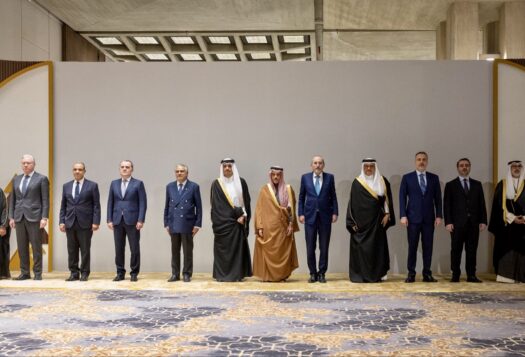
Image 1: India in Nepal via X
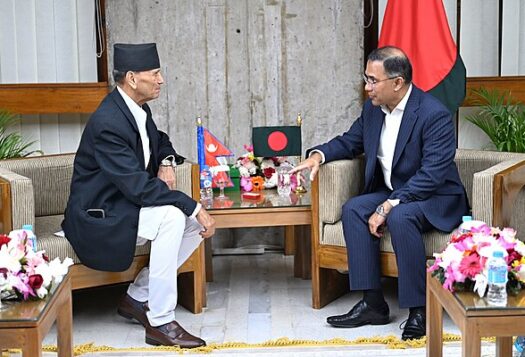
Image 2: MOFA Nepal via X