




Editor’s Note: This article is part of South Asian Voices’ annual Year in Review series. Browse the full series page here.
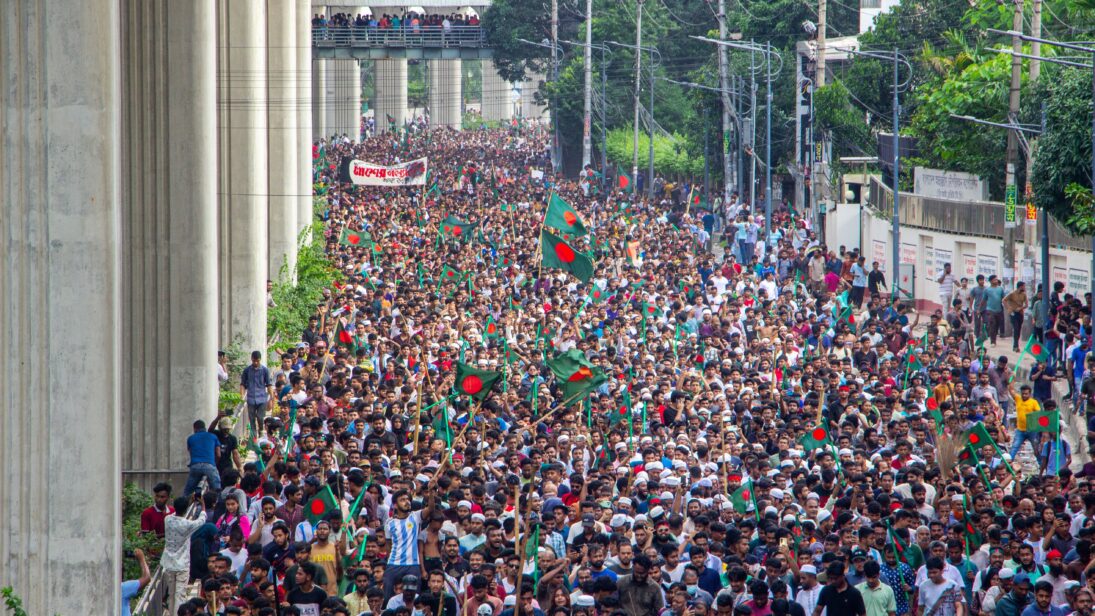
Marked by political upheaval and heightened public desire for accountability and transparency, the last few years have been eventful for Bangladesh. As the country approaches 2026, some pressing questions about its future trajectory loom large: Has the current interim government made tangible progress in ensuring reforms, security, and enhancing foreign policy engagement during this transitional period? Will the forthcoming election be free, fair, and participatory enough to ensure peace and stability? As Bangladesh prepares for this long-awaited referendum after the July People’s Movement of 2024, the country’s political stage has once again become a battleground of shifting alliances, tactical maneuvers, and ideological repositioning. With the Bangladeshi diaspora expected to vote for the first time, comprising over 10 percent of the electorate, and the inclusion of a large number of young voters due to a massive demographic shift, this is likely to be a historic election.
However, Bangladesh’s political transition remains incomplete and reforms unfinished sixteen months after the dramatic departure of former Prime Minister Sheikh Hasina. The interim government, led by Nobel Laureate Professor Dr. Muhammad Yunus, was tasked with stabilizing the economy, rebuilding public trust in institutions, and preparing for free and fair elections. But while the interim regime initially enjoyed broad domestic and international support, it gradually became clear that the scale of the challenge was far greater than anticipated for them, and it continues to face mounting challenges in realizing this vision. The post-Hasina period promised reform and renewal.
Yet what has emerged instead is a fragile political landscape marked by opportunism, volatility, and competition for influence both at home and abroad. The major political parties, the Bangladesh Nationalist Party (BNP) and the Jamaat-e-Islami (JI), and a collection of smaller actors such as the National Citizen Party (NCP), have not demonstrated a genuine commitment to internal reform. Structural weaknesses in Bangladesh’s political system—centralized decision-making, weak accountability, opaque financing, and entrenched patronage networks—have continued to dominate party behavior. The result is an environment where loyalty and access matter more than vision or competence, and parties are now engaged in what many observers describe as a “political game” rather than a democratic contest. The persistence of patronage networks, coupled with short-sighted elite actions driven by tactical survival and immediate gain, risks entrenching the very dysfunctions that the 2024 protests sought to dismantle.
Moreover, this lack of internal democracy within the political parties directly affects their ability to represent citizens effectively and creates conditions for further disaffection and volatility. Many party members at the local level express frustration at being excluded from decision-making. In response, some have turned to factional politics, intensifying internal rifts. For instance, despite being poised for a potential return to power, the BNP continues to struggle with generational divides and leadership disputes. Meanwhile, religious and identity-based parties like the Jamaat-e-Islami and Hefazat-e-Islam face internal fragmentation, even as they gain traction among youth and rural populations. The broader picture reveals a system that remains stuck between change and continuity.
Consensus, Conflict, and the Return of Intolerance
The promise of a new political culture based on dialogue and tolerance, which was so vividly articulated during the protests of July 2024, has yet to materialize. Despite repeated calls by Yunus for cooperation among parties, consensus-building remains fragile. Even modest agreements, such as those concerning electoral management or the conduct of political rallies, tend to collapse under the weight of mutual mistrust. Intolerance continues to define political competition. The opposition and ruling factions alike frame their rivals not as legitimate adversaries but as existential threats. Political rhetoric has become increasingly inflammatory, and physical violence remains an ever-present risk. For instance, disagreements over the implementations of the July Charter quickly devolved into public accusations, with BNP leaders claiming the interim government was selectively applying reform commitments while JI and the NCP accused the BNP of attempting to dominate negotiations. The recurrence of clashes between rival student groups, as well as attacks and violence on the campaign trail, points towards the volatility of the pre-election environment.
This lack of tolerance has effectively transformed political violence into a negotiating tool. This became apparent following the recent shooting of Sharif Osman Hadi, who is contesting in the upcoming election from the Dhaka-8 constituency and serves as a spokesperson of Inquilab Moncho. Parties deploy street power to project strength, intimidate opponents, and influence electoral procedures. Such tactics have led to a widening credibility gap between the political elite and the public. Weary of confrontation, citizens express growing skepticism about whether the forthcoming elections will bring genuine change or merely mark another round of elite realignment.
Coalition Politics and Tactical Maneuvering
Coalition-building has emerged as the defining feature of the 2025 political game. Yet these alliances are highly fluid and opportunistic. The BNP, now widely regarded as the frontrunner, has taken a cautious approach to formalizing any large-scale partnerships at this stage. Instead of coalition commitments, it engages in quiet dialogues with both centrist and Islamist parties, balancing the need for electoral advantage with the need to preserve ideological coherence. JI, once politically sidelined, has re-entered mainstream discourse through a combination of strategic moderation and grassroots organization. Its call for proportional representation in Parliament has generated significant debate, with supporters arguing that it would make the political system more inclusive.
Meanwhile, the newly formed NCP, or the students’ party, is seeking to position itself as a modern, visionary, and technocratic alternative. Its strong social media presence and urban youth appeal have earned it attention, but its organizational reach remains limited. Analysts speculate that while NCP may not win more than a handful of seats, despite party leaders’ claims to the contrary, it could nonetheless emerge as a “spoiler” in key constituencies, splitting votes and influencing the balance of power in a closely contested election. In this context, ideology is often subordinate to strategy. Alliances are negotiated not on shared principles but on pragmatic calculations: control of constituencies, access to funding, and external endorsements. Thus, it can be said that in Bangladesh today, coalition politics is not about governing together; it is about surviving together.
Weary of confrontation, citizens express growing skepticism about whether the forthcoming elections will bring genuine change or merely mark another round of elite realignment.
External Influence and the International Dimension
The intersection between Bangladeshi domestic politics and foreign relations has become increasingly pronounced in 2025. Political parties are acutely aware that their international image can strengthen or weaken their standing at home. As a result, lobbying with foreign governments, international organizations, and even diaspora groups has intensified. The BNP has sought to reassure Western partners of its commitment to democratic governance and human rights, positioning itself as a moderate force capable of rebuilding ties with the major powers. Meanwhile, the interim government continues to rely on International Monetary Fund (IMF) support and World Bank financing to stabilize the economy, although austerity measures have sparked discontent among the poor.
New Delhi’s position remains measured at this stage, given Dhaka’s significance for Indian domestic and foreign policy. While New Delhi maintains open communication with the interim government, it observes BNP’s potential return with cautious interest, given its historical alignment with more Islamist and nationalist elements. Bilateral tensions have also flared periodically over the issue of cross-border migration, and social media narratives concerning the treatment of minority communities in Bangladesh indicate the need for careful diplomatic communication between the two neighbors. Most recently, the political landscape has shifted again following the November 2025 court verdict sentencing former Prime Minister Sheikh Hasina, who is in exile in India, to death.
The pertinent question now is: What will New Delhi decide regarding Hasina’s extradition? Unlike the case of Anup Chetia, Hasina’s extradition would be markedly distinct, considering her political stature and her family’s deep-seated connections to both Bangladesh and India. India’s neutral position on the verdict and stated intention of working together with Bangladesh’s next elected government imply that New Delhi will take a cautious approach on this issue. However, there is a likelihood that India could still refrain from returning the deposed leader out of concerns about endangering Hasina’s life. Even if New Delhi were willing to send her back to Dhaka, the Bangladeshi government would have to take careful security measures to manage the extradition, considering the outpouring of support expected from the substantial presence of Awami League (AL) party members and voters.
China, in contrast, has expanded its quiet diplomacy in Bangaldesh. It has continued to invest in infrastructure and development projects, signaling its intention to continue to be a long-term strategic partner regardless of which party assumes power in the country. Pakistan, too, has cautiously rebuilt diplomatic engagement, capitalizing on the goodwill generated by its supportive stance during the 2024 protests. This web of external relationships highlights how domestic legitimacy and foreign policy are increasingly intertwined in the country’s transition politics. Each major party campaigns for votes at home but also seeks validation abroad, which is a dual competition that further complicates Bangladesh’s political trajectory.

Youth and the Reconfiguration of Student Politics
One of the most significant developments of 2025 has been the transformation of Bangladeshi student politics. Once dismissed as a corrupt extension of party patronage, youth mobilization is now re-emerging as a powerful force in electoral dynamics. Across rural Bangladesh, political parties are investing heavily in engaging young voters, using student organizations as the primary vehicle of grassroots organization.
The Bangladesh Jatiotabadi Chatra Dal (JCD), affiliated with the BNP, has been particularly active in this regard. Central leaders in Dhaka have cultivated local youth leaders to strengthen rural bases, effectively linking village activism to national strategy. Their narratives of injustice resonate strongly among young voters, especially in districts where unemployment and disillusionment run high. However, this mobilization is double-edged. While it energizes youth participation, it also raises the risk of street-level confrontation. Rival groups, particularly those linked to JI and NCP, are competing to assert dominance on campuses and in localities, sometimes resulting in violent clashes. As the election nears, the prospect of escalating student violence remains a major concern for security agencies and election observers alike.
The elections ahead represent not merely a change in government but a test of whether the country can overcome its entrenched cycle of rivalry, intolerance, and institutional fragility.
The Road to 2026: Prospects and Perils
While the election is now expected in early 2026, most likely in February, the political outlook continues to remain uncertain. The BNP appears to hold the upper hand, buoyed by public frustration with the previous government and discontent over economic hardship. Its campaign promises of building a $1 trillion economy by 2034 and creating 10 million jobs have resonated with voters hungry for opportunity. Yet critics warn that such pledges may prove unrealistic unless accompanied by meaningful reform. For the BNP, the real test will be whether it can abandon its traditional political culture of patronage and clientelism and show a renewed commitment to transparency, accountability, and good governance. The post-2024 political environment has produced an electorate that is more skeptical, better informed, and less forgiving. Failure to deliver credible reforms could quickly erode the party’s legitimacy, even if it wins the polls.
The JI, meanwhile, is quietly positioning itself for an electoral breakthrough. Its expanding youth base, organizational discipline, and focus on social issues suggest that it could secure a significant parliamentary presence, potentially 40 to 50 seats, according to optimistic projections. Should this materialize, it would mark JI’s most substantial comeback since it was banned from electoral politics.
As for the students, the NCP’s rise, though modest in scale, shows a growing appetite for political alternatives outside of the traditional BNP-AL binary. Even if limited to urban constituencies, its presence could perhaps signal the beginning of a generational shift in Bangladeshi politics.
Finally, the broader political landscape suggests that the AL is unlikely to be permitted to participate in the upcoming 2026 election due to the controversies surrounding its actions before the regime change. Both this decision and whether New Delhi chooses to extradite Hasina will decide the trajectory of electoral violence pre- and post-polls, as well as Bangladesh’s overall political stability in the future.
As 2025 draws to a close, Bangladesh stands at a crossroads once again. The elections ahead represent not merely a change in government but a test of whether the country can overcome its entrenched cycle of rivalry, intolerance, and institutional fragility. The current political game, driven by tactical alliances, opaque financing, and external lobbying, has deepened public cynicism. The reliance on youth mobilization and coalition maneuvers, rather than program-based competition, clearly points to the persistence of interest-driven politics over principle-driven governance. Yet within this turbulence, there still lies a glimmer of hope. The activism of young voters, the calls for transparency, and the growing demand for accountability suggest that Bangladesh’s democratic aspirations are far from extinguished. Whether the country’s leaders rise to meet these expectations or once again allow short-term interests to eclipse long-term reform will determine not only the outcome of the 2026 election, but also the trajectory of Bangladesh’s democracy and pursuit of lasting harmony for decades to come. Bangladesh’s political transformation has stalled not because of a lack of popular will, but because of the structural inertia within the very institutions meant to deliver reform.
Views expressed are the authors’ own and do not necessarily reflect the positions of South Asian Voices, the Stimson Center, or our supporters.
Also Read: One Year after the Revolution: Reform, Reconciliation, and the Road Ahead for Bangladesh
***
Image 1: Rayhan Ahmed via Wikimedia


