




Nepal’s current political moment reflects longstanding concerns about institutional legitimacy and the rule of law amid the evolution of its constitutional framework. The convergence of mass protest, political rupture, and judicial restraint has once again brought Nepal to a defining constitutional threshold. What began as a reaction to state overreach has evolved into a reckoning with the legitimacy of the interim government, the limits of the country’s democratic institutions, and the endurance of its constitutional order. The ongoing crisis has brought the doctrine of necessity back into the constitutional discourse, highlighting a central question: can any interim arrangement be justified if it is strictly temporary, narrowly focused, and firmly constrained by judicial oversight?
Crisis at the Crossroads
On September 8, Gen-Z youth-led demonstrations erupted in Kathmandu and across the country triggered by the government’s decision to block major social-media platforms. As the protests, which were fueled by public frustration built up over years of chronic concerns of state corruption, snowballed, security forces opened fire on the crowds near the federal parliament.
Initial reports confirmed 17 people killed and over 100 injured, with authorities imposing curfews and deploying troops to secure government buildings. By the following day, the death toll rose to 19, and subsequent investigations by independent forensic teams confirmed that live ammunition had been used against demonstrators. The United Nations Office of the High Commissioner for Human Rights and international rights groups such as Human Rights Watch subsequently called for transparent inquiries and accountability.
“What began as a reaction to state overreach has evolved into a reckoning with the legitimacy of the interim government, the limits of the country’s democratic institutions, and the endurance of its constitutional order.”
Following this abject use of force by the state, the protest grew even larger on September 9 and quickly led to arson and vandalism on a nationwide scale, with damage documented in 484 locations across the country. Prime Minister K. P. Sharma Oli resigned amid the turmoil, following mounting criticism of his handling of the crisis. In the days that followed, Gen-Z activists intensified their demand for a neutral figure from outside the traditional party hierarchy to lead the country, creating visible uncertainty about what mechanism or process could credibly produce an interim leadership. On September 12, President Ram Chandra Poudel appointed former Chief Justice Sushila Karki as interim prime minister to restore order and lead a transitional government. The following day, the president announced fresh parliamentary elections for March 5, 2026, alongside the dissolution of the lower house.
By mid-September, the official toll in this political violence had climbed to 72 people killed and 2,113 injured, making this civil unrest the deadliest in Nepal since 2006. Official reports claimed 688 public offices, 259 private homes, 128 businesses, 198 party offices, and 307 police posts were attacked or destroyed. On-ground reporting confirmed that parts of the federal parliament complex, district administration offices, and local government buildings were set ablaze or reduced to rubble in the worst-affected urban centers. But what this mass uprising, subsequent civil destruction, and a new interim setup kickstarted was a deeper crisis, challenging the institutional and political foundations of the modern Nepali state.
Cycles of Deadlock and Disillusionment
Nepal’s present crisis cannot be understood without situating it within the repetitive patterns of instability that have defined its modern political evolution. The democratic transition initiated after the 1990 People’s Movement unleashed multi-party competition but soon revealed structural weaknesses in Nepal’s party system, with entrenched elites, fragile coalitions and recurring institutional breakdowns plaguing the country’s democratic journey. The abolition of the monarchy in 2008 and the adoption of the 2015 Constitution were celebrated as milestones in federal republican consolidation.
These transitions brought important reforms, but did not ultimately solve the fundamental problem of equity of and access to power. The 2015 Constitution enshrined extensive fundamental rights, mandated proportional inclusion of women and marginalized groups, and prompted the amendment of key laws, including the Civil Service Act, 1993, to introduce quotas in public employment and state institutions. Between 2014 to 2019, Nepal reduced its multidimensional poverty rate from about 30.1 to 17.4 percent, lifting approximately 3.1 million people out of multidimensional poverty. Yet, despite these formal gains, political power has remained concentrated among dominant elites, primarily senior leaders of the three major parties and the Khas-Arya establishment, who continue to control candidate selection, cabinet appointments, and leadership pipelines. Patronage over state resources, public contracts, and key bureaucratic postings is typically exercised through tightly knit party hierarchies, which has limited the practical impact of constitutional inclusion mandates. As a result, marginalized communities remain underrepresented in decisionmaking spaces, and political mobility often depends less on merit and more on proximity to entrenched networks, with the distribution of opportunities continuing to be mediated through informal patron–client frameworks.
This persistence of elite-driven governance and fragile coalitions has eroded public confidence in democratic institutions. A 2022 survey shows citizens now place more trust in the Supreme Court and the security forces than in political parties or parliament. The protests of 2025 therefore reflected not merely anger at censorship and corruption, but accumulated frustration with a political order that has failed to translate constitutional promises of inclusion and accountability into practice.
Doctrine of Necessity: Between Preservation and Overreach
Within weeks of the formation of the current interim government, multiple writ petitions were filed at the Supreme Court challenging both Karki’s appointment and the dissolution of the House of Representatives, with a constitutional bench convened to hear the cases. The apex court, however, declined to issue an immediate interim order but sought written clarifications from the president’s office and other respondents, signaling cautious judicial restraint.
At the same time, the Court asserted its oversight role by issuing an interim order on November 2, restraining the government from implementing its decision to recall 11 ambassadors appointed by the previous administration, reasoning that the envoys’ terms had not expired. However, the Ministry of Foreign Affairs went ahead and wrote to the envoys to return, provoking concerns of executive defiance of judicial oversight.
This formation of an unelected interim government and its dealings with the judiciary have reopened a constitutional debate: can extraordinary measures taken in the name of stability coexist with the rule of law? In law, the doctrine of necessity permits limited deviations from strict constitutional procedure to preserve order when governance would otherwise collapse. This extends far beyond Nepal and has recurred across South Asia, where courts in Pakistan, Bangladesh, and Sri Lanka have all grappled with the tension between preserving constitutional order and legitimizing temporary departures from its text during moments of crisis. The doctrine was first articulated in Pakistan’s The State v. Dosso and later tempered by Grenada’s Mitchell v. DPP (1986) and Canada’s Manitoba Language Rights Reference (1985).
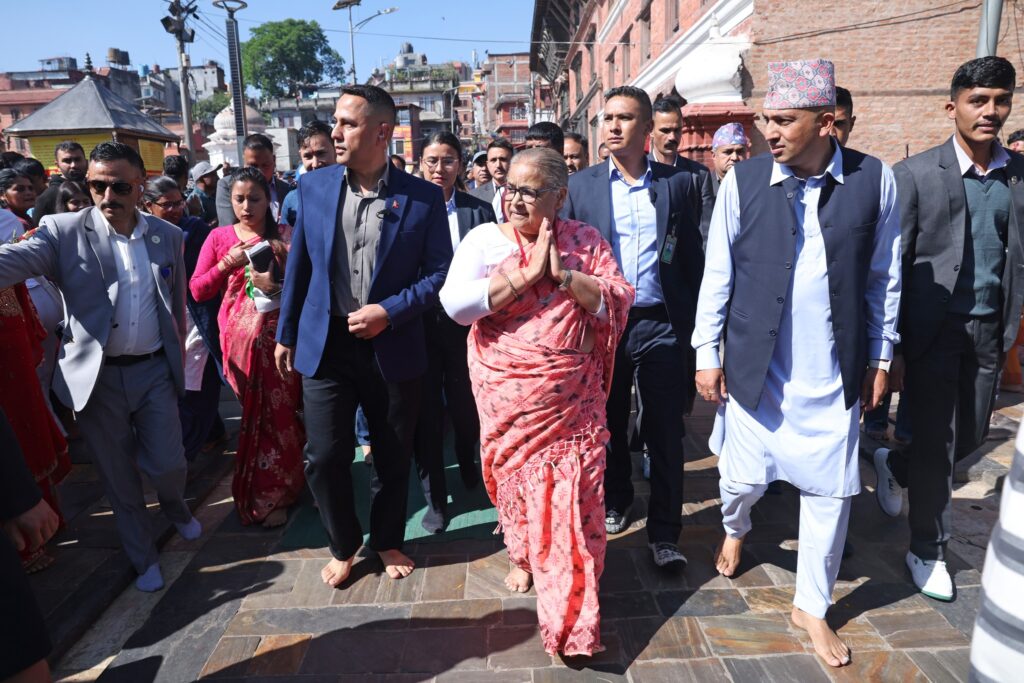
Nepali jurists have long grappled with this tension. During the 2013 Regmi interim government, the Supreme Court refrained from delivering a final judgment on the constitutional validity of the arrangement of appointing the Chief Justice as the head of the government, later dismissing the petitions as moot, after the caretaker administration’s term had expired. Prime Minister Sushila Karki, then a member of the constitutional bench, publicly expressed disagreement on the appointment, stating that the appointment of Chief Justice Regmi as head of the executive was contrary to the spirit of the 2007 Interim Constitution.
In past rulings, Nepal’s Supreme Court has demonstrated a judicial preference for constitutional continuity through ordinary legal interpretation rather than recourse to exceptional doctrines. For instance, in 2021, the Supreme Court of Nepal issued two major rulings concerning Prime Minister K.P. Sharma Oli’s dissolution of the House of Representatives. In February 2021, the Constitutional Bench reinstated the House of Representatives dissolved by Oli, holding that the dissolution was unconstitutional because the prime minister still had the possibility of forming a new government under the existing constitutional provisions. In a second decision in July 2021, the court again overturned a later dissolution and directed the president to appoint Sher Bahadur Deuba as prime minister under Article 76(5), stating that this step was required by the Constitution and existing parliamentary process.
By restoring the House and directing the formation of a new government under Article 76(5), the Court reaffirmed that constitutional mechanisms were sufficient to resolve political impasses without departing from established norms. However, in the current crisis, the relevance of the doctrine of necessity has re-emerged. Its legitimacy now depends on whether any interim arrangement remains temporary, narrowly tailored, and subject to judicial oversight.
At the heart of the debate is a simple but critical concern: if the Supreme Court hesitates to rule decisively in moments of constitutional breakdown, it risks normalizing extraordinary governance as a default political tool. The court’s decision to stay the recall of ambassadors while allowing day-to-day administration illustrates this delicate calibration between pragmatism and principle. Yet there remains a strong possibility that the court will again choose institutional caution, opting to wait until the interim government’s tenure expires rather than issuing a definitive ruling, thereby repeating its earlier approach during the Regmi period. Such restraint, while politically prudent, could incentivize the future misuse of ad hoc means to govern and shape the boundaries of Nepal’s constitutional democracy going forward.
“At the heart of the debate is a simple but critical concern: if the Supreme Court hesitates to rule decisively in moments of constitutional breakdown, it risks normalizing extraordinary governance as a default political tool.”
Legitimacy, Restraint, and Renewal
The appointment of an interim prime minister, the dissolution of parliament by the president, and the Supreme Court’s cautious interventions have revealed the fragility of the balance between legality and legitimacy in Nepal. Yet this moment is not merely a crisis of procedure; it is a test of constitutional fidelity. If the political and judicial actors can rise above expedient calculations and act in the spirit of constitutionalism rather than its manipulation, this rupture could yet serve as a site of renewal. Whether Nepal’s political class and the judiciary can navigate this interregnum with restraint, transparency, and accountability will determine whether this episode strengthens or corrodes the democratic vision articulated in 2015.
The Supreme Court’s pending judgment or its decision to withhold one will define the future reach of the doctrine of necessity. Should the court, as in 2013, choose institutional caution and allow the interim government’s term to lapse without a final ruling, it may preserve short-term calm but risk legitimizing exceptional governance as a recurring political method. It would signal that political actors can force a constitutional crisis, wait out judicial scrutiny, and still get away with using supra-normal arrangements to govern. In practical terms, this could encourage future leaders to manufacture deadlocks or undermine institutions whenever it suits their interests, knowing that the courts may stay silent. The challenge before the court is therefore not merely legal but moral: whether necessity will be invoked to protect the constitutional order or to accommodate its circumvention. Legality without conviction cannot sustain legitimacy, and restraint without responsibility easily becomes abdication. If this moment of rupture can be transformed into a reaffirmation of constitutional discipline, the upheaval of 2025 may yet mark not another descent into instability, but the beginning of a more self-correcting and accountable republic.
Views expressed are the author’s own and do not necessarily reflect the positions of South Asian Voices, the Stimson Center, or our supporters.
Also Read: SAV Q&A with Bidushi Dhungel: Nepal’s Political Revolution and Quest for a More Equitable Future
***
Image 1: Sushila Karki via Facebook
Image 2: Sushila Karki via Facebook


