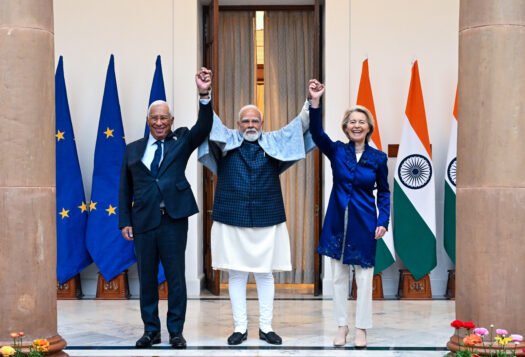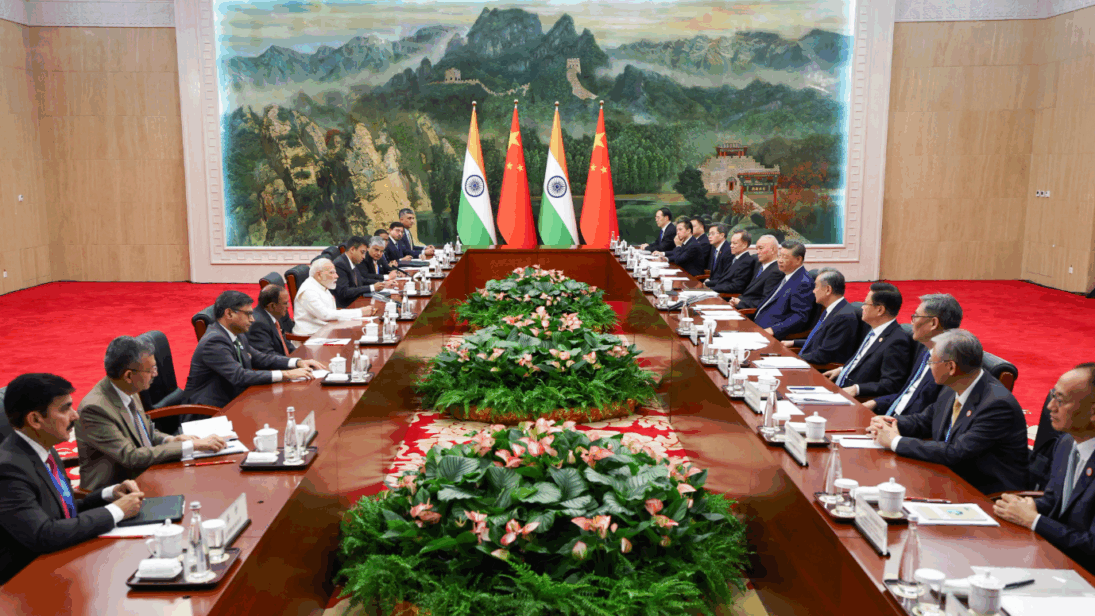
India appears to be at a foreign policy crossroads, with a downturn in ties with the United States accompanied by growing engagement with China and steadfast relations with Russia. Indian Prime Minister Narendra Modi’s recent appearance at the SCO summit in Tianjin, China, and bilateral meetings with Chinese President Xi Jinping and Russian President Vladimir Putin underscored this juncture. South Asian Voices spoke with Dr. Srinath Raghavan on September 3 about the pivotal moment in Indian foreign policy—in the first of two parts, we discussed New Delhi’s approach to the United States and China. Dr. Raghavan is a celebrated historian currently serving as a Visiting Senior Research Fellow at the Lee Kuan Yew School of Public Policy. He is also Professor of International Relations & History at Ashoka University; his latest book is Indira Gandhi and the Years that Transformed India.
How do you view developments in the India-China relationship in the last year or so, beginning with the October 2024 patrolling agreement and culminating in the Modi-Xi meet on the sidelines of the SCO summit on August 31? Does this warming of ties represent an enduring shift or a tactical decision with underlying strategic tension continuing?
Instead of thinking of it as a warming of ties, I’d perhaps characterize it more as a thaw, because I think the relationship has actually been in something of a deep freeze since the events of 2020, particularly with the Galwan confrontation and everything that followed in its wake, the massive military mobilization that we’ve seen, the eyeball-to-eyeball situation that has now persisted for so long, the fact that it has taken us such a long time to work out disengagement. And my understanding, based on what’s available in the public domain, is that each element of that disengagement seems to have had somewhat different and specific localized conditions, so it’s been a fairly drawn out and difficult process, even to get to the point where we can claim some degree of successful disengagement.
And even then, from the Indian perspective, it’s not very clear what the terms are, what does it mean for India’s ability to patrol up to the lines, say, to which we were doing in 2019? Is it temporary? Is there a time period? What does the resumption of joint patrolling, etc., mean? And throughout this period, you had practically no movement forward in the bilateral relationship, because I think New Delhi’s position has been that until such time as we are able to actually agree to some significant level of disengagement and de-escalation, only then there is a possibility.
But clearly, the de-escalation bit has been now bracketed out; we’ve agreed that we’ll have to move forward, even if things don’t. So in fact, you would recall that last year ahead of the meeting in October in Kazan, actually, it was the Indian side, the foreign minister first said, and then the foreign secretary made a statement saying that significant progress has been made, we’ve sorted out 70 percent of things, etc. That was a bit of a surprise statement, just given what seemed to be the glacial progress of talks, which were just going on and on, and the readouts were not indicating much by way of change. But clearly, a political decision had been taken that perhaps we’d reached a threshold point where we could now move towards other things. And I think, in the year since then, we have seen more preparatory work leading up to this meeting.
So, is it something tactical or strategic, as you were saying? I think the underlying strategic issues are all there. None of them are gone. But I don’t see this as necessarily a tactical move simply in response to very immediate events that have happened. Even the timeline doesn’t quite lend itself to that particular interpretation. But I think the more recent events, particularly in the U.S.-India relationship, only hastened the imperative to move towards normalization, rather than being the causal element. The way I see it therefore is that although it is a thaw, the underlying strategic problems, be it military, security, economic, all of those are still in play. But I think there is a recognition on the part of both India and of China, that there is an imperative to prevent the relationship from lapsing into more difficult and outrightly hostile situations. There is a joint interest in putting a lid on this and trying to see if we can move a little forward from where we are.
There seems to have been a shift in the Indian approach to China, from a more cautious strategy post the 2020 standoff that linked progress in the bilateral relationship with the resolution of the border dispute and considered national security even in economic engagement to a different posture recently that is more open to China’s involvement in India’s supply chains. How are these debates playing out in New Delhi?
On the first question, which is about the Indian position that we need some kind of a restoration of status quo ante pre-April 2020 before other things can move forward—now, the first point is that I think that position itself, in some ways, is a turning away from another stance, which had been in place at least since the 1990s, which was that we will not allow border issues to come in the way of development of other ties. So as much as these issues were important and contentious, you would try and bracket them and move on to other planes.
Whereas here, I think India realized after the initial few steps that it took, that it had very few levers with which to shape China’s behavior. Banning TikTok is not really a serious answer to the problem. Preventing Chinese investment flows into, say, the Indian startup ecosystem, that is small business, those are not things that are going to get the Chinese to think differently about how they want to deal with this difficult situation.
So, then what came next is this argument that the principal vehicle we have is to suspend all kinds of engagement, and that’s what we’re going to do. But the problem was that the Chinese also hunkered down. And I think there were some mistaken assumptions in India about how long the Chinese and the PLA could hold those kinds of lines.
Initially, in 2020, there was a lot of chatter saying the Indian army has so much experience in winter deployment on these heights, whereas the PLA never does that, it’s only border forces, it is going to be more challenging for them. I think the Chinese proved all of those calculations to be totally wrong. They too dug their heels in and dragged out the process. And we’ve found that getting every bit by bit of this result has been a pretty painful and slow process, which has meant that the futility of holding on to the position that no negotiation till restoration of status quo was coming to the fore. So, that position was tacitly abandoned.
Now, the second point is that this whole argument about linking economic ties with China, particularly technology and investment flows, to national security issues was also a response to Galwan, rather than something that had an autonomous logic of its own. And I think it was also coming out in the milieu of a lot of talk about how the United States was thinking about Chinese investments, which I think is a totally inappropriate way for India to think about what is happening.
At some level, if you ask any economist, if you are running persistent trade deficits with a country, the only way that this thing can be balanced out is if you allow capital inflows. So having trade deficits and not allowing capital inflows is a double whammy. So, it wasn’t an argument which I was very persuaded by even when it was being made. I felt that particular position was not a very sensible one in economic terms. But then, the real needle started shifting not so much because of what the national security side of the Indian establishment was doing, but more the economic policy and perhaps the trade lobbies and businesses and others. I think it was in 2024 in the Economic Survey that the Chief Economic Advisor actually mentioned that we need to reconsider some of this stuff.
That is because the fact remains that the increasing imports from China only suggest that Indian businesses still in several segments find it very important to import industrial products from China, which are clearly highly competitive and have the cost advantage. Secondly, there are a number of sectors in which Indian production is actually dependent on Chinese imports and intermediaries of various kinds. Pharmaceuticals is a well-known case, but there are several others.
The third thing is that India’s own story of saying that, when the rest of the world is talking about China plus one, this is India’s market, so we can step in and benefit from that—that particular storyline also started being contradicted by facts. The facts were that countries like Bangladesh and Vietnam were able to benefit from the plus one strategy in a way that was better. And of course, now the U.S. tariff situation has complicated that particular angle for India tremendously.

There has been an unprecedented deterioration in U.S.-India ties over the past two months, with some commentators calling it the most serious setback in the last 25 years. How does New Delhi see these developments in the relationship, and how have these changes influenced India’s broader foreign policy calculus?
Let’s take a step back. What explained the upswing in U.S.-India relations, say approximately 20 years ago? For a historian, the interesting thing is how in the preceding 50 odd years, the United States and India seemed to find it very difficult to get along, especially in geopolitical terms. Despite the fact that you had common political systems, you were both democracies in the Cold War, India was the largest recipient of U.S. foreign aid during the Cold War, even then, the United States and India found it very difficult to find some kind of a modus vivendi for the most part. And then there were various episodes. There were also underlying differences because of India’s desire to pursue a policy of non-alignment, its desire to have a mixed economy with high levels of protectionism, the Indian state taking the lead, et cetera.
But what changed in the 1990s? One thing which of course changed at the geopolitical level was the end of the Cold War, which then meant that non-alignment in the traditional sense in which India had practiced it, which is to say, we want to stay out of alliances, be it with the West or with the Communist bloc, that particular way of thinking about the world ceased to have purchase. That does not mean that strategic autonomy went away, but still there was a recognition of what the unipolar moment meant and the importance of the United States and of balancing relations.
The second thing which happened in the 1990s was the transformation of India’s own economic development model from being one of more import substitution industrialization to one which was much more about giving the private sector a greater role in India’s development and then embracing globalization. Of course it was hesitant, but it went ahead and tried to plug into globalization, which was an American-led project.
The third thing, as I see it, is the coming to the fore, particularly from the early 2000s, of a very strong Indian diaspora in the United States, which signified the thickening of social relations between the two countries. So that created a certain density of connections between the two societies.
What you had was the coming together of these large forces in the mid 2000s, with the Bush administration realizing that going forward on the horizon, the competitor is China. And if we want to balance the rise of China, the best way would be to have other peer competitors to China in the Asian context. And India then emerges as an important thing, because those were the years when India’s economic growth was highest, 8 to 10 percent of GDP, and it seemed like we could be within touching distance of China. You had an administration in the United States, which felt that India’s identity as a liberal democracy was very important. That was very important to President George W. Bush.
The conjunction of these factors then means that U.S.-India relations undergo a certain kind of a change. Ashley Tellis and others call it “strategic altruism.” I’m not so sure that that’s the correct way to characterize what was happening. I don’t think there’s any altruism in international politics. Certainly not in U.S. foreign policy, if I may be so frank as to say. What I will say is that there was an asymmetry in terms of expectations. The United States was willing to do more, even if India was willing to do less.
Now, clearly, under President Trump, there is a belief that that framework has to be set aside. Because what we need is reciprocity, a clear agreement on tariffs, and so on. Even under President George W. Bush, there were requests from Washington asking India to open itself up to certain imports from the United States. I still remember that the Bush administration wanted Harley Davidson, the motorcycle manufacturer, to be able to set up shop in India. And one of the things that the Indians got in return for that was that Alphonso mangoes would be exported from India to the United States.
It’s well known that India has protectionist tariffs on various kinds of things. But the Trump administration, however, has taken it in the way that it takes the general problem: the United States has a problem of deficits, and those deficits are fundamentally an aggregation of bilateral deficits. And which are the countries that are creating problems for us? The ones who are imposing the highest tariffs. Ergo, you go after X, Y, Z, which includes China and India in this context.
Talking of New Delhi’s expectations, I think the expectation was that they’d actually have a trade deal. I think President Trump’s flip in early August came as something of a surprise, because I think the Indians were hoping that they would still be able to manage to cut a deal. Perhaps that was a misplaced expectation on the Indian part.
But nevertheless, I think it is fair to say that I don’t think they saw it coming in quite that way. Certainly, they did not see those tariffs, then this additional tariff that targeted India’s oil purchases from Russia. And I think that is problematic, at least in a couple of dimensions.
In the first instance, I think it is problematic because it puts a question mark on India’s autonomy to choose how it wants to deal with other great powers. And that has always been a very basic element of India’s pursuit of strategic autonomy throughout independent India’s history, and the Russian relationship is an important one for India. So, I think that that was a problem on its own terms.
But the second one was that it was seen by New Delhi as patently unfair. Now, I do not believe that fairness is a value in international politics. But nevertheless, that is the way it was perceived, that this is unfair. And why is it unfair? Because it was the Americans, the Biden administration, that asked us to pivot towards importing Russian oil at a time when the Europeans were pivoting to buying Middle Eastern oil, which would have boosted oil prices globally. So, in order to stabilize the markets, we were asked to do all of this stuff. And when we have done it, now we are being targeted at a time when China, which is importing more Russian oil, is clearly not subject to the same level.
And I think the kinds of explanations that have been trotted out by U.S. officials on multiple occasions are only adding to the act. The kinds of statements and the political overtones have left a very distasteful impression on New Delhi. And we must remember that at the end of the day, the Indian government and Prime Minister Modi, like every elected political leader, is in the first instance responsive to domestic political constituencies, not to external constituencies that are bent on extorting a deal on the basis of threats of additional tariffs. Because it’s all very clear that all this is being done simply so that India will fall into line and then come to some kind of a deal. We are finding problems in terms of giving concessions in the traditional sectors like agriculture. Agriculture accounts for a very small part of Indian GDP, but accounts for a very large part of the workforce. 40 percent of Indian labor is in agriculture.
So, there are limits to what any government will be able to do with those kinds of things. But I think there has been another important and perhaps somewhat underappreciated aspect of how this whole tariff story, particularly this additional 25 percent on the Russia account, is playing out. This is just my interpretation. I’m not saying that this is necessarily the way that New Delhi sees it, but these are structural facts.
The principal company that is being singled out without being named is Reliance Industries. And it’s a well-known fact that Reliance is seen by the current government as one of the key national champions. The political economy of the Modi regime over the last three to four years has been reliant on this idea that we will promote a few national champions who will then get our economic growth going. Because the overall story of getting private investments going was not seen as working for whatever reason. The other national champion is already under investigation by the U.S. Department of Justice, which is the Adani Group.
So, in a sense, you could say that the actions taken by the United States are cutting to the core of the way that the political economy of this particular government is operating. And I think that is too close to the bone for the government to be able to take, which is why I think there has been a significant degree of circumspection.
Now, having said all of that, I do believe that India still wants a deal. I think they recognize that there is an interest in getting first the economic relationship with the United States in place, and then the geopolitical relationship. Because if we do not have the economic relationship, or if the economic relationship is going to hold other things hostage—for instance, the ability of India to convene a successful Quad Summit, which is of interest to New Delhi as well—then the economic issue is important on its own terms. We’ve had the Indian Commerce Minister Piyush Goyal just say that he hopes that by November, we’ll have a deal.
There is a possibility that when Prime Minister Modi travels to the United States for the UNGA later this month, there may be a meeting with the U.S. president. But I suppose all of that will only happen if they feel that things are already tied up, because Mr. Modi is a very shrewd politician, he wouldn’t want to be berated by Trump in front of X, Y or Z.
All of that is so, but the expectation in New Delhi is there. And again, another very significant signal that India has sent out is they’ve agreed that import duties on Bt cotton will be dropped to zero until the end of this calendar year. Now, this is an issue that is of concern to the United States and is one of the sticking points in the negotiation. That is because China, which was one of the major importers of American Bt cotton, has cut its imports by almost 50 percent over the last two years. Now, that has meant that there is a large drop in overall American exports of Bt cotton, which is why the United States is pressing upon other economies like India to open up and accept more imports there.
So, what the Indians have done by giving a time-bound window is a signal to the United States that maybe things can be worked out. And I think this is what President Trump was referring to in his last post on his social media account, when he said that now the Indians are willing to bring it down to zero.
So, some signals are being sent, and perhaps they’re being picked up. I think the Indians do want a deal, but it will not be a deal that can be done on these terms. I understand pressure is being brought to bear for a range of reasons. But I think the manner in which the United States is doing so is hamfisted and counterproductive to an outcome, which I think could actually work for both sides.
This is the first part of the SAV Q&A with Srinath Raghavan. Read the second part here.
Views expressed are the interviewee’s own and do not necessarily reflect the positions of South Asian Voices, the Stimson Center, or our supporters.
Also Read: Modi at SCO: The Significance of China in India’s Foreign Policy
***
Image 1: Narendra Modi via X
Image 2: Narendra Modi via X