May 7 through 10 marked the one-year anniversary of one of the most intense crises in decades between India and Pakistan, two nuclear-armed neighbors that share a long and heavily militarized border and together hold at risk nearly 1.7 billion people. What began with a familiar trigger—a terrorist attack that India was quick to attribute to Pakistan-based groups—evolved into a crisis that differed in some key ways from earlier confrontations such as the Pulwama-Balakot incident in 2019. Among its many firsts, the crisis featured deep strikes across the international border for the first time since overt nuclearization, extensive drone and standoff operations, and one of the most significant beyond-visual-range aerial engagements in recent history. Yet despite these changes, the ending followed a familiar script with the United States stepping in to broker a ceasefire.
A year later, multiple official and semi-official accounts have emerged, from military narratives and academic volumes to think tank assessments. These include, but are not limited to, Pakistan’s Strategic Reckoning volume, including Lt. Gen. (Retd.) Khalid Kidwai’s preface, which narrates the Pakistani account of Marka-e-Haq and Operation Bunyan-un-Marsoos; and, on the Indian side, edited volumes by the New Delhi-based think tanks Council for Strategic and Defense Research (CSDR) and Centre for Air Power and Strategic Studies (CAPSS), as well as Lt. Gen. (Retd.) K.J.S. Dhillon’s book on Operation Sindoor. Together with additional webinars, interviews, and expert commentaries that continue to trickle out, these post-crisis analyses offer a window into how each side is making sense of what happened in May 2025 and what it means.
Critically, rather than producing a shared understanding of the crisis, these accounts continue to reinforce distinct national interpretations. Indian narratives frame the crisis as evidence of a “new normal” in which a calibrated conventional force can impose meaningful costs while staying below the nuclear threshold. On the other hand, Pakistani accounts tend to emphasize how “responsible deterrence” produced “game-changing strategic effects,” credibly countering Indian aggression and ultimately restoring stability on Pakistan’s own terms. These key differences in national narratives shape the lessons each side has drawn about deterrence doctrine, escalation dynamics, and technological capability. This article reviews where these interpretations clash most sharply and where there are limited areas of convergence. Most importantly, its goal is not to adjudicate between competing accounts, but to provide a comparative analysis of why and how variations in crisis narratives matter for what could come next.
Areas of Divergence
How Did It Start? Framing Attribution and Culpability
The first key area of divergence concerns the origin of the crisis and how quickly India pointed fingers at Pakistan, treating its involvement as an established fact from the outset. Indian accounts pointed to the Resistance Front’s (TRF) initial claim of responsibility (later withdrawn), the group’s reported links to Lashkar-e-Taiba (LeT), and a longer history of terrorist attacks with Pakistan-based connections. They also repeatedly mentioned Asim Munir’s April 2025 speech, in which he referred to Kashmir as Pakistan’s “jugular vein,” as evidence of a hostile political context. Based on these alleged associations, India struck nine sites it described as terrorist infrastructure, including the LeT headquarters at Muridke and the Jaish-e-Mohammed (JeM) headquarters at Bahawalpur. They also claimed that over 100 militants were killed and that terrorist infrastructure was significantly damaged. In this portrayal, Operation Sindoor became a legitimate and necessary response to hold Pakistan accountable for the attack. Indian accounts tend to justify this framing by emphasizing the past record of alleged links and previous attacks, as well as Pakistan’s failure to act against such groups, rather than providing more detailed or internationally-verified evidence specific to Pahalgam.
Pakistan has continued to deny these allegations, especially pushing back against the speed of India’s attribution and the absence of an impartial investigation. Pakistani accounts not only classify these initial strikes as a violation of international law, but also dispute India’s stated casualty figures. They claim that the strikes killed 40 civilians, including 7 women and 15 children, and destroyed mosques and houses. While Pakistan called for an independent investigation, India refused such offers and has not shared any evidence internationally to corroborate these linkages. This perceived lack of transparency further fuels Pakistani claims that Pahalgam was a “false flag,” or an attempt by India to deflect attention from internal security failures and homegrown militancy. Pakistani officials have also situated these claims within a broader narrative of alleged Indian destabilization efforts inside Pakistan, including alleged ties to the Jaffar Express attack and support for groups such as the BLA and TTP.
This divergence in narratives on attribution is concerning because it indicates that the very premise that initiated the crisis is under dispute. This dynamic impacts perceptions of the response, its proportionality, and its political objectives. Most importantly, it highlights the absence of a trusted and mutually accepted mechanism for joint investigation or crisis transparency. Without one, future crisis triggers are likely to follow similar patterns.
Who Won and Imposed a Higher Cost? Military Outcomes and Losses
The most visible point of divergence is related to competing claims about military outcomes, especially the extent of losses incurred by each side. While the detailed balance sheet of claims and counterclaims is too numerous to elaborate here, some key aspects recur in their national narratives.
One is related to the early Indian aircraft losses and their tactical significance. During the first day of the crisis, Pakistani Air Vice Marshal Aurangzeb Ahmed publicly claimed five Indian jets were downed, which was later updated to six. Later, in the preface to Strategic Reckoning, Lt. Gen. (Retd.) Khalid Kidwai goes further and claims that eight Indian top-line aircraft were destroyed (including 4 Rafales, 1 Mirage 2000, 1 MIG-29, 1 SU-30, and 1 Heron UCAV), that there were zero PAF losses, and that the IAF was effectively grounded for 48 hours. Indian accounts, by contrast, have remained more vague on the exact numbers but continue to frame aircraft losses as limited and “part of combat.” They also emphasize that India identified the “tactical mistakes” made on day one and corrected course, framing these losses as the price of restraint rather than evidence of failure.
A similar divergence appears around May 10, when India struck multiple Pakistani airbases. The Indian accounts tend to highlight how debilitating these losses were for the Pakistanis, whereas Pakistani accounts frame the damage as negligible. The full truth remains difficult to establish a year out, but it likely lies somewhere in the middle. Other claims remain disputed as well, including the performance of air defense systems, especially the S-400, and Indian claims that it downed Pakistani aircraft, which Pakistan has refuted.
One year later, this divergence has persisted, with both sides using claims of military success to support their preferred narrative of the crisis. This can be a double-edged sword. On the one hand, competing claims of victory can create the face-saving space needed for both sides to back down. On the other hand, they can also legitimize the initial use of force and entrench domestic political narratives in ways that complicate the next crisis. Ultimately, it shows that these contests over who won are not only about achieving a clear battlefield victory, but also about imposing costs, providing sufficient evidence thereof, and perhaps more importantly, making one side’s version of events appear credible.
“Key differences in national narratives shape the lessons each side has drawn about deterrence doctrine, escalation dynamics, and technological capability.”
Who Kept the Crisis From Spiraling? Escalation Control and Sources of Restraint
A third key area of narrative divergence is each side’s claim of being the responsible actor that kept the crisis from escalating, while framing the other as the destabilizing influence.
Indian accounts emphasize the “calibrated,” “measured,” and “deliberate” nature of their response at every stage. They frame the strikes on alleged terrorist infrastructure in Pakistan as being non-escalatory and proportionate because they avoided military and civilian targets, caused no collateral damage, and communicated their limited intent to Pakistan in advance. Even the fifteen-day gap between the Pahalgam attack and launching Operation Sindoor is cited as evidence that India showed “strategic patience,” which allowed it to carefully plan and consider escalation thresholds. At the operational level, Lt. Gen. (Retd.) K.J.S. Dhillon highlights that the strikes were launched from Indian territory using standoff-range weapons and loitering munitions, which helped avoid airspace violations. Indian accounts contrast this with Pakistan’s response, which they allege did not maintain the same distinction because it targeted civilian areas and conducted indiscriminate cross-border shelling. Overall, as retired Indian Air Vice Marshal Ashish Vohra writes, this narrative holds that India “maintained strategic superiority while degrading the Pakistan terrorism ecosystem without risking an uncontrolled war.”
The Pakistani narrative has firmly pushed back on these Indian assertions while characterizing Pakistan’s own conduct as “responsible deterrence: a strategy of restraint by design, calibrated retaliation, and rigorous crisis management.” In Strategic Reckoning, Dr. Rabia Akhtar writes that Pakistan chose “not to mirror India’s reckless bravado,” and instead “maintained responsible control over escalation.” For example, in June 2025, Bilawal Bhutto Zardari argued that Pakistan had locked 20 Indian jets but downed only six to avoid escalation. Ambassador Zamir Akram has also pointed out that Pakistan showed restraint by not using the longer-range Babur cruise missile, which could have sent a more escalatory signal to India, opting instead for more unambiguously non-strategic systems to convey their conventional-only intent. In the information space, they also argue that Pakistani media showed restraint, unlike what they describe as inflammatory Indian coverage during the crisis.
Pakistani analyses also highlight specific Indian actions they deem irresponsible and escalatory. These include the Indian decision to weaponize water and hold the Indus Water treaty in abeyance, the attacks on PAF bases close to Pakistan’s nuclear command center, and the use of missile systems such as BrahMos, whose widely presumed dual capability can feed into misperceptions. They also frame India’s declaration that any future terror attack would be treated as an act of war, and its refusal to accept Pakistan’s proposal for an impartial external investigation, as evidence of a willingness to engage in a reckless cycle of escalation.
A somewhat reassuring feature of these divergent narratives is that, even though the hard facts remain disputed, both sides seem to recognize the value of escalation control and calibrated response. The lack of nuclear saber-rattling during this particular crisis provides further evidence of that recognition. The only brief episode was reporting that a meeting of the Pakistani National Command Authority had been called. Pakistan’s Defence Minister Khawaja Asif denied the report later that day. For Pakistani accounts, this reinforces the broader claim that Islamabad exercised responsible restraint and did not signal the consideration of nuclear options. Indian analyses also recognize the muted nature of nuclear signaling during the crisis and view the retraction of the meeting announcement as introducing ambiguity rather than a clear nuclear signal. In the first of her two chapters in the Indian CSDR volume, Hely Desai argues that this instance could be read as an attempt to draw international attention and accelerate diplomatic off-ramps. However, even the brief circulation of such news shows how complex it is to separate the crisis from its nuclear backdrop.
This feature of the crisis also matters because the emphasis on calibration can create a false sense of control or overconfidence in escalation management. If, as both narratives claim, both sides acted with restraint, responsibility, and proportionality, then the crisis should not have escalated so quickly or so sharply. Instead, the opposite occurred: As Pakistani analyst Dr. Naeem Salik argues, an analogy more appropriate than the classic escalation ladder is that of an elevator, with the crisis “straightaway jumping to a higher pedestal, bypassing many intermediate rungs.”
Not only do both sides claim they were practicing restraint, but they also perceive the other side as reckless and irresponsible in their reactions. As Robert Jervis’s work on misperception suggests, crises can become especially dangerous when each side views itself as defensive and responsible, while perceiving the other as the source of instability. Hence, “calibration” and “restraint” may themselves lie in the eye of the beholder, and the same actions can be perceived as aggression and result in a spiral that is not under the control of any one party.

How Did It End? Ceasefire Dynamics and Third-Party Involvement
Following the discussion of escalation drivers, the starkest divergence appears in narratives about the ceasefire and the role of external actors, especially the United States, in de-escalation. The competing accounts that followed President Donald Trump’s May 10 announcement of a full and immediate India-Pakistan ceasefire reveal how differently each side has narrated the end of the crisis.
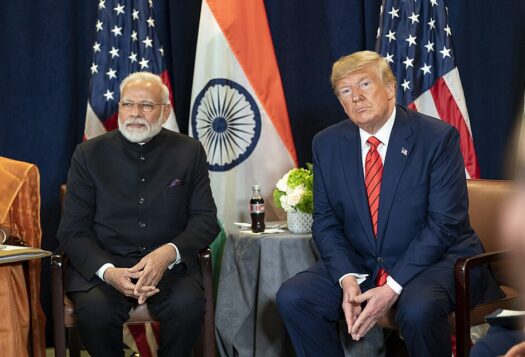
The first disputed detail is whether the United States played a decisive role in bringing about the ceasefire at all. This factor is important to delineate because there is an Indian tendency not to involve third parties in what it considers to be strictly bilateral matters. Pakistani officials and commentators have been far more willing to credit Washington, and especially Trump, for helping broker the ceasefire. The key question is whether the United States merely facilitated talks or used coercive influence to push both sides toward de-escalation. From the Indian side, External Affairs Minister S. Jaishankar put it most directly in a July 2025 interview, saying there was no linkage between trade and the ceasefire when Vice President J.D. Vance spoke to Prime Minister Narendra Modi on the night of May 9. Since then, however, President Trump has repeatedly claimed he was crucial in stopping the war between India and Pakistan, that he leveraged tariffs to do so, and that he even offered to mediate on Kashmir.
The second key point of contention relates to which party metaphorically blinked first and asked for the ceasefire. Here again, each party points fingers at the other. Kidwai framed this as a “rescue ceasefire” for India, arguing that New Delhi sought a halt because it was losing after Pakistan allegedly hit 26 Indian military sites on May 10. Indian accounts make the opposite claim, arguing that Pakistan sought a ceasefire after suffering strategic setbacks, and that U.S. involvement only helped route the matter back to the DGMO channel. In their telling, therefore, the United States played more of a facilitating role than that of a broker that imposes its own terms.
Much still remains under wraps about the exact nature of the “alarming” intelligence which resulted in the shift of the U.S. stance from Vance’s initial statement that the war was “fundamentally none of our business” to holding direct calls with Pakistan’s army chief, General Asim Munir, and with Jaishankar. Nonetheless, these calls appear to have helped create the conditions for the eventual ceasefire understanding reached through the DGMO hotline.
Overall, the lack of shared understanding about the role of outside actors creates two distinct risks. First, if public-facing narratives treat external actors as the default off-ramp, this may quietly erode the incentive to build a more indigenous crisis management toolkit. If neither side accurately represents how consequential outside intervention truly was, neither will recognize the gap in their bilateral crisis management. Second, and more immediately, the dispute has become deeply politicized in each country’s relationship with Washington: Pakistan’s embrace of Trump’s mediator narrative has drawn it closer to the administration, while India’s rejection of it has introduced friction into a relationship that had previously been on solid footing. This means that in a future crisis, U.S. involvement and traditional sources of leverage will be impacted by a more complicated political baseline, which could affect how consequential Washington can be in helping the region avoid a “bad nuclear war.”
Areas of Convergence: Role of Technology and Narrative Competition
While these narratives differ in several key areas, there are also some limited aspects in which they overlap.
The first is on the transformative role of technology. Both sides acknowledge that the conflict was fought largely in the standoff domain, with drones, precision strike systems, cruise missiles, and layered air defenses playing a critical role. This pattern included an unprecedented use of beyond-visual-range capabilities, drone swarms for intelligence gathering and air defense suppression, and the emergence of coordinated multi-domain operations. In comparison to the 2019 Balakot operation, Ambassador (Retd.) Rakesh Sood writes that India was “better placed to ensure precision targeting” through its expanded drone and precision-strike capabilities; on the Pakistani side, Air Cdre. (Retd.) Khalid Banuri described the air battle as a “masterclass execution of multi-domain elements with simultaneity across space, cyber, kinetic, and non-kinetic operations.” Together, these accounts suggest that both sides see the crisis as evidence of a shift toward no-contact or limited-contact warfare centered on precision, integration, and standoff capabilities.
In one way, this shift could make limited engagements seem less costly and more controllable, especially when platforms are integrated across domains and kill chains. At the same time, however, it may also create a false sense that escalation itself can be more effectively calibrated and managed through standoff technologies.
The second area of convergence is the importance both sides attach to narrative competition and perception management, even where their claims differ sharply. Both sides mobilized multiple channels in real time, from coordinated military press briefings and the release of satellite imagery, to a wider ecosystem of social media content and even meme warfare. While this helped provide more information as the crisis was ongoing, it also created space for the spread of fabricated content that tends to pull things apart rather than bring the crisis to an end. This dynamic made it harder to move toward a shared account of events. Pakistan’s Information Minister Attaullah Tarar has acknowledged this element at play and described the conflict as “a war of narratives” from the beginning. In a similar vein, Indian Ambassador (Retd.) Ajay Bisaria has highlighted narrative management as one of four pillars of India’s integrated deterrence posture, alongside military, diplomatic, and economic tools. Overall, there seems to be a consensus on both sides that this conflict was also fought in the information space—an effort that is still underway.
“At the heart of these competing narratives lies a deeper disagreement over what the crisis ultimately revealed about escalation under the nuclear shadow.”
Conclusion: Competing Lessons, Converging Danger
A year after Pahalgam, it is not only important to study the ground facts of May 2025, but also to understand what both sides believe happened, and what impact those beliefs may have on their choices and actions in a future crisis. While some factual clarity will emerge over time, the range of national accounts published in the year since suggests that both sides believe they won decisively, even though the goals and metrics they each use to characterize their win do not fully overlap.
At the heart of these competing narratives lies a deeper disagreement over what the crisis ultimately revealed about escalation under the nuclear shadow. Indian narratives emphasize that they not only degraded terrorist infrastructure in Pakistan but did so while carving out space for conventional war under the nuclear shadow. This perception informs the logic of what Modi later called a “new normal,” which includes decisive retaliation, no tolerance for nuclear blackmail, and no distinction between terrorists and their state sponsors. Pakistani narratives firmly counter this reading of the crisis and highlight that the space for conventional war has not widened. Instead, they argue that deterrence continues to impose meaningful limits on escalation. Kidwai provides a succinct illustration of this by pointing to Modi’s explicit order to limit strikes to terrorist targets and avoid Pakistani military installations entirely at the outset of the four-day war. As he writes, “if this self-imposed politico-military caution by India was not a deterrence against escalation, what else was it?” Hence, from Islamabad’s perspective, India’s objectives remained constrained because conventional deterrence held, Pakistan’s full-spectrum deterrence doctrine was validated, and retaliation imposed meaningful costs on India.
Regardless of how much the space for conventional retaliation has actually increased, both sides are now investing in more diverse conventional capabilities and faster response options to in line with that conclusion. This trend includes expanding their toolkit to include drones, more precision-strike systems such as the BrahMos cruise missile and Fatah-series missiles, and layered air and missile defense networks. On the command and integration side, Pakistan has created the Army Rocket Force Command to centralize its conventional missile firepower, while India is seeing renewed debates over theater commands and an Integrated Rocket Force, both of which remain works in progress.
While India and Pakistan are not becoming risk-acceptant in the same way, their public-facing narratives emphasize, to different degrees, confidence in their ability to control escalation. India appears increasingly willing to expand the space for conventional retaliation, while Pakistan is focused on restoring deterrence credibility in response. These dynamics will play out in a setting where sensors and strike systems are increasingly integrated into faster kill chains, leaving less time for deliberation. While May 2025 did not escalate further, it is less clear whether those limits would hold if tested again by more advanced technologies, shorter decision timelines, and such starkly different interpretations of how the last crisis unfolded.
Views expressed are the author’s own and do not necessarily reflect the positions of South Asian Voices, the Stimson Center, or our supporters.
Also Read: Narrating Victory, Enabling Exit: Discursive Control in the May 2025 India-Pakistan Crisis
***
Image 1: Narendra Modi via X
Image 2: Government of Pakistan via X