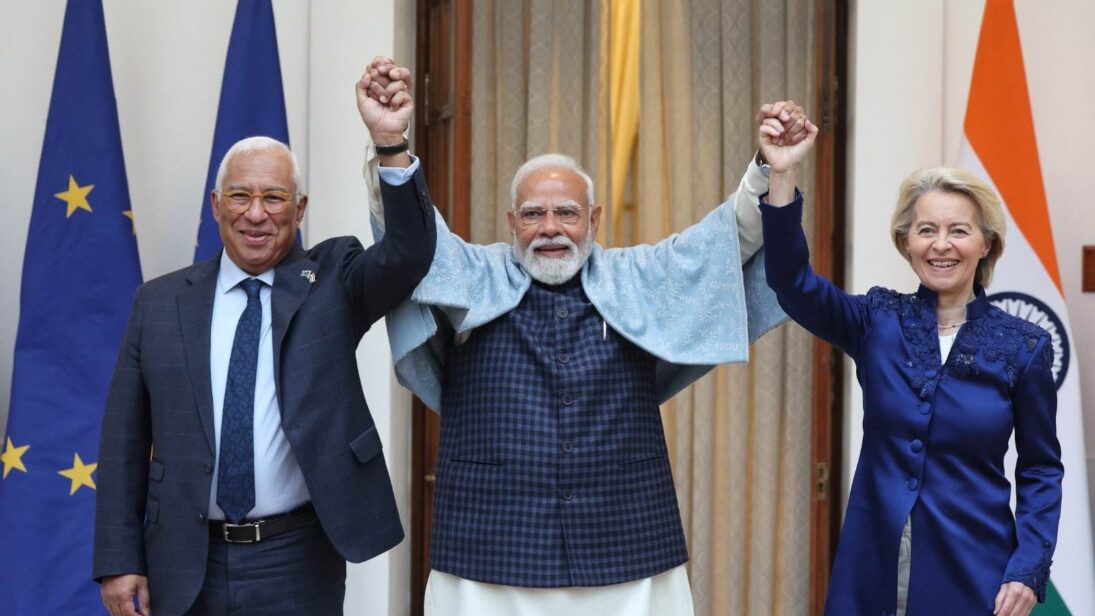
The conclusion of the India–European Union Free Trade Agreement (FTA) in January 2026 marks one of the most consequential shifts in India’s post-1991 trade strategy. After nearly two decades of negotiations, New Delhi and Brussels have forged an agreement that reflects structural changes in the global political economy. Beyond a simple trade liberalization exercise, the FTA is a strategic response to rising protectionism and value chain fragmentation, and reflects Indian ambition to shape global economic pathways.
For the European Union, India represents scale and a potential hedge against overreliance on China amid geopolitical turbulence. For India, a country of 1.48 billion people with the fourth largest economy, the agreement offers access to one of the world’s richest and most regulated markets, but tests the coherence of its development-oriented trade policy. Reciprocal tariff reductions promise to propel bilateral trade, but both sides must navigate regulatory and implementation hurdles to make the most of the agreement. Crucially, for New Delhi, a refashioned economic relationship with the EU represents a lever through which India can project regional leadership and reshape the economic geography of South Asia.
What’s in the Deal?
The India–EU FTA is ambitious in scope, envisaging tariff elimination on over 90 percent of traded goods alongside liberalization of services, investment facilitation, and regulatory cooperation. The EU will reduce or abolish tariffs on 91 percent of its goods imports by value from India, while India will reciprocate on 93 percent of its imports by value from the EU. This mutual opening establishes a foundation for increased trade volumes and deeper economic integration.
The agreement’s significance is underscored in the scale of India–EU commerce. Annual bilateral trade in goods and services had already exceeded USD $212 billion before the deal, supporting nearly 800 thousand jobs in the European Union and underpinning employment across India’s export-oriented manufacturing and services sectors, which have borne the brunt of U.S. tariffs. In 2024–25, India exported approximately USD $76 billion in goods to the EU while importing USD $60.68 billion, yielding a healthy trade surplus and making the EU one of India’s most important and diversified economic partners.
Beyond the bilateral economic logic, the impetus for the FTA can be tied to recent shifts in global trade. The U.S. turn to tariffs and the growing appreciation for industrial policy tools in advanced economies have rendered diversification a necessity rather than a choice for Indian exporters. The India–EU FTA thus provides an alternative gateway to demand-rich markets, while reducing dependence on any single trade partner and mitigating supply-chain risks.
In addition, services and mobility are core Indian interests in the agreement. As a global leader in information technology and business services exports, India has long sought greater predictability in the temporary movement of skilled professionals. Although the FTA stops short of full labor liberalization, it includes provisions facilitating short-term business travel, contractual service suppliers, and intra-corporate transferees, broadly aligned with the EU’s existing GATS Mode 4 commitments. Beyond macroeconomic gains, expanded mobility responds to a widespread aspiration among Indian students and professionals to live, work, and study abroad, making the issue domestically consequential for the Indian government.
“This balance reflects India’s evolving trade philosophy: integration without excessive exposure, and liberalization without destabilization.”
Crucially, the agreement follows a calibrated approach to sensitive domestic sectors. Agriculture, long India’s political fault line in trade negotiations, has not been fully liberalized. Dairy, cereals, poultry, and other staple commodities remain protected, reflecting concerns over farmer livelihoods and rural employment. At the same time, the FTA expands market access for processed foods, tea, coffee, spices, and horticultural products, aligning export opportunities with India’s growing processing capacity and improving compliance with non-tariff standards.
This balance reflects India’s evolving trade philosophy: integration without excessive exposure, and liberalization without destabilization. Unlike the unilateral tariff reductions of the late 1990s under World Trade Organization commitments, the India–EU FTA acknowledges domestic structural constraints while targeting sectors where India holds comparative or emerging advantages.
Outstanding Challenges
Despite its strengths, the agreement should not be romanticized. Implementation will potentially expose the Indian industry to heightened European competition in areas such as high-end automobiles, medical devices, and capital goods, where European firms retain technological and brand advantages.
As per the deal, tariffs on European automobiles, which currently exceed 100 percent in some segments, will be phased down. While European automobile manufacturers do not directly compete with mass-market Indian producers, trade impact assessments note that tariff reductions are likely to increase competitive pressure in luxury and electric vehicle segments, where EU firms are better positioned and where India is simultaneously attempting to build domestic capacity. The new agreement will test whether domestic firms can move up the value chain in the face of intensified competition.
Importantly, even with tariff cuts, regulatory compliance poses a persistent challenge. The agreement’s provisions on customs facilitation, sanitary and phytosanitary measures, technical trade barriers, and digital trade are designed to reduce non-tariff barriers that have historically constrained Indian exports to Europe. However, closer alignment with EU regulatory frameworks reflects the “Brussels effect”—the EU’s ability to externalize its regulatory standards globally through market access rather than formal coercion. For India, which places a premium on policy autonomy in areas such as digital governance and data protection, regulatory convergence entails trade-offs and risks, raising compliance costs for Indian firms, particularly MSMEs, and creating uncertainty for cross-border digital trade.
The array of similar policy gaps will undoubtedly complicate implementation. EU demands related to environmental conditionalities, intellectual property protections, and regulatory disciplines on sustainability, labor standards, and public procurement were among the most contentious negotiating points. India is cognizant that stricter intellectual property enforcement and sustainability-linked compliance requirements could adversely affect generic pharmaceutical exports and traditional knowledge-based sectors such as Ayurveda, herbal products, nutraceuticals, and handicrafts—industries that rely on fragmented production networks and cost-based competitiveness. Managing these frictions will require sustained policy engagement beyond ratification, including government-to-government consultations, phased implementation schedules, regulatory dialogues, and transition periods or carve-outs in sensitive sectors.
In Indian domestic politics, the FTA has already triggered a vociferous debate. Government leaders portray it as a transformative deal capable of doubling exports within five years, while critics warn of economic asymmetries and threats to farmers and MSMEs. Peasant organizations, in particular, fear that cheaper European imports could undermine domestic markets. These concerns underline the importance of complementary domestic measures—ranging from logistics modernization and port efficiency for industry to credit access, skills development, and compliance support for smaller firms—without which the gains from preferential access may remain unevenly distributed.
Ultimately, implementation will determine the agreement’s impact. Bottlenecks, particularly regarding the EU’s Carbon Border Adjustment Mechanism (CBAM), pose significant challenges. This measure threatens to erode the tariff gains from the FTA by imposing a 20 to 35 percent cost layer on carbon-intensive goods. Additionally, inadequate port infrastructure, customs delays, and logistical hurdles can undermine competitiveness, regardless of preferential access. Equally, Indian exporters must invest in meeting European standards on quality, traceability, and sustainability to capitalize on market access. As such, without parallel domestic reforms, the agreement’s benefits to the Indian economy may remain unrealized.
India’s Regional Leadership Opportunity
The India–EU FTA also presents an underappreciated opportunity for India to exercise regional economic leadership in South Asia. To translate the FTA into regional economic leadership, New Delhi must act quickly on three fronts: first, negotiate regional cumulation rules of origin that allow inputs from South Asian partners to qualify under the agreement; second, establish an India–South Asia compliance fund to help MSMEs meet EU technical, sanitary, digital, and sustainability standards through shared testing and certification systems; and third, create EU-linked production clusters near major ports with integrated logistics, customs facilitation, and quality-testing facilities to anchor regional supply chains in India.
Multinational firms seeking diversification from China are likely to locate parts of their Asia–Europe supply chains in India to benefit from preferential access under the FTA. If India negotiates flexible rules of origin and preferential cumulation for South Asian inputs, it can position itself as the primary gateway for regional exports to Europe.
The second proposal posits that, as India aligns its standards with EU technical, sanitary, and digital requirements, it can become a standards-provider for neighboring economies whose exports face high entry barriers into Europe. This would create incentives for South Asian producers to align with Indian norms and seek technical assistance through Indian institutions.
“By exercising regional economic leadership, India can help build the material foundations for deeper cooperation across trade, connectivity, and development—an economic fabric the region sorely lacks.”
Lastly, an India-led standards and capacity-building facility, supported by European development finance, could help regional exporters meet compliance requirements. Shared testing centers, common certification systems, and fast-track clearance for exports routed through India would reduce transaction costs. Furthermore, digital cooperation through the India–EU Trade and Technology Council could further extend common rules on data protection and cybersecurity across the region.
South Asia remains among the least economically integrated regions in the world, despite deep geographic and cultural linkages. By exercising regional economic leadership, India can help build the material foundations for deeper cooperation across trade, connectivity, and development—an economic fabric the region sorely lacks. At a moment when political and economic shocks have repeatedly destabilized the neighborhood, greater regional integration would also directly serve Indian interests, mitigating spillover risks that have often complicated its foreign policy.
Outlook
The India–EU FTA is a landmark in India’s trade diplomacy: it signals India’s readiness to engage with one of the world’s most regulated markets while testing the resilience of its domestic institutions and industrial strategy. If treated as a foundation rather than a finish line, the FTA could anchor India more deeply in global value chains while enabling it to exercise economic leadership in South Asia. Success will depend on implementation capacity, complementary domestic reforms, and the imagination to convert bilateral gains into regional public goods. Without these, the agreement risks becoming an ambitious trade pact without the domestic and regional architecture needed to fulfill its promise.
Views expressed are the authors’ own and do not necessarily reflect the positions of South Asian Voices, the Stimson Center, or our supporters.
Also Read: The EU-India Partnership: Realigned and Re-imagined?
***
Image 1: Narendra Modi via X
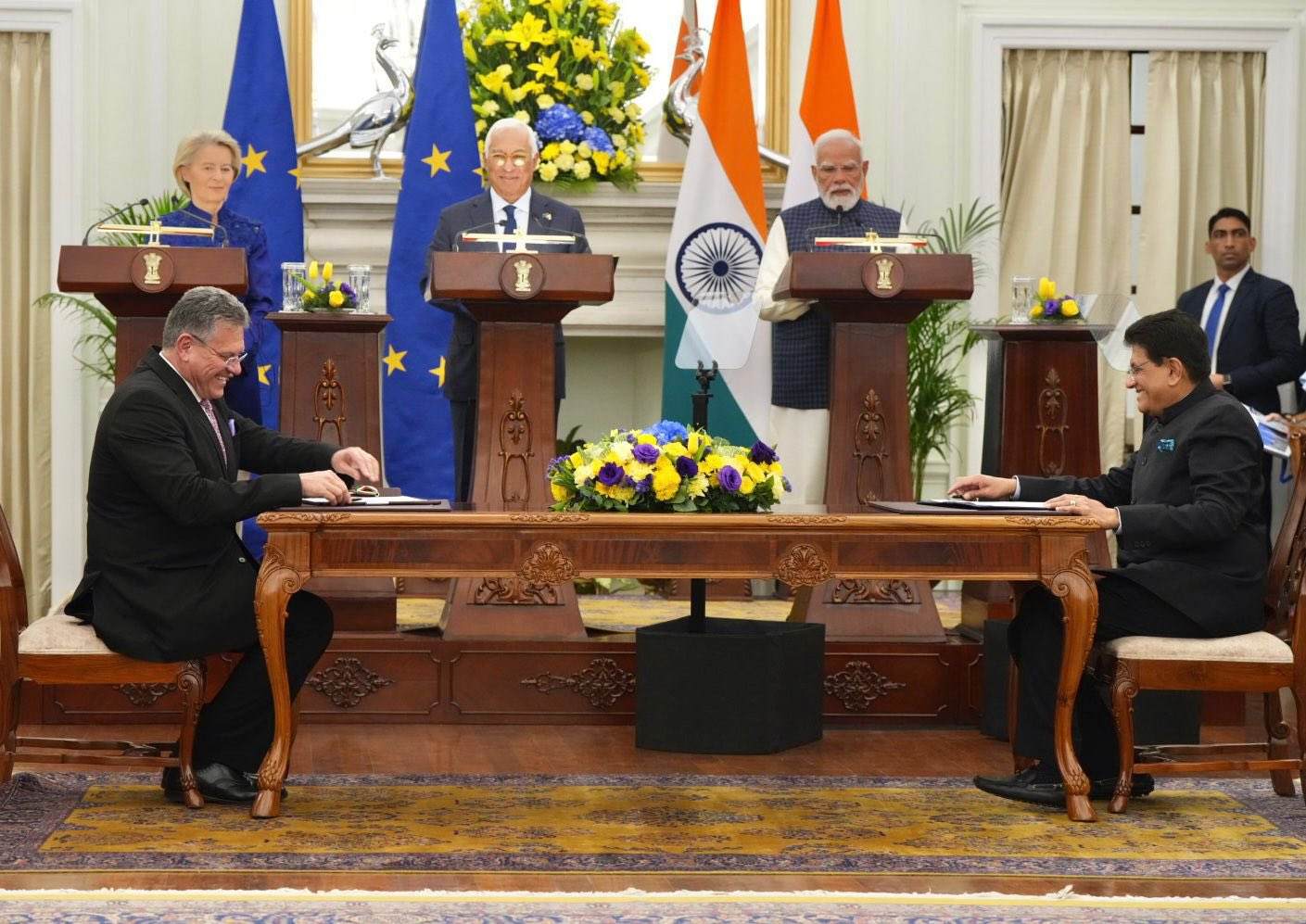
Image 2: Maroš Šefčovič via X