From the Silk Road to the Suez Canal, trade corridors have long served as geopolitical architectures that shape power, forge alignments, and produce dependencies. Over the past few years, emerging frameworks such as the India, Israel, United Arab Emirates, and United States (I2U2) grouping and the proposed India-Middle East-Europe Economic Corridor (IMEC) have been championed by Washington and New Delhi as strategic instruments to deepen India’s westward economic integration. The IMEC project seeks to actualize this strategy in physical and logistical form, while I2U2 serves as a platform for economic, technological, food, and energy cooperation between India, the United States, and key West Asian partners.
These flexible minilateral arrangements rest on a fundamental assumption of relative regional stability. In that context, the conflict in West Asia is a severe structural stress test for a new generation of ambitious connectivity projects. For New Delhi, the Iran war exposes the fragility of visions of westward connectivity that depend heavily on a secure Gulf and Levantine transit space. Simultaneously, the disruption has created a geoeconomic vacuum, allowing Beijing to project its entrenched Belt and Road Initiative (BRI) as a more reliable alternative for the Global South. Ultimately, the 2026 crisis is not merely a regional security shock, but rather, a profound test of competing connectivity architectures, narrative credibility, and the resilience of India’s broader foreign policy in an increasingly contested multipolar era.
India’s West Asia Policy Push
Over the last decade, New Delhi transitioned from traditional non-alignment toward a strategy of multi-alignment and “diplomatic de-hyphenation.” This approach theoretically allowed India to simultaneously cultivate deep, independent partnerships with countries such as Israel, the United Arab Emirates (UAE), and Iran, despite tensions and rivalry among them, without allowing those frictions to derail India’s broader policy agenda.
India’s westward strategy has been anchored in strong bilateral relationships across the region. With the UAE, the implementation of the Comprehensive Economic Partnership Agreement (CEPA) rapidly accelerated bilateral trade to USD $100 billion in FY2024-25, alongside investments by Emirati sovereign wealth funds in India. Simultaneously, India’s relationship with Israel reached unprecedented heights. During a state visit to Tel Aviv in late February 2026, Prime Minister Narendra Modi and Prime Minister Benjamin Netanyahu elevated ties by signing 16 pacts covering key areas like artificial intelligence and quantum computing and setting the stage for a free trade agreement. Economic partnerships with Qatar in LNG and with Saudi Arabia in energy, investment, and emerging logistics cooperation are also notable.
Atop these bilateral foundations, New Delhi also pursued plurilateral ambitions in the region. The I2U2 grouping sought to match Emirati capital with U.S. and Israeli technology across India’s vast agricultural and energy landscape, shifting toward geoeconomic minilateralism rather than military alliances. For India, IMEC represented the ultimate physical manifestation of this logic: a multimodal network designed to strengthen westward access to Europe through the Gulf and the Eastern Mediterranean, while avoiding the sovereignty and transit sensitivities that have long complicated India’s engagement with BRI-linked corridors involving Pakistan.
“[T]he 2026 crisis is […] a profound test of competing connectivity architectures, narrative credibility, and the resilience of India’s broader foreign policy in an increasingly contested multipolar era.”
Implications of the Ongoing Conflict
However, the rapid expansion of the 2026 war in West Asia has transformed these diplomatic triumphs into strategic liabilities. The crisis exposes severe geographic, financial, and narrative vulnerabilities that threaten the core of India’s West Asia strategy. For instance, the current crisis has laid bare IMEC’s significant physical and diplomatic chokepoints. The eastern maritime link relies on commercial shipping lanes across the Arabian Sea toward the Strait of Hormuz, where war-risk insurance costs have surged: by early March 2026, market estimates placed rates at roughly 1 to 1.5 percent of vessel value, with some tanker pricing assumptions rising as high as 3 percent, compared to around 0.25 percent before the conflict. More critically, the northern overland corridor is structurally dependent on the Israeli port of Haifa, and on the formal normalization of Saudi-Israeli relations, a diplomatic prospect Riyadh has effectively frozen indefinitely.
While I2U2 was never conceived as a physical connectivity link like IMEC, its experience nevertheless reveals how regional instability can undermine the commercial logic of geoeconomic minilateralism. From the outset, the grouping was conceived as a platform that could mobilize private-sector capital and expertise, with the UAE’s proposed USD $2 billion investment in integrated food parks in India and the planned 300-megawatt hybrid renewable energy project in Gujarat presented as its flagship ventures. Even before the current crisis, some flagship I2U2 projects were moving unevenly. The war has since made the commercial environment markedly less favorable: Disruption in Gulf shipping and air corridors, steep increases in war-risk premiums and freight costs, and broader market stress have all raised the cost of regional business and weakened investor confidence in corridor-linked ventures. In that sense, the conflict has not halted I2U2 as a diplomatic platform, but it has made the geoeconomic logic underpinning such initiatives harder to operationalize.
Beyond exposing commercial and infrastructural fragilities, the conflict has also sharpened the diplomatic and perceptual challenges surrounding India’s westward engagement. A revealing example came on March 4, 2026, when the Iranian warship IRIS Dena, returning from the Indian-hosted MILAN naval exercise, was sunk by a U.S. submarine roughly 19 nautical miles off Sri Lanka’s southern coast, extending the geographic reach of the war into India’s immediate maritime neighborhood. India’s response remained cautious and operationally focused: New Delhi continued to urge restraint and de-escalation, while also allowing the Iranian vessel IRIS Lavan to dock in Kochi on humanitarian grounds. The episode illustrated how quickly a conflict centered in the Gulf can spill into the wider Indian Ocean and complicate India’s effort to preserve strategic partnerships across competing regional alignments while maintaining its longstanding image of strategic autonomy.
Importantly, as U.S.- and India-backed frameworks come under strain, regional governments and investors are likely to take a closer look at alternative routes (Table 1). If the realization of IMEC is seen as contingent on a favorable regional security environment, other initiatives with less exposure, such as the Middle Corridor, and possible Red Sea linkages, could position themselves as more practical pathways for Eurasian trade. Certainly, China is a major beneficiary of this potential recalibration: Unlike IMEC, BRI corridors already operate in an established connectivity ecosystem with functioning assets, operational familiarity, and financial networks across several regions. The duration and scope of the conflict remain unclear at this stage, but the geoeconomic landscape is already shifting in ways that could outlive the current war.
Table 1: Westward Connectivity Initiatives
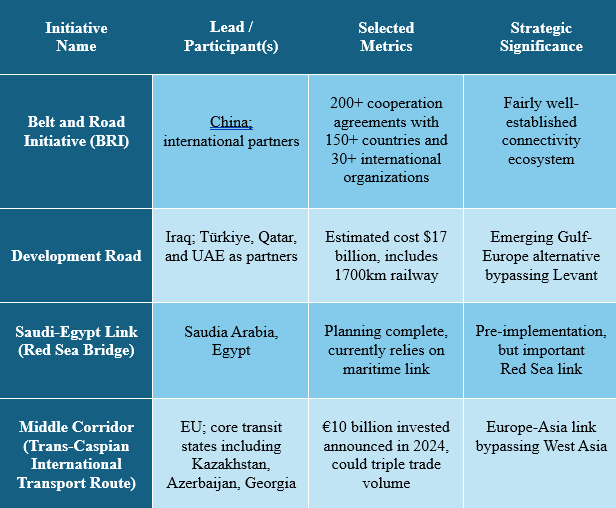
Sources: BRI; Development Road; Red Sea Link; Middle Corridor
Recasting the Logic of Connectivity
The immediate challenge for New Delhi is not to abandon its westward ambitions, but to reimagine them for a region where instability is structural, rather than episodic. The central lesson of the current crisis is that connectivity frameworks such as IMEC cannot rest on narrow assumptions of secure transit, frozen alliances, or deferred political normalization. For India, this means reducing overdependence on any single corridor and building greater geographic redundancy through alternative maritime and logistical nodes, including Oman and Egypt. For the United States, too, which has championed IMEC as a strategic counterweight to China’s Belt and Road Initiative, the crisis is a reminder that corridor diplomacy must be backed by more credible risk-sharing, sustained political investment, and a realistic appreciation of regional fault lines.
Yet the crisis has also highlighted the value of nimble diplomacy within India’s multi-alignment strategy. Even as the Strait of Hormuz became a major flashpoint, New Delhi used direct engagement with Tehran to secure passage for some India-bound vessels, including Indian-flagged LPG tankers, while continuing to coordinate with other regional stakeholders on energy security. While not a formal strategic settlement, this effort demonstrated that flexible diplomatic channels can still preserve critical connectivity even when larger corridor architectures come under severe strain.
At the same time, India and its partners must place greater emphasis on the institutional layer of connectivity, rather than focusing only on large physical assets that are vulnerable to disruption. In periods of conflict, progress on economic cooperation is more likely to come from customs harmonization, digital trade systems, regulatory alignment, and trusted commercial standards than from headline infrastructure announcements. For platforms such as I2U2, this offers a more practical near-term agenda to build interoperable economic frameworks that preserve momentum even when the region’s physical geography becomes contested. Ultimately, the credibility of India’s westward strategy will depend on whether it creates connectivity arrangements that are flexible and resilient in the face of geopolitical disorder.
Views expressed are the author’s own and do not necessarily reflect the positions of South Asian Voices, the Stimson Center, or our supporters.
Also Read: Risk and Resilience: India’s Energy Security in a Volatile Middle East
***
Image: Narendra Modi via X