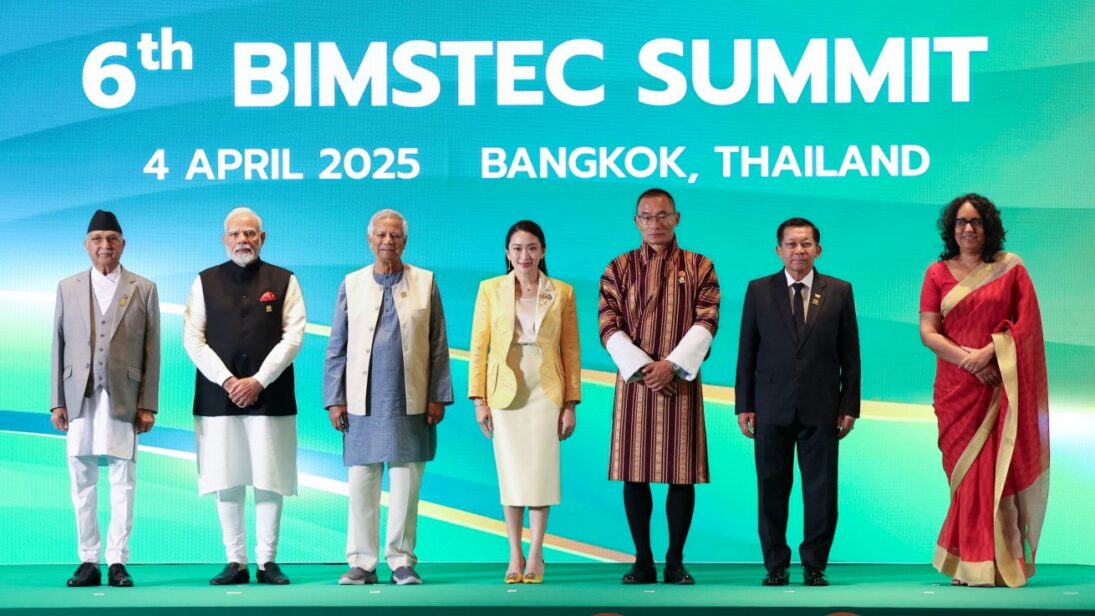
Long dismissed as “summit-driven” and superficial, the Bay of Bengal Initiative for Multi-Sectoral Technical and Economic Cooperation (BIMSTEC) is now beginning to deliver. On May 16, 2026, the BIMSTEC Secretariat confirmed that the Agreement on Maritime Transport Cooperation (AMTC), the first significant instrument to emerge from the Bangkok Vision 2030 adopted at the 6th BIMSTEC Summit in April 2025, had formally entered into force following Myanmar’s ratification three days earlier. This development—following ratifications by Bhutan, India, and Thailand—leaves Nepal, Sri Lanka, and Bangladesh, the bloc’s current Chair, as the three holdouts. The split offers a window into an important geoeconomic story in the Bay of Bengal, where India is increasingly the architect of a regional connectivity order that incorporates physical infrastructure, digital integration, payments interoperability, and institutional Centres of Excellence, while smaller members weigh the incentives of aligning commercially with New Delhi and contemplate alternatives, including deepening ties with Beijing. The first year of Bangkok Vision 2030 thus provides critical insight into how BIMSTEC and its members are positioning themselves as great-power rivalry strains the established economic architecture in the Indo-Pacific.
Bangkok 2030: A Year of Uneven Delivery
Bangkok Vision 2030—the bloc’s first long-term strategy—committed members to a “prosperous, resilient, and open” Bay of Bengal region. Twelve months on, the record is mixed. The AMTC’s entry into force is the headline achievement, providing for the first time a comprehensive framework to harmonize port operations, customs procedures, and shipping coordination across the region. India has gone furthest in operationalizing the agreement, hosting the 2nd BIMSTEC Ports Conclave in 2025 and announcing a BIMSTEC Sustainable Maritime Transport Centre at the Indian Ocean Centre of Excellence for Sustainable Maritime Transport (IOCE-SMarT) in Mumbai.
Progress elsewhere has been slower. The long-pending BIMSTEC Free Trade Agreement (FTA), under negotiation since 2004, remains stuck at the level of technical working groups on rules of origin, customs cooperation, and trade facilitation. The India-Myanmar-Thailand Trilateral Highway, the bloc’s landmark land corridor project, remains stalled on its critical Myanmar segment due to the country’s protracted civil war. India’s 21-point action plan, spanning initiatives from digital public infrastructure (DPI) to a proposed BIMSTEC Chamber of Commerce, has progressed largely through India-led institution-building rather than binding regional commitments. Finally, intra-BIMSTEC trade still hovers around a modest 6 percent of members’ total trade—marginally ahead of the roughly 5 percent recorded across South Asia more broadly, but far short of the roughly 22 percent intra-bloc share achieved by ASEAN. In absolute terms, intra-regional trade has grown from around USD $46 billion in 2019 to USD $53 billion in 2023, but the share of total trade has barely budged.
This emerging architecture, in which India underwrites the bulk of public goods and effectively sets the technical and regulatory standards governing them, sits uneasily alongside BIMSTEC’s founding commitment to equitable regional development. For smaller economies, the gains from connectivity, digital integration, and trade facilitation depend not only on access to Indian-led platforms, but on the power and space they retain to shape those platforms to local needs and capabilities. This pattern represents the most consequential dynamic from the bloc’s first year under Bangkok Vision 2030: India is building institutional architecture without sufficient political commitment from other members, risking significant challenges at the point of implementation.
“India is building institutional architecture without sufficient political commitment from other members, risking significant challenges at the point of implementation.”
An Indian-Anchored Architecture
Across nearly every functional pillar of the bloc, the center of institutional gravity now sits in India. This reality reflects an active strategic choice as much as structural weight: India accounts for roughly 75 percent of BIMSTEC’s combined GDP of around USD $5 trillion, but economic dominance alone does not explain the ambition and consistency of New Delhi’s institution-building agenda. The BIMSTEC Energy Centre operates from Bengaluru; the proposed Sustainable Maritime Transport Centre in Mumbai is set to anchor implementation of the AMTC; and India has offered to host Centres of Excellence in Disaster Management, Traditional Medicine, and Agricultural Research. Beyond physical infrastructure, New Delhi is also pursuing an ambitious digital agenda. India has proposed linking its Unified Payments Interface (UPI) with member-state payment systems, sharing its DPI stack through a pilot study, and exploring trade settlement in local currencies. These initiatives, if adopted by the bloc, would embed Indian technology and standards across the region.
From New Delhi’s perspective, BIMSTEC offers a natural platform to operationalize its Act East and Neighborhood First policies, link India’s landlocked northeastern states to the Bay of Bengal economy through projects like the Kaladan Multi-Modal Transport Project, and project influence into a sub-region where five of the seven members are immediate or near neighbors. With SAARC effectively moribund, BIMSTEC has become the most viable institutional vehicle for deeper Bay of Bengal integration — and India’s centrality within it has come with an outsized role in shaping the technical and regulatory grammar of that emerging order. This positioning is less a bid for dominance than a reflection of an asymmetry of political will within the bloc: New Delhi has been more eager than most members to invest diplomatic energy, institutional capacity, and policy resources into making BIMSTEC operational. Without this Indian push, the grouping would likely remain largely summit-driven, a common accusation across its nearly three-decade existence.
The challenge is that other members have been slow to adopt elements of this Indian architecture. Many of BIMSTEC’s flagship instruments depend on ratifications, regulatory harmonization, and political buy-in from capitals that are simultaneously balancing competing partnerships and domestic transitions.

The Ratification Fault Line
The pattern of ratification is itself instructive. The three states that have ratified alongside India include BIMSTEC’s sole Southeast Asian member, Thailand, and two economies with close economic relationships with New Delhi, namely Bhutan and Myanmar. By contrast, the three holdouts—Bangladesh, Nepal, and Sri Lanka—are the South Asian capitals with the longest history of navigating asymmetric political relationships with India. That all three are non-ratifiers reflects a structural wariness that runs deeper than any economic cost-benefit calculation.
Bangladesh’s chairmanship has unfolded across two distinct governments. The interim administration under Muhammad Yunus, which assumed the BIMSTEC chair in April 2025, reoriented Dhaka’s strategic posture toward Beijing and Islamabad, and showed little enthusiasm for India-led regional initiatives. The new Bangladesh Nationalist Party (BNP) government under Prime Minister Tarique Rahman, sworn in on February 17, 2026, has signaled its interest in resetting ties with India under a “Bangladesh first” framework that is explicitly non-aligned with major powers. How Dhaka navigates AMTC ratification alongside outstanding bilateral issues with India, including the Teesta water dispute, the Ganga Water Treaty (GWT), and border management, will be an early signal of the new government’s regional approach.
Nepal and Sri Lanka face their own balancing acts. In Kathmandu, the new government under Prime Minister Balendra Shah has only recently assumed office, and BIMSTEC-related legislation has not yet featured among its early priorities. In Colombo, the Anura Kumara Dissanayake administration has emphasized economic stabilization and bilateral maritime cooperation over bloc-wide instruments. None of these positions amounts to opposition to BIMSTEC, but they reflect a common reality: smaller members are calibrating regional commitments against domestic transitions, bilateral engagements, and the parallel pull of China’s Belt and Road Initiative, which continues to deepen its footprint across the Bay of Bengal littoral.
“The credibility of BIMSTEC as a vehicle for an Indian-anchored architecture will ultimately depend on the political quality of New Delhi’s bilateral relationships with its smaller neighbors.”
Between New Delhi and Beijing
The geoeconomic backdrop to BIMSTEC’s evolution is the steady consolidation of the Chinese economic presence in the Bay of Bengal through port investments in Sri Lanka and Myanmar, infrastructure financing in Bangladesh and Nepal, and proposed involvement in strategically sensitive projects such as Teesta River management. China is not a BIMSTEC member, but its economic pull conditions how smaller members approach Indian-led initiatives. For Bangladesh, Nepal, and Sri Lanka, the calculation is rarely binary: Each capital seeks to extract maximum economic benefit from both partners while resisting overdependence on either.
For India, this implies that its preferred regional order cannot be consolidated through institutional design alone. The credibility of BIMSTEC as a vehicle for an Indian-anchored architecture will ultimately depend on the political quality of New Delhi’s bilateral relationships with its smaller neighbors—not merely the transactional exchange of connectivity financing or visa facilitation, but whether those relationships are perceived as reciprocal rather than extractive. A Bangladesh, Nepal, or Sri Lanka that carries unresolved bilateral grievances with India has little political incentive to champion Indian-led multilateral commitments domestically, however attractive the bloc-level framework may appear on paper. Recent disruptions in the Strait of Hormuz and the resulting scrutiny of Indian Ocean maritime governance have added urgency to the case for resilient regional frameworks, but they have also reminded smaller states of the value of geographic diversification and of the leverage it affords them in negotiations with New Delhi.
With the Dhaka Summit scheduled for late 2026 or early 2027, the period ahead is more consequential than the first year of the Bangkok Vision 2030. The summit will be the first major test of whether the new Bangladesh government can convert its chairmanship into substantive deliverables, including ratification of the AMTC and meaningful movement on the FTA’s outstanding components. It will also reveal whether India can persuade fellow members to translate the bloc’s expanding institutional architecture into binding commitments rather than aspirational statements. The Bay of Bengal is unlikely to become anyone’s exclusive sphere. But BIMSTEC’s arc, from prolonged stagnation to institutional renewal and the uneven accommodation of an Indian-anchored architecture, will demonstrate how India’s geoeconomic project is being received by its neighbors, and how the smaller states of South and Southeast Asia choose to position themselves in an increasingly contested neighborhood.
Views expressed are the author’s own and do not necessarily reflect the positions of South Asian Voices, the Stimson Center, or our supporters.
Also Read: Navigating Politico-Security Hurdles to Regional Connectivity: Pathways for New Delhi
***
Image 1: Narendra Modi via X
Image 2: S. Jaishankar via X