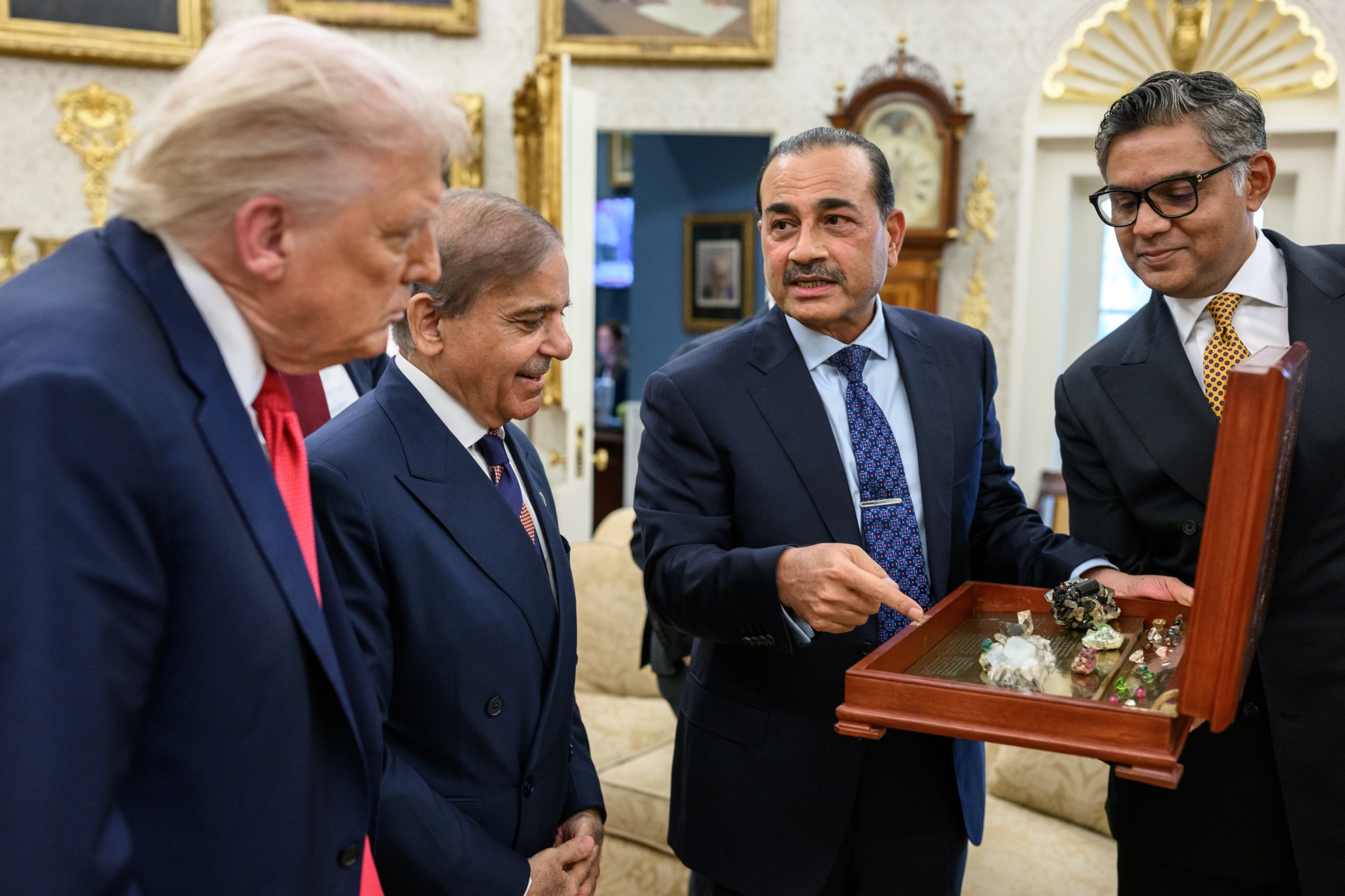
Following a period of relative diplomatic isolation under the Biden administration, Pakistan seems to be enjoying what some have called its “year of diplomatic miracles” in 2025. From floating contribution to the International Stabilization Force in Gaza to nominating U.S. President Donald Trump for the Nobel Peace Prize, Islamabad appears to be striking all the right notes with the new U.S. administration. Amid this diplomatic momentum, Pakistan has positioned itself as a potential supplier of rare earth elements and critical minerals to the United States, framing mineral wealth as the foundation of deeper bilateral ties.
From a strategic standpoint, Pakistan’s mineral play seemed well-timed. Washington seeks reduced dependence on Chinese rare earth supplies amid escalating strategic competition, and Pakistan holds significant untapped deposits of critical minerals. However, China’s brief imposition of wide-ranging export controls in October 2025 exposed a fundamental constraint on Pakistan’s strategy: the country lacks the indigenous capacity to extract and process its minerals without foreign technological assistance. While Beijing suspended these restrictions until November 2026 following a “trade truce” with Washington, the episode revealed the enduring vulnerability of Pakistan’s rare earth ambitions to technology dependencies beyond its control.
Six months prior, Pakistan’s mineral strategy looked straightforward: attract investment, extract resources, and supply the United States. In theory, this approach drew on Islamabad’s oft-stated shift to prioritize geoeconomics over geopolitics. In reality, Pakistan must now confront the political risk of future export controls to its economic agenda of rare earth extraction. Facing this challenge requires not just diplomatic positioning but strategic diversification through technology partnerships, indigenous capacity building, and realistic timelines that account for both China’s technology restrictions and Pakistan’s domestic security challenges in mineral-rich regions.
October 2025 Export Controls
On October 9, 2025, China’s Ministry of Commerce announced a significant expansion of its rare earth export control regime: Announcement No. 61 imposed extraterritorial controls on rare earth materials, while Announcement No. 62 introduced restrictions on rare earth extraction and processing technologies. Together, these measures represented the culmination of a year-long tightening of China’s rare earth export controls, following earlier restrictions on such materials announced in December 2024 and April 2025.
Announcement No. 61’s extraterritorial scope extended Chinese regulatory authority beyond its borders: the now-suspended rule required foreign entities to obtain Chinese government licenses to export (1) any permanent magnet or sputtering target containing at least 0.1 percent controlled Chinese-origin rare earths, (2) any controlled rare earth produced using Chinese technologies listed in Announcement No. 62, and (3) any controlled rare earth originally produced in China. These measures would force many foreign manufacturing and mining firms using Chinese rare earth material and technology to seek Beijing’s approval on a case-by-case basis for exports to third countries, offering China significant economic leverage.
“China’s brief imposition of wide-ranging export controls in October 2025 exposed a fundamental constraint on Pakistan’s strategy: the country lacks the indigenous capacity to extract and process its minerals without foreign technological assistance.”
Announcement No. 62 complemented these material controls by prohibiting the export of technologies related to rare earth mining, smelting and separation, and magnetic material manufacturing without permission from China’s Ministry of Commerce. The controls extend beyond equipment to include assembly, commissioning, maintenance, and upgrading of production lines, covering the entire operational ecosystem required for commercial-scale extraction. The announcement further prohibits Chinese citizens and companies from providing technical assistance to overseas rare earth operations without explicit government approval. Announcement No. 62 also includes a catch-all provision: even non-controlled goods and services require export licenses if the exporter knows they will contribute to overseas rare earth activities.
The October restrictions—though deferred for a year—hint at a harsh new world of economic security and sweeping export control regimes. In 2010, when Beijing restricted rare earth exports to Japan following a territorial dispute, Tokyo could still access Chinese processing technologies or cultivate alternative suppliers; by contrast, the October 2025 rules would prevent countries from developing the infrastructure needed to become suppliers in the first place. China’s rare earth dominance makes this constraint acute: Beijing controls approximately 70 percent of global rare earth mining and over 90 percent of global processing capacity.
Implications for Pakistan’s Rare Earth Strategy
For Pakistan, the spectre of this new, expansive export control regime looms large. Before October, Islamabad could comfortably pursue a dual-track approach to critical minerals and rare earth elements, courting U.S. investment while maintaining access to Chinese technology and expertise. If revived, the Chinese measures would concretely threaten Pakistan’s ability to exploit and export much of its mineral wealth to the United States, at least in the short- to medium-term.
Not all of Pakistan’s mineral ambitions are vulnerable to Chinese export controls. For instance, Pakistan has significant deposits of copper, gold, and chromite, including at the Chinese-run Saindak Copper-Gold Mine and the planned Reko Diq Copper-Gold Mine in Balochistan; efforts to tap these reserves should prove more resistant to any future Chinese restrictions, given that the United States and Europe still account for nearly 30 percent of global copper refining.
However, Pakistan’s plan to exploit antimony deposits discovered in Balochistan in 2025 could face challenges were China to resurrect rules governing the critical mineral used in a range of dual-use products, including semiconductors; although the United States does possess some antimony processing capabilities, China still dominates processing for high-purity antimony compounds. Similarly, the October rules could directly impact Pakistan’s hope of exporting light rare earth elements (LREEs)—especially neodymium and praseodymium, used in magnets—found in the country’s northern regions. China also controls the bulk of global processing and refining of these two elements.
In sum, transforming geological potential into commercial supply requires precisely the technologies subject to China’s postponed export control regime. Announcements 61 and 62 target the entire value chain needed to exploit these deposits, including the critical stage of separating mixed rare earths into individual elements. Under Announcement 62, transferring these technologies to Pakistani entities now requires Chinese government approval, as does any technical assistance from Chinese citizens and companies. These measures will make the development of domestic critical mineral and rare earth processing infrastructure in Pakistan extremely challenging.
China’s export controls, even if temporarily suspended, signal that Beijing views its near-monopoly on rare earth technology as strategic leverage to defend Chinese interests; China is unlikely to facilitate supply chains that could compete with those interests, challenging Islamabad’s assumption that it could position itself as an alternative supplier to Washington while receiving Chinese technological assistance. Chinese officials denied any connection between the October controls and U.S.-Pakistan mineral cooperation, yet noted pointedly that Islamabad had assured Beijing its U.S. engagements would not harm Chinese interests. This statement reveals the constraint facing Islamabad: to a certain extent, Beijing feels it can decide on its own terms which of Pakistan’s partnerships are acceptable.
Pakistan’s Technology Options under New Constraints
Given these risks, Pakistan must plan for scenarios in which Chinese technology becomes inaccessible and reckon with the feasibility and timeline of its rare earth extraction goals. Pakistan’s options exist along a spectrum, but with a central trade-off between its deep relationship with China and its ambitions to export rare earth elements to the United States. With either approach, Pakistan must also pursue technology transfer and indigenous capacity building to achieve long-term autonomy.
Prioritizing Diversification
At one end of the spectrum, Pakistan could prioritize seeking rare earth extraction and processing technology from the United States and its allies, including Japan, Australia, South Korea, and the European Union. Australia, for instance, has sought to develop rare earth processing capabilities independent of China. Similarly, Japan has actively pursued rare earth supply diversification following its 2010 dispute with China over export restrictions. Furthermore, the European Union has identified rare earth elements as critical raw materials and established funding mechanisms for supply chain partnerships. Such partnerships may offer more flexibility than direct U.S. technology transfer, which could face higher scrutiny given Washington’s concerns regarding technology security.
However, this pathway carries significant risks. First, U.S. rare earth processing capabilities remain limited compared to China’s dominance. Secondly, technology transfer to Pakistani entities might be difficult to secure and partners might prefer operating ventures using their own technology. Most challenging for Pakistan, though, is that continued U.S.-China strategic competition could jeopardize Pakistan’s access to Chinese technology. Moreover, the timeline for the commercial viability of this pathway could also extend beyond the window of U.S.-China competition that created Pakistan’s leverage in the first place.
Prioritizing Chinese Partnership
At the other end of the spectrum, Pakistan could negotiate continued access to Chinese rare earth technology through a negotiated carve-out in China’s export control regime. Such an arrangement would see Pakistani companies receiving exemptions from case-by-case licensing agreements in exchange for static restrictions. For instance, it could be negotiated that mining operations using Chinese technology would supply only the Chinese market or destinations Beijing approves, potentially foreclosing U.S. and allied markets.
This pathway offers certainty and proven technology while maintaining CPEC momentum and preserving Pakistan’s relationship with China. However, it would also likely necessitate Pakistan abandoning its aspirations of using rare earths to diversify partnerships and deepen ties with Washington. Moreover, it accepts that Pakistan’s mineral wealth will primarily serve Chinese strategic interests, with Beijing having effective veto power over Pakistan’s extraction and export activities.
“The rare earth case exemplifies a larger challenge confronting Pakistan’s ‘year of diplomatic miracles.’ Pakistan’s recent diplomatic push might have created expectations that the country does not have the technology, expertise, or capital to meet.”
Pakistan’s challenge is to calibrate where along this spectrum to position itself. Diversification maximizes strategic value and long-term autonomy but faces technological uncertainty, extended timelines, and the risk that Chinese restrictions could undermine extraction and export plans entirely. Chinese partnership provides technological certainty and operational continuity but forecloses diversification and subordinates Pakistan’s mineral strategy to Beijing’s interests. Movement in either direction involves accepting different constraints. Regardless of where Pakistan positions itself along this spectrum, it must prioritize technology transfer and indigenous capacity development to reduce structural dependence on any single power.
The Way Forward
China’s October 2025 export controls, though subsequently suspended, clarified what was previously ambiguous: Pakistan’s rare earth leverage is contingent on access to technology Pakistan does not control and which can be restricted at Beijing’s discretion. The one-year suspension offers breathing room but not security.
The rare earth case exemplifies a larger challenge confronting Pakistan’s “year of diplomatic miracles.” Pakistan’s recent diplomatic push might have created expectations that the country does not have the technology, expertise, or capital to meet. This creates a structural tension: courting the United States risks alienating China, whose cooperation Pakistan needs to fulfil the very commitments it’s making. On the other hand, deepening dependence on China risks raising concerns in the United States about Pakistan’s reliability as a potential strategic partner.
In the past, Pakistan has navigated great-power competition through strategic ambiguity and by maintaining transactional relationships with multiple partners. However, technology-driven competition creates chokepoints that force more explicit alignment compared to Pakistan’s traditional hedging strategy. Rather than overselling near-term supply capabilities Pakistan cannot currently deliver, Islamabad should pursue measured capacity building that prioritizes long-term strategic autonomy. This means comprehensive geological surveys before major commitments, transparent regulatory frameworks before foreign involvement, and pilot projects in secure areas before ventures in contested regions.
But Pakistan’s challenge extends beyond rare earths to every sector where technology, supply chains, and security intersect. If the country fails to develop indigenous capacity, and if the battle over rare earths represents the future of U.S.-China competition, Pakistan’s promising diplomatic moment could ultimately fall flat.
Views expressed are the author’s own and do not necessarily reflect the positions of South Asian Voices, the Stimson Center, or our supporters.
Also Read: Pakistan’s Potential Path to Global Relevance through Critical Minerals
***
Image 1: White House
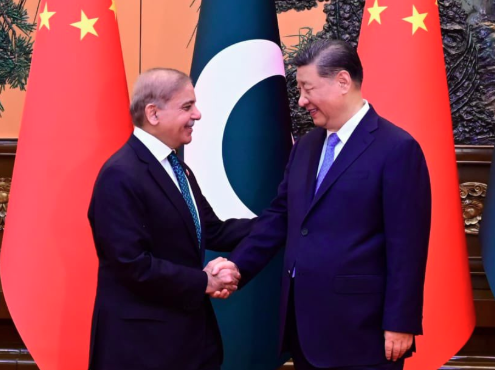
Image 2: Shehbaz Sharif via X