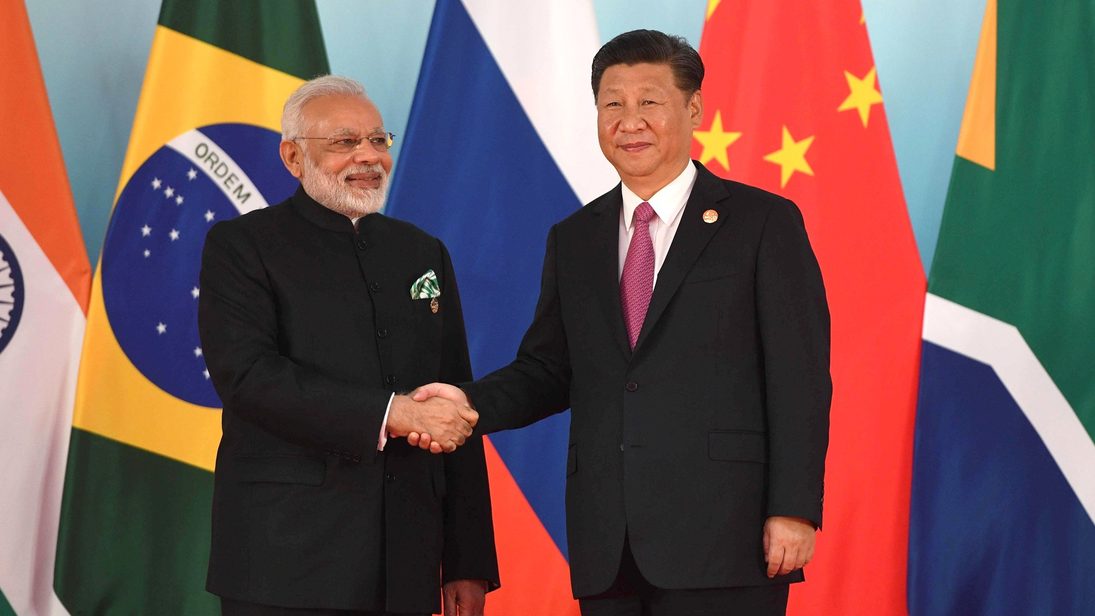
On September 12, 2026, China’s President Xi Jinping came to India for the first time in seven years to attend the BRICS summit in New Delhi. The India-China relationship has changed quite dramatically since Xi’s last visit in 2019: the deadly Galwan Valley clash of 2020 and the subsequent years-long border standoff plunged the relationship to a frosty low, marked by visa restrictions and escalating economic retaliation. As the relationship inches its way to a thaw, the meeting between President Xi and India’s Prime Minister Narendra Modi on the sidelines of the BRICS summit offers a fresh opportunity to examine the trajectory of the relationship and where it may go next. On September 16, 2026, South Asian Voices spoke with journalist and author Pallavi Aiyar to help unpack the impetus behind recent India-China engagement and contextualize how it is being shaped and received on either side of the border. Aiyar is an award-winning columnist and author based in Beijing. Previously, she was the Indonesia correspondent for The Hindu, Europe correspondent for the Business Standard, and China bureau chief for The Hindu.
How would you characterize India-China relations at this moment in time leading up to this BRICS summit? How has perception of the other side shifted in each country?
I think at this particular moment, the relationship is very calibrated, managed, and cautious. It’s certainly better than it was, say, five years ago, but probably a lot worse than 15 or 20 years ago. I lived in China between 2002 and 2009, and I think the perception of India at that time is dramatically different to what the general perception is in this moment.
At that time, there was still very much a sense of India and China in some ways being collegiate: These two large, Asian developing countries were grappling in similar yet different ways with modernity and trying to figure their way out in what could possibly be an Asian century, one that would see a certain amount of cooperation between the two countries. There used to be a lot of talk of hardware and software and India emerging as the back office of the world, while China was the workshop of the world. So, there was a sense of some kind of camaraderie. A fellow-developing country vibe.
I would say that has really disappeared. Today, there’s a much more negative perception of India in China, and it is really seen as a laggard in many ways. It’s seen as hubristic, somewhere to be put in its place, or at best, advised on what it should be doing. There are many reasons for this. I think one of the most obvious ones is just that the power differential between the two has grown so much in that interim, with GDP per capita being roughly five times more in China. So just as China has grown in its own sense of civilizational, economic strength, its sense of what its place in the world is, the feeling has grown that India tries to position itself alongside China, and is propped up unfairly, undeservedly, by the West in many ways. China sees India as having become a braggart of sorts that tries to punch above its weight.
Why, then, is China looking to engage India now, and how has this tactical reset of sorts been received in each country?
I think China sees this as a moment in which, perhaps because of what’s happening with President Trump and the kinds of pressures that he’s putting on India, it could be a moment where India can be dislodged from an anti-China camp. Beijing has very much seen things like the Quad as being a mechanism that’s working against China. And, so this, in some ways, is a moment in which it’s possible that India will finally see that its interests do not lie that way. India is also, obviously, a big market, and when it comes to the Chinese economy, they need places where their capacity can be absorbed.
The fact is, that ultimately, India is there. India and China share a boundary thousands of kilometers long. To have such a big power right there—whether it is reaching its potential or not, whether it’s going to be another China or not—the fact is that it’s a big economy and a populous country, and that it cannot be wished away. So, I think that there always has been that awareness in China, that India is a fact of life that they, at minimum, must have a managed relationship with. It does not help in any way to be in a very antagonistic posture. So, given the global situation where we don’t know what the future is going to look like, given that the old consensuses and the old order is changing, China is trying to define its own role within it. This is a good moment for China to look and reset relationships where it is possible for it to reset them.
“[G]iven that the old consensuses and the old order is changing […] this is a good moment for China to look and reset relationships where it is possible for it to reset them.”
As for how things are being received, there’s a lot more outreach about India in China. I’ve had people reaching out to me from different organizations including the party and the state-controlled media to ask about what can be done to shift opinion and to break out of this negative loop that both India and China have been in, at the perception and communication level. So, there is an attempt on the Chinese side to start reaching out to people who might have some ability to shape the conversation. I think there is genuinely a feeling that the current negative perceptions are going to hold back any kind of forward movement, whether it is on the economic front or on the border. But despite there being some kind of political will at the top, we have let the genies out of the bottle with these nationalistic troll armies on both sides that have shrunk the space for governments to have that room.
If you look at Indian media, I still very much think that China is being seen as enemy number one. The whole mood whenever China is talked about in India tends to become quite alarming. I wouldn’t say that Indian media doesn’t have government direction, but in China, it’s more obvious, and the change in direction can be seen more clearly and more quickly. And there’s definitely been a change even in the last two months once it became certain that Xi was going to be going to India, in terms of more positive stories about India in China. Even the narrative about civilizational connections and historic ties has been reignited, when it had basically disappeared.
What did this summit mean for each China and India? How significant is it that Xi Jinping chose this venue as the setting for his first visit to India since 2019, rather than making a specific state visit?
It reflects a certain amount of cautiousness—the fact that this is really a step-by-step, tactical rapprochement, rather than some dramatic, broad, deep, strategic reset. But still, the fact that we have had high-level meetings between Xi and Modi three years in a row now is nothing to sneeze at, even if this has happened in multilateral settings.
The visit was very short. Xi came in on Saturday, he left on Sunday, he skipped the dinner that Modi threw for dignitaries, and the visit was not actually announced until, I think, the day before, which led to a lot of speculation that he might not go at all. But he did go, and he took a substantial delegation with him.
And I think something to point out was that there was an unusually large contingent of Chinese journalists accompanying him on this visit as well, which is quite notable, given the fact that we haven’t had a single Chinese journalist stationed in India for years now. There’s been this tit-for-tat expelling of journalists that began around 2016, and since Galwan, essentially, there hasn’t been any Chinese journalist stationed in India at all. That coincided with a deterioration in perceptions of India, and the rise of really sort of nasty, nationalistic, xenophobic, often quite racist commentary about India in the Chinese cybersphere, social media, and the media in general.
So, what we have seen on this trip is a huge contingent of state media that accompanied Xi, pushing out more positive stories about India than we’ve seen in years, both before, during, and after the summit. So, there seems to be quite a clear directive coming from the top that this negative perception environment perhaps needs some kind of shifting, because if it does not shift, then at a government-to-government level, whatever agreements or political will there might be to start moving the relationship forward would be made difficult by public opinion. This counts for China as well; we often think that there is no such thing as public opinion in China, but there is, and I do think that there is now this attempt to start to rein in some of the more nationalistic anti-India elements on the Chinese side.
China’s FM Wang Yi said that Modi and Xi reached a consensus that “China and India should be partners,” while Modi said that “differences” between India and China “should not become disputes.” What areas do you find most promising for this ‘partnership,’ especially in light of the productive signals that Xi and Modi offered this week? How do these compare to past promises made, especially with regard to Chinese investment in India? Which will remain the most contentious?
So, in terms of what the most promising areas for partnership are: anything that is multilateral; things that affect both countries. Climate change is an obvious one. Bilaterally, I think there’s some low-hanging fruit that have been identified. Easing visas is one of them, and there’s been a lot of noise made about this in the last year. To some extent, that’s true, but it’s still not that easy. From what I’ve heard, Indians who are engineers or in any kind of technical, scientific capacity are not getting visas to visit China. So that still shows that there’s a fear that they will come, they will learn, and they will take it back. Again, this points to the deeper economic competition, which then makes all this talk of economic cooperation complicated as well.
Other low-hanging fruit are more connectivity, flights, and increased people-to-people contact. But even this is proving difficult. I was at Beijing University last week, which has a big, storied Hindi department that was first set up in the 1940s. Up until 2015, they had a named chair funded by the Indian Council for Cultural Research. Since then, it’s been empty. So, despite all this talk of people-to-people contact, something as basic as that is still not filled. But I think both governments do seem to be accepting that the relationship cannot be managed purely through strategic rivalry; that there is a certain amount of interdependence that is almost inevitable.

Nonetheless, the competitive elements of the relationship remain quite clear. What are some of the things that we can see that are promising? There are some export curbs that have been lifted. China partially began to lift restrictions on things like tunnel boring machines and fertilizers, which is very important for India. India, earlier this year, relaxed what they call Press Note 3, which are these investment screenings rules which, would, in theory, allow easier investment from China into different kinds of sectors.
I think what has been agreed upon is expanding business links and transport connectivity, to maybe start looking a little bit at the structural trade imbalances where the trade deficit is hugely in China’s favor, dealing a little bit with supply chain problems. But there have been no quantified investment commitments, no promise to actually eliminate any kind of concrete specifics on the trade deficit, and certainly no kind of big economic package. So, ultimately, a lot of the language is describing the problems, rather than coming up with solutions: There’s nothing binding and no timelines. In some ways it’s getting ready for a reset, and it’s registering intentions, rather than any kind of obligation.
But there are big questions, including even on the economic relationship. Because if India uses China to develop itself, does China then create a competitor for itself?
Many scholars and commentators point to India’s extant economic dependence on China as driving much of the “thaw” of the last few years. Some analysts see this moment as China trying to lure India into some sort of grand bargain. How is India’s economic dependence seen in China?
It’s difficult to say. I spoke to quite a few Chinese scholars who, even six months ago, were talking about how India should be looking at China’s economic assistance as a kind of no-brainer. They said that China is the only country that’s really capable of assisting India in meeting its economic developmental goals, and that preventing Chinese business and investment in India constitutes India shooting itself in the foot. They argued that China should be India’s closest partner for industrialization, that it can supply India with capital, with talent, with intermediate products, management know-how, and so on and so forth. I was told that this was similar to how developed countries in the West had supported China’s industrialization and now China can play that role for India in some ways. So, I suppose the idea would be that India imports Chinese capital goods and intermediate products, and then Indian factories become more competitive, and India’s exports would rise.
But now, of course, you have the question of whether India would then become China’s competitor. And I think we had Foreign Minister Jaishankar, who came out and said, “yes, we want to use China to take on China,” to paraphrase a bit. There was some negative pushback on this statement in the Chinese media, who said “in that case, why would China be interested in essentially creating its own greatest rival?” So, whatever we’re going to see, it’s going to be calibrated.
I’ve also spoken to people who are quite familiar with both contexts who say that in India, there is an overblown idea of how much the Chinese are going to invest even if all restrictions were lifted. There’s this idea that, if India just opens up, Chinese investment is going to come flooding in. But India is seen as a difficult place, not an easy, predictable environment. The desire of the Chinese to invest in India is not something that can be taken for granted. There’s this sense in India that the Chinese are just chomping at the bit. But again, I’m not sure that that’s the case.
“The border is such a sticking point, and it’s so intractable, that until you have some kind of movement on the border, everything else will essentially remain more rhetorical than real.”
Much has been made of the fact that the term “early harvest” appeared in India-China joint statements on border talks. Some in India see this as Beijing trying to be accommodative of New Delhi’s concerns, since China abandoned delimitation/sector map exchange talks in the mid-2000s and never returned. How meaningful and realistic is such a proposal?
From what I know, the “early harvest” language is more of a China thing than an India thing. India really wanted more of the package solution, which would resolve the border in one fell swoop. China is the one that’s been pushing this idea of “early harvest,” which asks to get at least some gains in the areas where there isn’t much contestation, like Sikkim or in the middle sector, so that there is a “win” that maybe changes the mood and allows a simultaneous second track on the economic front and on the people-to-people front. So, if you have a more positive mood about things happening on the border, the governments can start looking at other things as well. There was quite a lot of pushback on this on the Indian side, because it was felt that agreeing to an early harvest would, in some ways, abandon the package solution and be a concession to China.
To me, personally, it seems like a positive. The border is such a sticking point, and it’s so intractable, that until you have some kind of movement on the border, everything else will essentially remain more rhetorical than real. I think getting any kind of win on the border is not a bad thing, and it can start shifting perceptions and mood. So, at least, I’m on the side of the “early harvest,” and I’m glad that this was mentioned in the talks that we had in Beijing between the special representatives last month. Hopefully we can at least see something, whether it’s delineation on a map or on the ground, in the sectors that are undisputed, i.e. the “early harvest,” that can start unlocking some of the other areas. It would show that there’s something that we can come do. Otherwise, all these talks and meetings can almost be like an exercise in absurdity. India and China have a history of missed opportunities, and I feel like the more opportunities the Indians have missed, including in the early 2000s, it’s gotten harder and harder to find solutions, and by now, we’ve sort of dug ourselves into a hole.
Views expressed are the author’s own and do not necessarily reflect the positions of South Asian Voices, the Stimson Center, or our supporters.
Also read: Industrial Realism: India, China, and the Limits of Supply-Chain Decoupling
***
Image 1: Wikimedia Commons