The South Asian Association for Regional Cooperation (SAARC), originally envisioned as a platform for regional integration, has struggled to sustain momentum amid bilateral tensions among its member states and successively stalled SAARC Summits over the years. This paralysis is not due to a lack of mutually beneficial areas of cooperation. Rather, regional engagement in South Asia often remains narrowly defined by traditional security concerns, leaving little room for collaboration in those areas where interests do align.
The recent SAARC dialogue on the care economy signals a critical shift toward non-traditional issues as a currency for regional cooperation. Held earlier this year, SAARC member states committed to an Action Plan on Transforming Care Systems, the first of its kind in South Asia, aimed at increasing women’s labor force participation and advancing job creation.
While seemingly outside the conventional scope of international relations, this shift reflects a broader recognition that non-traditional challenges are increasingly central to regional stability. Significantly, it also reflects the emergence in SAARC of what can be described as gender diplomacy, which includes cooperation among countries over women’s economic empowerment, labor market participation, and support of women’s leadership in peace-building. Here, the care economy, or the “paid and unpaid labor and services that support caregiving in all its forms,” is a crucial lever for advancing gender equality.
At a time when South Asia seems as politically divided as ever, SAARC and its member states acting on the care economy positions gender equality and social policy as pragmatic, workable entry points for reviving regionalism.
At a time when South Asia seems as politically divided as ever, SAARC and its member states acting on the care economy positions gender equality and social policy as pragmatic, workable entry points for reviving regionalism.
South Asia’s Common Crisis: Women’s Participation in the Labor Market
South Asia has one of the lowest female labor force participation rates in the world: A little over 30 percent of working age women are in the workforce, compared to 77 percent of South Asian men. Crucially, this rate has remained stagnant over decades, remaining within the 30-35 percent range between 1990 and 2025, which is well below the rate observed in a majority of emerging economies. At the same time, the region faces an added challenge of job creation for its working-age population. According to recent figures, 18-20 million working-age South Asians enter the labor market each year, many of whom are women, but only a third to a half will be employed.
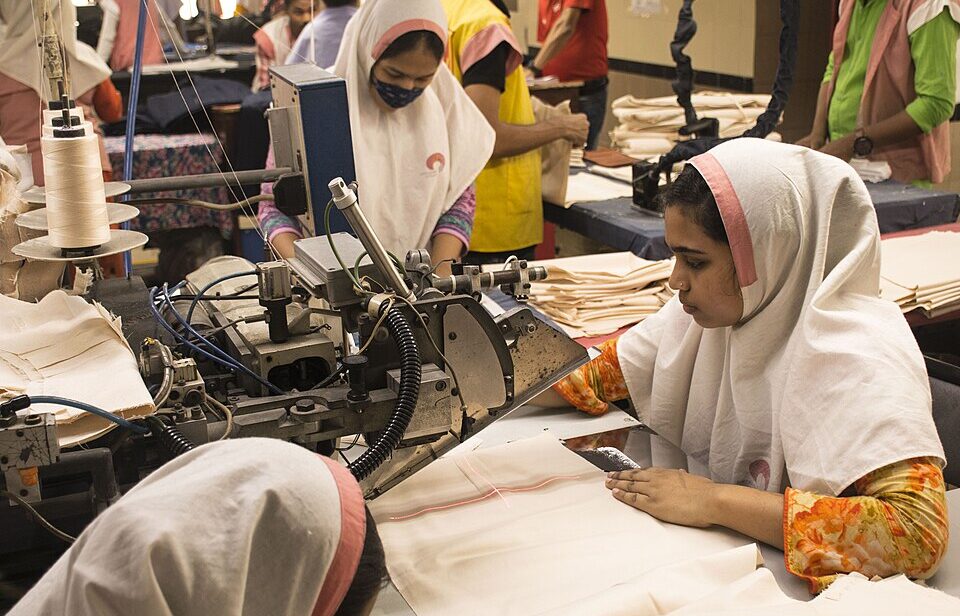
A key structural barrier to addressing this issue is unpaid care work. Across South Asia, caregiving responsibilities, such as caring for children, the elderly, and persons with disabilities, as well as domestic work, are borne overwhelmingly by women and girls. This is one of the major reasons women are unable to enter and stay in the labor market. The expansion of public facilities for care services and supporting infrastructure, like roads and piped water, can support low-income families, freeing up time for women to participate in economic and public life.
Against this backdrop, many countries in South Asia are beginning to recognize care as a lever for both job creation as well as inclusive economic growth. Public investments in care can potentially generate even more jobs than construction while advancing women’s economic opportunities. Bangladesh recently recognized the value of unpaid care to national GDP, finding in its first time-use survey that women spend 88 percent of their time on unpaid domestic and care work annually. Similarly, the New Delhi Declaration at the 2023 G20 Summit recognized the importance of investing in the care economy for women’s economic empowerment. Similarly, India and Sri Lanka have formulated national care strategies. Nepal has taken steps to build the investment case for care, estimate national and sub-national coverage gaps, and project job creation benefits, including the number of jobs that could benefit women, and has created a multi-sectoral working group to that end.
In South Asia, the expansion of care services and infrastructure is not just an issue of domestic interest. Transnational dynamics of the care economy create constraints that cannot be fully addressed without regional coordination. For instance, region-wide financing of care provision can help identify replicable models and generate economies of scale. In a similar vein, there are lessons to be learned through comparative analysis of existing large-scale social protection programs, such as the Benazir Income Support Programme in Pakistan and the Integrated Child Development Services in India, which could in turn strengthen their own care service provisioning.
The upcoming SAARC Action Plan on Care aims to meet many of these problems, holistically recognizing the need for systematic change rather than fragmented efforts to reform national care economies. The Plan emphasizes the elements of this transformation that would benefit from regional cooperation through aligning policy approaches, learning from different care and social protection models. It also advocates for developing shared standards for quality services, the working conditions for care workers, and shared behavioral change initiatives that engage men and boys. This dual approach also effectively leverages SAARC’s institutional strengths, as an intergovernmental platform that can support member states through dialogue, policy coordination, standard-setting, and increased regional alignment. Taken together, these steps help create an enabling environment for SAARC countries to collectively boost their female labor force participation.

An Incremental Path to Regionalism
Regionalism can take multiple forms, from looser coordination to deeper economic integration. Part of SAARC’s limitations have stemmed from an overemphasis on more ambitious forms of economic integration, such as the relative underutilization of the South Asian Free Trade Area (SAFTA) without first consolidating cooperation on more feasible domains. An incremental approach can offer a more realistic pathway. Cooperation tends to succeed where interests are aligned, coordination costs are low, political risks are manageable, and the benefits of acting collectively are clear. Care systems meet all of these conditions.
Focusing on the common pressing challenge of boosting women’s labor force participation offers SAARC member states a less politically sensitive arena for coordinated action. Importantly, advancing gender equality requires engagement by ministries at the technical and not the political level, thereby reducing the reliance of member states on both the SAARC Summits as well as the respective Ministries of Foreign Affairs to initiate cross-border dialogue.
It also offers opportunities for smaller or less geopolitically dominant countries within SAARC to shape the regional agenda by sharing technical expertise and driving cross-country learning on women’s economic empowerment. For instance, Nepal has recently initiated care co-operatives in to improve community-driven care systems. For more dominant countries within SAARC, initiating discussions on non-traditional issues offers an opportunity to demonstrate their leadership by adopting a more forward-looking foreign policy that recognizes the interconnected nature of ensuring inclusive economic growth for both domestic and regional stability. This can help build geopolitical goodwill.
Further, amid global shocks and volatile global trade relations, building more cohesive regional blocs can help diversify supply chain risks while providing a stronger collective front for South Asian countries to negotiate their interests as a grouping in the future.
Functional cooperation can generate trust and institutional habits and increase communication across different line ministries, creating a foundation for deeper regional integration over time.
Counting all eight South Asian countries as members, SAARC also offers a lever that BIMSTEC, with its smaller and more diffuse grouping, cannot. SAARC’s origins are strongly normative as an institution, with issues such as social development, gender equality, and poverty alleviation firmly enshrined in its grounding frameworks such as the SAARC Social Charter. Compared to BIMSTEC’s stronger focus on regional connectivity and economic growth, SAARC would be a more natural home for regionalism through gender diplomacy.
As SAARC embarks on this new focus, it can also look to other regions for useful precedents. ASEAN endorsed its first Care Declaration in 2024, similar to the SAARC Action Plan on Care. Successive ASEAN chairs have regularly convened its member states to informally monitor the status of national adaptation of this declaration, which has led to a clear emerging convergence in the discourse and practices surrounding the care economy as a lever for economic participation. Solutions shared during ASEAN meetings on the Care Declaration have also since diffused through other member states, such as increasing interest in supporting women-led care entrepreneurship in the region.
SAARC can draw clear lessons from the ASEAN experience for its own work. Functional cooperation can generate trust and institutional habits and increase communication across different line ministries, creating a foundation for deeper regional integration over time. Increased norm convergence, even in technical areas, can contribute to member states advancing progress on relevant sustainable development goals as well as the rise of a shared style of working diplomacy among SAARC countries. Indeed, “the ASEAN Way” is precisely such a form of diplomacy that emphasizes a functional form of regionalism through pragmatism and informal consensus-building “through frequent interaction,” resulting in what has been described as a “soft regionalism” or “thin institutionalization.”
Gender Diplomacy as Pragmatism in South Asia
As much as SAARC’s mandate still empowers it to convene its members to facilitate, monitor, and encourage the adoption of the Action Plan, its success, like any regional bloc which operates without delegated supranational authority or regional parliament (with notable exceptions such as the European Union), will depend on its implementation by its members. While it remains unlikely that SAARC will develop stronger delegated authority in the future, this cooperation on gender diplomacy, anchored in a practical, development-oriented sector that delivers tangible benefits and where political barriers are lower, suggests that a different form of pragmatic diplomacy, or a new ‘SAARC Way,’ is already well at work in South Asia.
Views expressed are the author’s own and do not necessarily reflect the positions of South Asian Voices, the Stimson Center, or our supporters.
Also Read: BIMSTEC and the Challenge of Asymmetric Adoption
***
Image 1: Wikimedia Commons