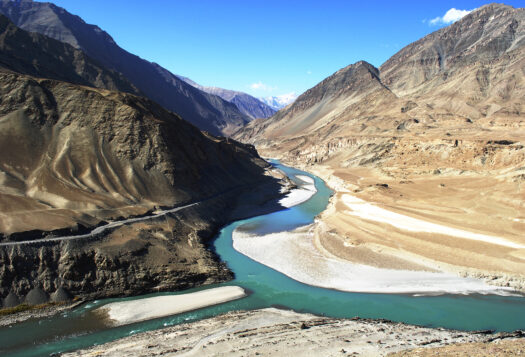
Of the 54 transboundary rivers India and Bangladesh share, only the Ganges has produced a formal water-sharing agreement, but on December 12, 2026, that agreement is due to expire. The Ganges Waters Treaty (GWT) between India and Bangladesh has governed dry-season water sharing at the Farakka Barrage in West Bengal for thirty years. Both governments have held fresh talks on renewal, but they face a harder problem than diplomacy alone can resolve: The basin’s physical conditions have shifted well beyond what the treaty was built to manage. The agreement distributed water through a ten-day schedule built on flow data from 1949 to 1988, a baseline that climate science now treats as unrepresentative of the basin’s present hydrology. How the two countries approach the expiration of the GWT will determine whether the region’s water institutions can adapt to the river they now govern.
What the 1996 Treaty Established and What It Left Out
When then-Indian Prime Minister H.D. Deve Gowda and then-Bangladeshi Prime Minister Sheikh Hasina signed it in December 1996, the GWT settled a dispute that had festered since India completed the Farakka Barrage in 1970 to divert water toward the Hooghly River for the navigability of Kolkata port. The treaty fixed a ten-day allocation formula: When flows at Farakka fall below 70,000 cusecs, both countries share equally; when flows exceed 75,000 cusecs, India receives 40,000 cusecs and Bangladesh gets the balance. For its time, this was a workable diplomatic result.
However, the treaty lacks enforcement mechanisms. The Joint Rivers Commission (JRC) facilitates data-sharing but holds no authority to adjudicate disputes. Bangladesh has raised concerns over lean-season shortfalls, but there has been no process in place for resolution.
The treaty also excludes Nepal entirely, one of the three critical Ganges riparians. Nepal contributes approximately 45 percent of the Ganges’s average annual discharge and up to 70 percent of its dry-season flow, even though major rivers like the Karnali, Gandak, and Kosi—which originate in or flow through Nepal—account for only 13 percent of the Ganges basin’s total drainage area. A framework that omits the state producing the dominant share of the flow it governs does not constitute holistic basin-wide water management.
Accelerating Glacier Loss and Monsoon Disruption
The physical changes reshaping the Ganges’s hydrology make the 1949-1988 baseline on which the GWT was negotiated increasingly unreliable. The International Centre for Integrated Mountain Development’s (ICIMOD) Hindu Kush Himalaya (HKH) Glacier Outlook 2026, based on fifty years of monitoring data from 38 glaciers, found that glacier ice loss across the region has doubled in rate since 2000, with five of the past six years recording the fastest retreat on record. Between 1990 and 2020, HKH glaciers lost approximately 12 percent of their total area and nine percent of their estimated ice reserves, with the largest absolute losses concentrated in the Indus, Ganges, and Brahmaputra basins.
Accelerating melt currently raises water volumes during warmer months, but as glaciers thin and retreat, projections indicate that dry-season base flows from January through May will decline. Monsoon patterns add further pressure. Intense precipitation events and extended dry spells now occur within the same annual cycle across the Ganges basin. For example, in August 2024, flash floods tore through 11 eastern Bangladeshi districts, killing 71 people and displacing more than 500,000. Bangladesh alleged that water releases from India’s Dumbur reservoir in Tripura worsened the flooding, while Indian authorities attributed the disaster to extreme rainfall and natural runoff. Because the JRC includes no legally binding mechanism for real-time data-sharing, neither side could produce verifiable evidence to settle the dispute.
The physical changes reshaping the Ganges’s hydrology make the 1949-1988 baseline on which the GWT was negotiated increasingly unreliable.
The Political Stakes for India and Bangladesh
For Bangladesh, water governance of the Ganges carries direct economic consequences. The country shares 54 rivers with India, and its agriculture, coastal ecology, and the Sundarbans, the world’s largest contiguous mangrove forest, all depend on adequate transboundary flows. Agriculture employs roughly 35 percent of Bangladesh’s labor force. Lean-season deficits from Farakka produce documented downstream effects, including agricultural disruption in northwest Bangladesh, salinity intrusion along the southwest coast, and loss of river navigability on routes central to rural commerce. These are economic losses that the existing treaty has not resolved, impacting tens of millions of people.
India’s stakes are shaped less by its relationship with Dhaka than by its relationship with its own states. Under India’s constitution, water is a state subject, and thus any agreement covering flows through West Bengal requires the state government’s political buy-in. This constraint has defined river negotiations with Bangladesh for over a decade. The Teesta River negotiation is a useful case study for understanding how water stress interacts with the Indian government’s federal structure. India and Bangladesh drafted a water-sharing arrangement in 2011 for the Teesta flood plain, which covers 14 percent of Bangladesh’s total cropped area, but West Bengal’s then-chief minister, Mamata Banerjee, blocked the deal, arguing that releasing water south would leave north Bengal short of drinking and irrigation supplies. However, in the spring 2026 West Bengal state elections, the Bharatiya Janata Party (BJP) defeated Bannerjee’s Trinamool Congress, placing the state and the central governments under the same party for the first time since the Ganges Waters Treaty was signed.

While Bangladeshi officials initially welcomed the change, officials in Kolkata have signaled that political alignment with New Delhi will not translate into open-ended concessions to Dhaka. The new state government is unlikely to support any arrangement seen as threatening the Syama Prasad Mookerjee Port, which BJP leaders in the state describe as central to Bengal’s economic plans, whose navigability depends on Hooghly River flows and continuous dredging.
Bangladesh’s own domestic politics have proven just as consequential for the treaty, moving through two changes of government in under two years. Bangladesh’s August 2024 political transition brought the Muhammad Yunus-led interim government to power, which demonstrated a more assertive posture on water rights. Bangladesh also approached China on the Teesta River management project at this time, pulling Beijing into a negotiating space India had long treated as strictly bilateral. Since the swearing-in of Prime Minister Tarique Rahman in February 2026, the BNP government has signaled a “Bangladesh first” framework. How it handles the GWT renewal alongside the yet-unresolved Teesta dispute will be an early test of its regional posture.
The GWT Negotiating Table
As the expiration of the GWT approaches, Bangladeshi negotiators have staked out their preferred deal points. They are pressing to restore a legally guaranteed minimum dry-season flow, along with a binding dispute-resolution mechanism and real-time data sharing that the current JRC framework does not require. India’s Ministry of External Affairs has said it prefers to handle renewal through the existing JRC rather than accept new binding commitments, arguing that population growth and irrigation demand have changed so much since 1996 that present-day flow realities at Farakka cannot be locked into a fixed formula. Indian officials and hydrologists have also raised a specific technical objection to Bangladesh’s parallel plan to build a Padma Barrage downstream of Farakka, warning that it could worsen riverbank erosion in West Bengal’s Malda and Murshidabad districts.
Bangladesh is also seeking other ways to add legal heft to its negotiating position. In June 2025, it became the first South Asian country to accede to the UN Water Convention. The Convention requires parties to apply principles of equitable use, environmental flow standards, and binding dispute resolution on transboundary waters. Bangladesh will carry these obligations directly into GWT renegotiation, strengthening its case for the institutionalized mechanisms the current treaty lacks and creating pressure on India to accept arrangements it has historically resisted.
Whether India, Bangladesh, and Nepal treat 2026 as an occasion for institutional recalibration, starting with a stronger bilateral treaty and building outward, will determine whether the Ganges basin enters a more climate-resilient era with governance adequate for how its rivers are evolving.
Complicating Factors: Nepal’s Upstream Role and China’s Construction Efforts
Nepal’s absence from the treaty framework matters because its rivers supply the majority of the Ganges’s dry-season volume. The 1996 Mahakali Treaty between India and Nepal envisioned Pancheshwar as a shared storage facility on the Karnali system. As of early 2025, the project’s Detailed Project Report remained unfinalized, with India and Nepal deadlocked over water-use accounting and cost-sharing formulas. That yet another water management treaty has failed to produce operational storage infrastructure decades later shows how far written commitments in this basin have to go to translate into working governance.
Nepal’s own political transition further complicates the picture. The March 2026 election, following the 2025 Gen-Z protests, brought the Rastriya Swatantra Party to power. The new government has signaled interest in reviving the Pancheshwar project, though its inexperience in water diplomacy raises questions about the prospects of it breaking through a three-decade deadlock. Nonetheless, this moment could give India an opportunity to bring Nepal into Ganges basin.
China’s construction of the Motuo hydropower project adds another variable that the bilateral India-Bangladesh framework cannot address. This project on the Yarlung Tsangpo, the upper course of the Brahmaputra, would be the world’s largest hydroelectric facility. China has no binding water-sharing agreement with any downstream neighbor on the Brahmaputra, and the absence of enforceable data-sharing obligations leaves downstream states managing water without reliable information about upstream conditions. The Brahmaputra also joins the Ganges-Meghna system in the Bengal delta, meaning that any Ganges successor arrangement that ignores upstream Tibetan Plateau activity governs only part of the system it claims to address.
What Should Come Next
India and Bangladesh should make use of this time before the December 2026 deadline to renew the GWT by adopting a rolling hydrological baseline rather than a fixed one, including an enforceable minimum flow during the dry season, and a binding clause for resolving disputes that empowers the JRC. The fact that Bangladesh has acceded to the Water Convention gives Dhaka the legal means to demand precisely this outcome, and the newly aligned governments in New Delhi and Kolkata have eliminated the domestic obstacle that previously blocked the Teesta agreement in 2011. However, West Bengal’s concern for Hooghly navigability means that India will likely prioritize the Teesta negotiation before adjusting the Ganges allocation formula.
India and Bangladesh could also account for the role of China in the region’s hydrology by including a review clause in the new treaty that would come into effect upon verified changes in the flow of the upstream Brahmaputra. This would help account for any shocks resulting from the Yarlung Tsangpo hydropower project without having to wait for another treaty renewal period.
While it may not be realistic to fold Nepal into a comprehensive trilateral Ganges treaty within the current negotiating period, a more feasible approach would be to put in place a standing arrangement for the exchange of data between the JRC and the Mahakali River Commission. In addition, restarting the Pancheshwar project under Nepal’s new government, with a cost-sharing formula, could help secure long-term flows during the dry season more than than any provision included in the Ganges treaty itself.
The institutions put in place in 1996 meet conditions fundamentally different from those that produced them. Whether India, Bangladesh, and Nepal treat 2026 as an occasion for institutional recalibration, starting with a stronger bilateral treaty and building outward, will determine whether the Ganges basin enters a more climate-resilient era with governance adequate for how its rivers are evolving.
Views expressed are the author’s own and do not necessarily reflect the positions of South Asian Voices, the Stimson Center, or our supporters.
Also Read: Water as a Multilateral Issue? The Case of Bangladesh and Implications for Indian Diplomacy
***
Image 1: European Space Agency via Wikimedia
Image 2: Indian Prime Minister’s Office via Wikimedia