After over a month of conflict, the U.S.-Israel-Iran war entered a two-week pause on April 8. Across this period, India has been significantly impacted given its reliance on Gulf Arab states for its crude, natural gas and fertilizer needs. The economic, strategic, and diasporic connections between India and the Gulf are significant: The Gulf Cooperation Council (GCC) is India’s largest trading partner; all Gulf Arab states—except Bahrain—have comprehensive strategic partnerships with New Delhi; and Indians form the largest diaspora group in the region.
These stakes have meant that India has had to simultaneously prioritize Gulf Arab states, rely on its historic experience of bilateral engagement with Tehran, and navigate increasing domestic concern about U.S. actions. This article assesses the drivers and impacts of New Delhi’s management of this precarious balancing act thus far with the Gulf Arab states, Iran, and the United States, and examines the lasting impacts it could have on its geopolitical relationships in and across the region, especially regarding its own energy security.
Before the War: India’s Gulf Arab Focus
Prior to February 28, India’s approach to the Middle East was focused on picking up the threads of grand cross-regional cooperation which had frayed since October 2023. Before that month, India was leveraging the region’s unprecedented stability on the back of Saudi rapprochement with Iran, the entrenchment of the Abraham Accords, and seemingly imminent Saudi normalization with Israel. By September 2023, the I2U2 framework had already laid the seeds for an even grander vision, the India Middle East Europe Economic Corridor (IMEC).
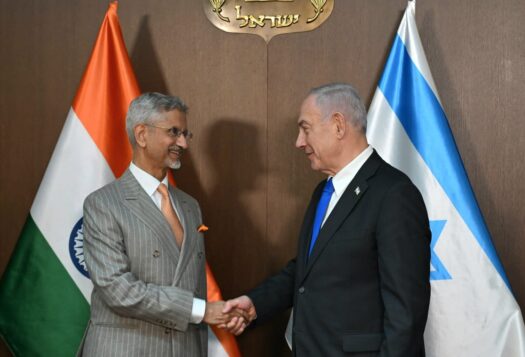
While the impact of the Israel-Gaza conflict put these lofty hopes on pause, India arguably found a reopening in early 2026 when President Donald Trump’s comprehensive peace plan for Gaza garnered Gulf Arab and Israeli support and UN Security Council sanction. This window also allowed India to back—if not join—Trump’s Board of Peace. New Delhi evidently believed that it was also enough to enable a Prime Ministerial visit to Israel on February 25. While the visit was rich in optics, it continued to reflect the traditional risk aversion built into Indian foreign policy, with Prime Minister Modi avoiding any reference to Israeli Prime Minister Netanyahu’s proposed “Hexagonal Alliance,” which would link Israel with Arab, African, Mediterranean, and Asian countries, with India at its center.
“India has had to simultaneously prioritize Gulf Arab states, rely on its historic experience of bilateral engagement with Tehran, and navigate increasing domestic concern about U.S. actions.”
More largely, India spent the period from 2023 to 2026 focusing on entrenching bilateral partnerships while waiting for the region to stabilize. To that end, its navigation of an unprecedented public spat between Abu Dhabi and Riyadh at the end of 2025 is especially illustrative, given the perception that India is closer to Israel and the Emirates, which is among the states Modi has most often visited, over Saudi Arabia. Accordingly, when Emirati President Mohammed bin Zayed undertook an unprecedented three-hour visit to New Delhi in January 2026, India avoided any significant defense commitments to the UAE. However, it catered considerably to Abu Dhabi’s need for positive optics during a sensitive regional predicament, and took the opportunity to ink long-awaited agreements across sectors including nuclear energy, agriculture, and infrastructure, as well as confirming Emirati financing for projects such as the Dholera Special Investment Region in Gujarat.
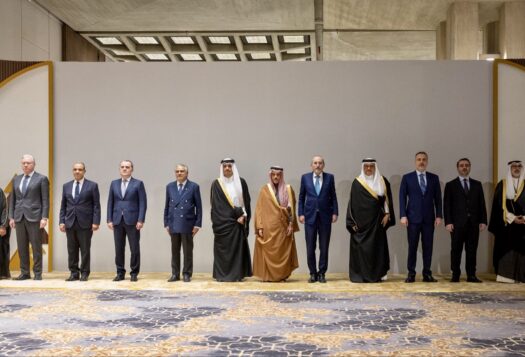
This background helps explain why India has largely looked to align with the interests of the Gulf Arab states since the war began on February 28. Indeed, New Delhi backed a GCC-led resolution condemning Iran’s attacks on Gulf countries—without condemning U.S. and Israeli attacks on Iran, and in April, External Affairs Minister Jaishankar visited the UAE on his first trip since the outbreak of war.
During the War: Engagement with Iran
As much as it has leaned toward the Gulf Arab states, India, like many others, has also had to reckon with Iran’s resilience and chokehold on the Strait of Hormuz. This has necessitated a continuation of India’s issue-based engagement with Iran, which itself is a product of decades of U.S. pressure on the bilateral relationship.
After all, Iran has not historically been viewed as an adversary in India: Tehran has been a partner to New Delhi in Afghanistan, and its occasionally troubled relationship with Pakistan has contributed to the logic of deeper India-Iran ties. For example, India invested in the Shahid Beheshti port at Chabahar for strategic dividends. Iran has also been a historically significant oil supplier to India, with Tehran consistently featuring in India’s top five suppliers during the 2000s and early 2010s. Yet India’s efforts to secure continuing sanctions waivers from Washington struggled during the first Trump administration, with Indian imports of Iranian oil ceasing completely by 2019. Now, New Delhi’s waiver to operate the Shahid Beheshti port in Chabahar is also set to expire in 2026. Despite these hurdles, India’s diplomatic engagement with Iran has continued at senior diplomatic and political levels.
As such, India has sought to translate its experience of sustained engagement with Iran into bilateral arrangements to allow India-bound oil and gas tankers to transit the Strait. To that end, Iranian Foreign Minister Abbas Araghchi has thus far spoken with his Indian counterpart more than with any other; there has also been recent communication between the Indian Prime Minister and the Iranian President. Such crisis-based India-Iran engagement is not novel: In January 2024, India relied on Iran’s good offices to raise concerns regarding the Houthi blockade of the Bab-el-Mandeb strait. India has also catered to Iranian sensitivities, expressing “profound grief” at the U.S. strike on the girls’ school in Minab and condoling the assassination of Iranian Supreme Leader Ali Khamenei, collectively helping to build goodwill with Tehran as much as it also diluted growing domestic criticism of New Delhi’s earlier silence.
These engagements, and Tehran’s own need to protect ties with non-Western states, resulted in Araghchi announcing on March 25 that the Strait was open to friendly countries, including India. Consequently, at least six India-bound tankers have transited the Strait thus far, with the Indian Navy escorting them thereafter. There is also a renewed domestic focus on India’s shared civilizational history with Iran, spawning support for Tehran even from conservative political constituencies. As such, ties with Israel and the United States are encouraged due to strategic needs, but without damaging India’s ties with civilizational partners such as Iran.

Domestic Reaction and U.S.-India Headwinds
That the government has been holding daily multi-ministerial public briefings since March 23—a first for the Modi government during a foreign conflict—is clear evidence of the seriousness of the war’s impact on Indian households. On March 10, India invoked the Essential Commodities Act for the energy sector for the first time in decades to respond to supply disruptions, rationing and redirecting fuel supplies and prioritizing household consumption. These economic pressures have exacerbated criticism within India’s strategic community of the war and U.S. actions therein.
Materially, of course, the India-U.S. relationship remains robust since the United States is still the world’s foremost technological and military power; when combined with U.S.-China competition, this produces a natural buffer for the bilateral partnership. India has usually reconciled the depth of this relationship with the broader lack of geopolitical alignment through a “non-West, not anti-West” logic. However, the current war has increased calls for greater Indian autonomy, especially vis-à-vis Washington.
The sinking of the Iranian warship IRIS Dena in particular—occurring as it did just off the coast of Sri Lanka in India’s perceived maritime sphere of influence, days after it had participated in India’s Exercise MILAN—generated perceptions in India of Washington disregarding the sensitivities of a strategic partner, reinforcing an increasing lack of trust in bilateral ties. These feelings exacerbate existing pressures on the relationship due to the second Trump administration’s tariffs, immigration policies, and the President’s oft-repeated claim of having mediated a ceasefire between India and Pakistan in May 2025, a view New Delhi has never accepted.
Such pressures also meant that India has felt less concerned than it might have otherwise about Washington’s sensitivities, as it became the only state to formally offer sanctuary to three Iranian warships after the United States and Israel began hostilities against Iran. On March 4, a second Iranian warship, the IRIS Lavan, accepted Indian sanctuary and docked in Kochi on the same day. Notably, India allowed the Lavan’s crew to later return home via an Iranian charter flight, demonstrating significant autonomy in its decision-making despite Washington’s insistence against repatriation. In contrast, Sri Lanka—which extended sanctuary to another Iranian warship, the IRIS Bushehr—has thus far kept the crew in port. External Affairs Minister Jaishankar characterized India’s decision as “the right thing to do,” for which Tehran also expressed its gratitude. This decision tracks with the reality of India’s traditional geopolitical non-alignment with Washington, despite their deep strategic ties. Importantly, even as the material guardrails for the India-U.S. relationship remain strong, Washington’s war on Iran has adversely affected the potential for long term strategic trust.
“[D]espite their formal condemnation of Tehran, the Gulf Arab states’ own future strategic positions are likely to be more nuanced than an uncompromising anti-Iranian orientation.”
Looking Ahead
As the war rages on, India’s broader approach is likely to track closely with its Gulf Arab partners, but without disengaging Tehran. In fact, despite their formal condemnation of Tehran, the Gulf Arab states’ own future strategic positions are likely to be more nuanced than an uncompromising anti-Iranian orientation. Three key variables influence these countries’ policy options: the ability of both Iran and Israel to violently disrupt their economies, the failure of U.S. security guarantees and U.S. bases instead inviting Iranian attacks, and limited Gulf Arab ability to influence Washington’s decision-making. For India, already facing challenges as the 2026 Chair of BRICS (with Saudi Arabia, the UAE, and Iran as full members since 2023), the Gulf approach to these variables will likely drive India’s own reactive policy.
Crucially, this war will also affect how India views future U.S. sanctions on both Russian and Iranian oil, given that India is now purchasing both due to a temporary waiver granted by Washington. If the war continues stresses on India’s economy and energy security increase, existing domestic perceptions that New Delhi is conceding to arbitrary U.S.-led constraints on energy imports will only grow.
This dynamic is supplemented by Iran’s proven control over the Strait of Hormuz, which will require greater Indian attention to Iran’s sensitivities. As a consequence, there will likely be greater pressure on India to insulate its Iran policy from U.S. influence, such as through greater investment in the Chabahar port and increased focus on the International North-South Transport Corridor. But even as the world hangs on tenterhooks waiting for ceasefire discussions to get underway, it is clear that India may have no choice but to continue its many-sided balancing act in order to strengthen its relationships with some of its closest partners, secure its domestic energy security, and burnish its reputation in the region.
Views expressed are the author’s own and do not necessarily reflect the positions of South Asian Voices, the Stimson Center, or our supporters.
Also Read: Walking the Tightrope: India in the U.S.-Israel-Iran Fire
***
Image 1: Randhir Jaiswal via X
Image 2: Randhir Jaiswal via X