As tensions between the United States and Iran approach the breaking point, the world is looking to Pakistan, alongside Qatar and Oman, in search of solutions. U.S. President Donald Trump has agreed to pause U.S. strikes, offering a fragile window for diplomacy, and said that the negotiations with Iran were ongoing.
Yet neither Washington nor Tehran has shown any sign of conceding on their core positions. The Islamabad Memorandum, concluded with Pakistani and Qatari mediation to halt the war, now faces its most serious test yet as the mediators redouble their efforts to prevent further escalation. Superficially, the Memorandum’s current strain might suggest that Pakistan’s leverage is limited. In practice, however, neither Washington nor Tehran is interested in an endless war, and Pakistan can still help bring both parties back together, driven as much by diplomatic ambition as by vital national and regional interests.
The Islamabad Process Continues
Trump’s Iran war has not turned out as he likely expected: The Iranian government is still in place, more emboldened, united and hardline than ever. Tehran has expanded the range of its regional attacks, recently targeting a U.S. base in Jordan and inflicting American casualties. Meanwhile, U.S. stockpiles missiles interceptors are being depleted; indeed, according to Reuters, the U.S. has used “virtually all of its long range precision missiles” in the war with Iran. Further strikes, short of a politically highly perilous ground invasion, are unlikely to change dynamics in Washington’s favor.
Cutting its losses and running, however, is also not an option for the U.S. Iran’s renewed blockade of the Strait of Hormuz, coupled with the Yemeni Houthis’ blockade of Bab el-Mandeb, would have devastating effects on the global economy and the stability of energy supplies. These pressures would be all the more acute for the Trump administration ahead of midterm congressional elections in the fall. On the other hand, Iran urgently needs economic relief, having suffered heavily during its last war with the U.S. and Israel. That can only come through lifting sanctions and improved regional economic integration.
Pakistan’s leverage stems from both sides’ reluctance to engage in all-out war and from the fact that both sides have treated it as a credible mediator, but its role is not merely reactive.
Accordingly, Pakistan and Qatar pitched a joint proposal to Washington and Tehran in July that includes the reopening of the Strait of Hormuz, the lifting of sanctions on Iranian oil sales, and a ten-day ceasefire designed to create conditions for both sides to return to the original Memorandum of Understanding. Iranian Interior Minister Eskandar Momeni visited Islamabad the day after the proposal was announced to discuss the prospects of a ceasefire and ways to halt further escalation. Significantly, Momeni’s counterpart on the Pakistani side, Interior Minister Mohsin Naqvi, rather than Foreign Minister Ishaq Dar, has emerged as the key interlocutor on the Iranian file. Naqvi enjoys a close relationship with Pakistan’s Chief of Army Staff, Field Marshal Asim Munir, who spearheaded the mediation from the outset.
Meanwhile, as Trump claims negotiations with Iran are ongoing, Pakistan’s foreign minister Ishaq Dar invited his Iranian counterpart Abbas Araghchi to visit Islamabad to discuss the prospects of peace, in a sign of Pakistan’s continued commitment to the Islamabad process.
Pakistan’s leverage stems from both sides’ reluctance to engage in all-out war and from the fact that both sides have treated it as a credible mediator, but its role is not merely reactive.
Pakistan’s Mediation Efforts
Islamabad maintains deep military-to-military ties with Washington, a strategic defense partnership with Riyadh, and a border and historical relationship with Tehran that no other state can parallel, notably housing an Iran interests’ section in its embassy in Washington since 1981. Perhaps most significantly, Pakistan’s relationship with Beijing gives it access to a key lever over Iran: China has substantial economic and political influence in Tehran and has consistently urged restraint. This network of relationships is why both sides have engaged with Pakistan from the outset, and why they continue to do so even as the Memorandum strains.
Pakistan’s mediation doctrine is also shaped by deeper historical currents. In the early 1970s, Islamabad facilitated a backchannel for the Richard Nixon administration to open up to China, in one of the 20th century’s most impactful geopolitical pivots. It is largely forgotten that Pakistan attempted to mediate between Iran and Iraq in their devastating war in the 1980s. Even though that mediation was ultimately unsuccessful, it points to a long-standing Pakistani policy of seeking to bridge rather than exploit sectarian and political divides.
Domestic and Regional Pressures
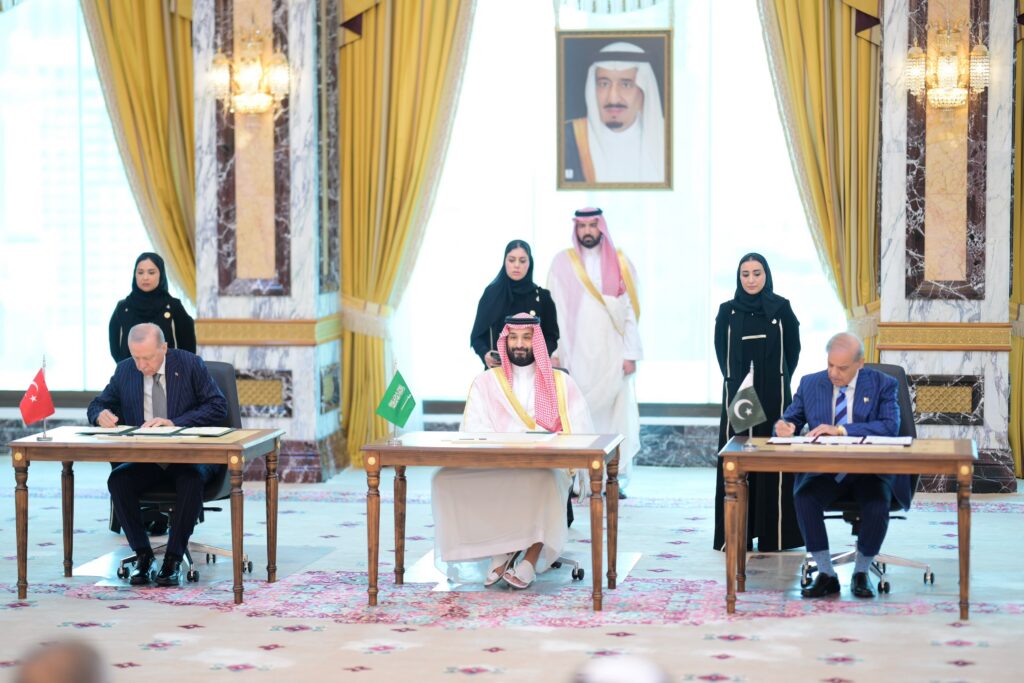
While Pakistan is offering diplomatic off-ramps to both Washington and Tehran, it has concerns of its own related to the war. Islamabad’s main worry is that the expanding regional conflict might draw in Saudi Arabia—if, for example, the Kingdom is attacked by the Houthis and/or Iran, or if it gets involved in military operations against either, or both. That would test the defense arrangement between Saudi Arabia and Pakistan, which holds that aggression against one country will be treated as an act against both. In August 2026, this bilateral pact was complemented by a trilateral agreement between Saudi Arabia, Pakistan and Turkey which stipulates, NATO-style, that “any armed attack against any one of three States shall be regarded as an attack against them all.”
From Pakistan’s perspective, the Yemeni Houthis’ attacks on Saudi Arabia and growing threat to shipping in the Bab al-Mandeb Strait create a deeply troubling scenario. Islamabad is increasingly concerned that, absent the U.S. and Iran’s return to the Islamabad Memorandum, Saudi Arabia could soon face a coordinated Iranian-Houthi campaign, potentially including intensified attacks on Saudi territory. Such a development would create difficult strategic choices for Pakistan, which has already deployed jets and troops in the Kingdom, including on the Saudi-Yemen border, that some Pakistani analysts believe could join the fight “if asked.”
There is, however, little doubt Pakistan would prefer to avoid such a course of action. If such a conflict devolves into a war against both Houthis and Iran, it could risk endangering Pakistan’s internal stability. Approximately one-fifth of Pakistan’s population is Shi’a, many of whom viewed Iran’s Supreme Leader Ayatollah Ali Khamenei as their supreme religious authority. This was reflected in the protests outside the U.S. Consulate in Karachi following Khamenei’s assassination in the opening days of the U.S.-Israeli war on Iran. In Islamabad’s calculus, domestic sectarian cohesion is central to the state’s ability to navigate this crisis.
Another pressing challenge is the situation in Pakistan’s Balochistan province, where terrorist activity by the Balochistan Liberation Army (BLA), which seeks Balochistan’s secession from Pakistan, has increased significantly. Islamabad views with alarm the discourse emanating from some Washington-based think tanks, including the neoconservative Foundation for Defense of Democracies, which have long advocated for leveraging Iran’s ethnic fractures as a tool for the country’s disintegration. That such arguments may circulate in influential U.S. policy circles feeds fears in Pakistan that regional instability could spill over across the border. As Pakistan wrestles with the BLA threat and that of the Tehreek-e Taliban Pakistan, the last thing it needs is to become involved in an armed conflict outside its borders.
The BLA, for its part, has welcomed the U.S.-Israeli strikes on Iran, seeing in them an opportunity to expand its own activities against both Pakistan and Iran. Significantly, the Iranian delegation that visited Pakistan in July included the governor of Iran’s Sistan and Balochistan province, Mansour Bijar, who engaged with Chief Minister Sarfraz Bugti of Pakistani Balochistan. This highlights Tehran and Islamabad’s shared concern about the destabilizing potential of separatist terrorism in the context of a broader turmoil.
Resilience is not the same as invulnerability, and the cascading effects of a regional war would test Pakistan at a time when it needs stability and development the most.
India is another complicating factor. Following the May 2025 war, there is a ceasefire in place, but there is no peace. Pakistan has publicly asserted that India aids the BLA in order to undermine Pakistan’s stability and economic prospects in a region rich with rare minerals and substantial Chinese interests, a charge New Delhi denies. In Pakistan’s view, New Delhi’s recent cozying up to Israel, which Islamabad views as based in part on the ruling Hindutva ideology, fosters a perception of India’s increasingly ideological and therefore unpredictable foreign policy, as one high-level Pakistani official recently characterized it to the author on the condition of anonymity.
None of this is to suggest that Pakistan is on the verge of collapse if the Islamabad Memorandum crumbles conclusively. The state has weathered similar challenges before—including the 1980s Soviet-Afghan war, the post-9/11 turmoil, and repeated cycles of militancy. Its institutions, particularly the army and security apparatus, have proven resilient. But resilience is not the same as invulnerability, and the cascading effects of a regional war would test Pakistan at a time when it needs stability and development the most.
For Pakistan’s civilian-military leadership, preventing a regional war is an existential priority—not only to avoid a security vacuum on its western flank, but also to sustain its delicate balancing act between Riyadh and Tehran. While the Islamabad Memorandum remains under severe strain, Pakistan’s mediation efforts, alongside Qatar and Oman, are likely to persist. The world continues to look to Pakistan not because it seeks a savior, but because no other mediator offers the same combination of relationships, credibility, and stakes in the outcome.
Views expressed are the author’s own and do not necessarily reflect the positions of South Asian Voices, the Stimson Center, or our supporters.
Also Read: Why Pakistan Should Not Be Blamed When Peace Falters
***
Image 1: Wikimedia Commons
Image 2: Pakistani Prime Minister’s Office on X