




Editor’s Note: This article is part of South Asian Voices’ annual Year in Review series. Browse the full series page here.
The political unrest and protracted uncertainty of 2025 marks yet another milestone along the wending path of democracy within Nepal’s recent history: King Mahendra’s 1960 coup that ended the country’s first democratically elected government, the 1980 unrest that forced King Birendra to announce a referendum on the monarchy, the 1990 People’s Movement that downgraded the absolute monarchy into a constitutional role, the abolition of the monarchy by an elected assembly in 2008, and the new federal republican constitution in 2015.
In 2025, just ten years after the adoption of that constitution, a youth-led protest escalated into deadly violence over September 8 and 9 that brought down an elected government in less than two days. Much has been written about the so-called “Gen Z protest” and its aftermath; above all, the events of September stand out for their remarkable speed and international resonance.
As the new year begins, Nepal is now less than two months from elections scheduled for March 5, 2026, which present the country with an opportunity for a fresh start. But a constructive transition will depend on whether legacy and emerging actors can work together to forge a more inclusive and accountable political culture.
The Year in Perspective
Youth-led protests have been a consistent feature of modern political history, from U.S. campus demonstrations in the 1960s to the 1988 Uprising in Myanmar. Nepal is no stranger to student protests set against international political developments: the country’s 1980 street unrest was triggered by the execution of Zulfikar Ali Bhutto by the military regime in Pakistan and the 1990 movement followed the collapse of the Berlin Wall and the disintegration of the Soviet Union. Importantly, however, these events took months to spark significant student-led movements in Nepal; the 2025 Gen Z protests were distinguished by their speed and spread, made possible by the proliferation of mobile phones and the use of digital platforms.
The political upheaval of September did not occur in an international vacuum: youth-led protests in Sri Lanka, Bangladesh, and Indonesia preceded—and informed—developments in Nepal. When Indonesian students amassed at the gates of their Parliament in Jakarta in late August, social media disseminated the visuals widely. Protestors borrowed a flag symbolizing the struggle against oppression from the Japanese anime One Piece and employed the “#nepobabies” hashtag to expose the extravagant lifestyles of corrupt political families—both motifs found purchase among Nepal’s disillusioned digital natives.
“In Nepal, an outpouring of public dissatisfaction seemed inevitable. The hopes of the 1990 People’s Movement—that democracy would bring about development—had not materialized.”
Nepal’s Gen Z protests have also had international reverberations; indeed, the political movement has given the country a new international identity. In the three months after the September protests, similar youth uprisings have rocked Madagascar, Morocco, Peru, Bulgaria, and Mexico. In Georgia, anti-government protesters were actually seen to be waving Nepal’s unique double-triangle flag on the streets of Tbilisi. Similarly, the manga memes from the Jakarta and Kathmandu protests were later deployed during youth-led street protests against corruption in Manila.
These movements around the globe not only shared means of expression; in each place, the roots of public frustration were remarkably similar—decades of state neglect of citizens, lack of jobs, corruption, and nepotism. Critically, those who took the streets were not simply the student wings of political parties, but rather average Nepali youth fed up with the status quo system, inspired by international events, and organized through digital platforms. The memes, icons, and video clips that pervaded TikTok, Instagram, and YouTube offered protesters a trans-national identity and solidarity that transcended rhetoric.
In Nepal, an outpouring of public dissatisfaction seemed inevitable. The hopes of the 1990 People’s Movement—that democracy would bring about development—had not materialized. Certainly, there has been progress: Nepal’s poverty rate has come down by half, maternal and child mortality has dropped dramatically, the total fertility is at replacement level, and forest cover has doubled.
But these advances have not translated into equity, jobs, or accountable governance. Young Nepalis got the runaround in government offices, had to offer bribes to register for driving licenses or passports, and sometimes wait years to get them. Those who wanted to leave had to go through recruiters who ripped them off for overseas jobs. Even those departing the country had to give one last bribe to the immigration official at Kathmandu airport before boarding their flights. The pressure had been building for the past two decades—domestic observers recognized that, sooner or later, something would give.
Political and Economic Dreams Deferred
After the decade-long armed conflict launched by the Maoists to end feudalism and ensure a more egalitarian society came to an end in 2006, the change people hoped for proved elusive. More than 17,000 Nepalis were killed in the conflict, but after the ceasefire, the former guerrillas, now participating in the political system, began to behave like the politicians they had fought against. From 2006 onward, the three main leaders of the three parties—the Communist Party of Nepal (Unified Marxist-Leninist) (UML), the Nepali Congress (NC), and the Communist Party of Nepal (Maoist Centre)—played musical chairs and took turns governing through coalitions. Nepal shuffled through fourteen governments in fifteen years, and these three party leaders became prime minister twelve times between them over the past three decades. While in office, they engaged in brazen corruption and avoided consequences through tight control of the state apparatus.
Despite its political failings, Nepal has managed to remain one of the most open societies in Asia, which included a free mainstream media. Investigative journalists covered one corruption scandal after the other, exposing some of the highest-ranking officials in the land. Yet, none of the major political leaders were charged or arrested. This fed the public perception of a state that had been hollowed out by corruption and impunity.
To manage such perceptions, Nepal’s post-1990 governments strategically used outmigration to export economic discontent and youth outrage. Making it easy for young Nepali men to migrate to the Gulf, India, Malaysia, or Japan for employment meant that they were not on the streets protesting. Now, at least 15 percent of young Nepalis between the ages of 20 and 35 are abroad at any given time. But this was only a temporary safety valve—after all, over 500,000 Nepalis enter the job market every year and only a fraction of them secure employment overseas.
Scattered though it is, however, the diaspora is further bound together as families, communities, and Nepalis by social media. The ruling class in Kathmandu failed to recognize that discontent among Nepalis all over the world was reaching a boiling point—or, even if they did, they chose to ignore it.
The 2022 election of Mayor Balen Shah in Kathmandu and the rise of the populist Rastriya Swatantra Party (RSP), which became the fourth largest party in Parliament, should have been a wake-up call. Both mobilized voters through TikTok and YouTube, but the main parties were complacent and confident that the public frustration with the status quo could be managed. However, this frustration boiled over in the run-up to the September protests, when Prime Minister K. P. Sharma Oli’s coalition government abruptly banned 26 social media outlets. Youth activists, who were already organizing through Discord and WhatsApp groups, used VPNs to bypass restrictions and announce protests on 8 September.
Overseas migration of youth allowed Nepal’s successive governments to manage public frustration, but in the end, it proved inadequate for managing long-simmering structural socio-economic pressures.
The Year Ahead
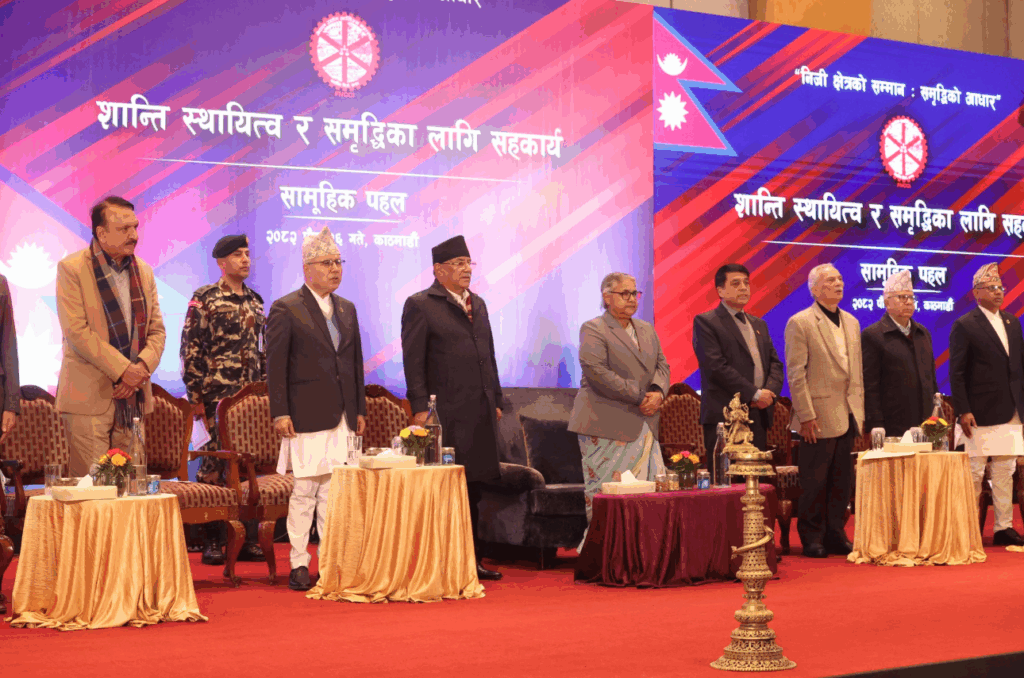
Looking ahead to the elections scheduled for March 5, 2026, several uncertainties remain. The NC and UML parties continue to be defiant, still smarting from the shock of being ousted, with their leaders showing little remorse or contrition. In addition to demanding the restoration of Parliament alongside election preparations, they are attempting to bargain by threatening to boycott the polls if the government charges their leaders with complicity in the September 8 massacre.
Meanwhile, the Judicial Commission of Inquiry completed its investigation and has taken depositions from the former prime minister, ministers, and security personnel. Its final report will likely have a bearing on the upcoming elections.
New Gen Z-inspired parties have been formed—though, perhaps tellingly, none of the more prominent youth figures from the protests have openly joined parties. Meanwhile, some in the Gen Z movement are unhappy with the interim government because it has dragged its feet on arresting Oli and his ministers for the killings in September.
Interim Prime Minister Sushila Karki is engaging in a delicate balancing act; however, she has repeatedly said that her single-point agenda is to hold elections on March 5. As of early January, elections appeared inevitable, with both old and new political parties campaigning in earnest.
However, elections are not the only challenge on the horizon. Nepalis are impatient for reform and expect decade-long problems to be fixed overnight; but jobs cannot be created out of thin air, and an investment climate destabilized after September will take time to recover. Meanwhile, corruption is so embedded in the bureaucracy that the old ways are already creeping back, and about 2,000 disillusioned Nepali youth are still flying out of Kathmandu airport every day. The mountain of structural problems in Nepali society represents the result of decades of misrule.
Geopolitical considerations will also play a role in the coming year. The two elephants in the room, India and China, have differing priorities in Nepal. New Delhi would like governments in Nepal to be more sympathetic to its border concerns, as well as benefiting from Nepal’s water resources for energy and irrigation. On the other hand, Beijing’s main aim is to prevent an unstable Nepal from becoming a springboard for Tibetan nationalism, especially as the Dalai Lama succession looms. In spite of their different priorities, however, Beijing and Delhi both want stability in Nepal. Indeed, if the next generation of political leaders play their cards right, Nepal’s location between two of the world’s fastest growing economies could be turned into an advantage rather than a hindrance.
On top of it all, the impacts of climate breakdown are accumulating in Nepal and the broader Himalayan region—with extreme weather, droughts, floods, and the threat of new kinds of mountain hazards occurring as the permafrost melts. The transboundary glacial flood that hit Nepal’s Rasuwa district in July is just the latest reminder of climate-related threats to critical infrastructure and the expensive hydropower projects that have finally given Nepal surplus electricity for export to India. While the government seemed to manage this year’s late monsoon storm better than the one that caused over 200 casualties in 2024, climatic volatility remains a major risk.
“Elections are not the only challenge on the horizon. Nepalis are impatient for reform and expect decade-long problems to be fixed overnight; but jobs cannot be created out of thin air, and an investment climate destabilized after September will take time to recover.”
Pivotal Elections
Much of what will happen to Nepal in the coming decade will depend on which way Nepalis vote in March. The new shape of government will dictate political and economic policy, geopolitical orientations, and climate and disaster risk management.
Which way might Nepal turn? Even if the diaspora is not allowed to cast ballots electronically, they will still influence who their families back home cast their ballots for—and one can assume that it might not be for the old parties. The legacy parties are relying on their rural vote banks and hoping that support for the new parties will fragment the ballots. Some of the new political alliances which claim to represent the Gen Z agenda are already behaving like the established parties in their choice of candidates, which could benefit the older parties. It will be tempting for both the old and new parties to resort to populism and ultra-nationalism and use disinformation, hate speech, and deep fakes on social media as propaganda tools.
The Election Commission has already registered 800,000 new first-time voters compared to the 2022 voter list, and many of them are young Nepalis desperate to make their ballots count to usher in an era of clean and efficient government that will finally allow Nepal to attain its true potential.
The true legacy of 2025 and September’s youth-led protests will depend on if and how new politicians and alliances can demonstrate a tangible change in governance post-election, with greater accountability and equity alongside economic growth and jobs. Three generations of Nepalis have waited for various political systems, from absolute monarchy to constitutional democracy, to deliver jobs and better living standards. They have been let down over and over again: this time, they hope a new crop of leaders can begin making up for the lost decades.
Views expressed are the author’s own and do not necessarily reflect the positions of South Asian Voices, the Stimson Center, or our supporters.
Also Read: Nepal in Churn: Political, Economic, and Constitutional Dimensions
***
Image 1: Himal Suvedi via Wikimedia Commons
Image 2: Sushila Karki via Facebook


