Pakistan’s defense industry, which for decades focused on ensuring indigenous defense production in light of sanctions and wartime embargos, is now entering a new phase centered on export potential. Pakistan’s defense production complexes were initially designed to secure a continuous supply for the country’s own security needs. However, the country is now positioning itself as an emerging global defense supplier, having lined up potential export orders worth USD $13 billion in the past year alone. If this pipeline were to materialize, it would represent a dramatic increase in the country’s still nascent but continuously expanding exports over the last few years.
Defense exports have long served as instruments of statecraft rather than purely commercial transactions. Military equipment sales can generate enduring institutional linkages, encompassing pilot training, maintenance contracts, spare parts supply, and doctrinal exchanges. For exporting states, such linkages create long-term dependencies, embedding defense relationships within the broader diplomatic and security framework.
As such, Pakistan has an opportunity to translate its growing defense industrial ecosystem into both global market relevance and diplomatic influence. Well-established suppliers in this category, such as Türkiye and South Korea, offer compelling pathways for Pakistan to emulate. The challenges notwithstanding—including continued reliance on imports for parts, governance hurdles, and still nascent R&D—Pakistan already appears on a trajectory to position itself on the international stage as a mid-tier supplier of reliable military wares for cost-conscious buyers.
The Evolution of Pakistan’s Defense Industrial Ecosystem
For most of its history, Pakistan’s defense architecture has been siloed, with each institution and production house operating within a narrow mandate: Pakistan Aeronautical Complex (aircraft production), Heavy Industries Taxila (armored vehicles), Pakistan Ordinance Factories (small arms and munitions) and Karachi Shipyard and Engineering Works (naval platforms) were aimed primarily at fulfilling specific operational requirements for the Pakistani military.
This model was likely intended to maintain discipline and secrecy, particularly in light of sanctions and technology denial during periods such as the post-Pressler Amendment era. However, this also limited the extent to which each separate institution could innovate, especially for cross-domain technologies. Ultimately, it constrained the development of emerging technologies, and little thought was given to export potential.
Over time, the industry matured, with considerable technology-driven progress in the defense and aviation sectors. A primary driver of this progress was the push for indigenization, which accelerated in light of technology denials, thus compelling greater self-help. In addition, the continued rivalry with India also led to military modernization to maintain conventional balance.
“Pakistan already appears on a trajectory to position itself on the international stage as a mid-tier supplier of reliable military wares for cost-conscious buyers.”
Now, more than twenty public sector organizations and over a hundred private firms collaborate for manufacturing defense equipment. On the export side, the Defence Export Promotion Organization (DEPO) was established to facilitate foreign deals, helping to coordinate the overseas sale of defense products and services and to organize IDEAS, the country’s flagship defense expo.
Another crucial enterprise in this budding ecosystem is Global Industrial and Defence Solutions (GIDS), a state-owned conglomerate and one of Pakistan’s largest defense manufacturers and exporters of a wide range of military systems. This ecosystem of production and export-oriented hubs is also augmented by Pakistan’s participation in numerous defense exhibitions around the world, highlighting a gradual expansion of its export-oriented industrial base.
The National Aerospace Science and Technology Park (NASTP), established in 2023, is a recent addition which can help augment the defense sector, especially in the aerospace domain. Based on a triple helix model, NASTP is designed to bring public and private sector industry, researchers, and end-users in the government under one roof to collaborate on technological innovation. The institution is in its formative years but has great potential to become a hub for aerospace manufacturing and potential exports to the global market. A comparable case is that of Turkish Aerospace Industries Inc., or TUSAŞ, a state-owned enterprise with humble beginnings that is now considered among the top hundred defense firms in the world, which began under similar conditions and also focused on aerospace technology development.
As a result of this evolution, Pakistan now produces a wide portfolio of systems, including air-to-surface munitions, surveillance payloads, standoff weapons, and electronic warfare subsystems alongside land-based systems including main battle tanks, small arms, and ammunition and explosives. All these systems also have ISO certifications and comply with the latest quality standards, making them well-positioned for exports.
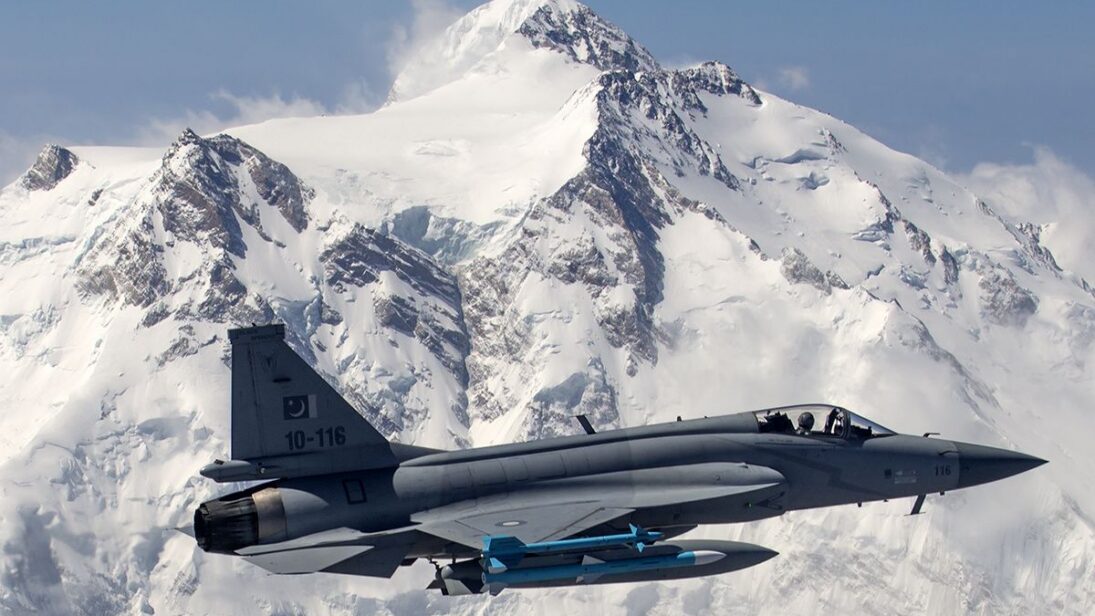
Within this framework, joint production has played a particularly important role. Pakistan has historically relied on co-production to overcome both technological and financial constraints, such as collaboration with China for military aircraft. The jointly-developed JF-17 Thunder is the most visible example of Pakistan leveraging its international partnerships to develop advanced manufacturing and design capabilities. The JF-17 program has enabled domestic assembly and systems integration and also provided Pakistan with an internationally marketable, battle-tested system.
Based on this success, Pakistan is now attempting to extend the production of defense equipment with an export focus into other sub-sectors, such as unmanned systems and precision munitions. The increasing presence of Pakistani defense technology firms in defense exhibitions around the world also indicates a gradual shift towards a more diversified industrial base. Thus, the products, domestic ecosystem, and global partnerships exist to position Pakistan as a mid-tier arms exporter.

Positioning in the Mid-Tier Segment of the Global Arms Market
Pakistan’s efforts to carve out a niche for itself align with a structural change underway in the global market. The United States, China, and Russia continue to dominate the world market for high-value products, including newer-generation combat aircraft and high-end missile defense systems, as well as electronic warfare and network-centric equipment. However, their prohibitive costs deter many states from purchase and demand for cost-effective military equipment has increased in recent years. Pakistan’s value within this supply-chain lies in offering a diverse range of operationally adequate systems which have lower acquisition costs and appeal to a larger demand profile.
The JF-17 Thunder is a clear manifestation of this demand. Marketed as a cost-effective multi-role aircraft, it costs approximately USD $25 – $30 million, compared to the SAAB Gripen, which comes in at roughly USD $80 million, or U.S. platforms, which cost more still. Additionally, the lifetime maintenance costs for many Western systems are exponentially higher compared to the JF-17. Moreover, the countries that have bought the JF-17 from Pakistan, including Myanmar and Nigeria, are likely to employ these in counter-insurgency operations. Therefore, they only require a reliable platform capable of fulfilling their needs and, as such, need not invest in relatively expensive products offered by the more established defense exporters. This makes the JF-17 a more attractive choice and positions it as a central pillar of Pakistan’s current push to become a mid-tier seller.
Unmanned vehicles, including Shahpar II and the upcoming Shahpar III produced by GIDS, are another competitive product for countries looking for cost-effective platforms. In addition, Pakistan’s other defense export products include battle tanks like Al-Khalid, basic and advanced training aircraft like Super Mushshak, anti-tank missile systems, sophisticated surface and sub-surface naval crafts, air-delivered munitions, small arms, and a wide range of ammunition and explosives.
The recent gains Pakistan has made in its defense industry and its marketability in the mid-tier sector hint toward an ecosystem which is outward- and forward-looking with the aim to augment reliability. While not a powerhouse yet, Pakistan is starting to occupy a space where its objective—to enter the mid-tier market as a supplier rather than an importer—could yield dividends.
Defense Exports and Foreign Policy Linkages
Pakistan has long leveraged military training as a component of its external engagements, particularly with states in the Gulf, Africa, and Southeast Asia. The expansion of its defense exports, with arrangements including technical support and lifetime platform maintenance, offers an opportunity to deepen these relationships. One example is the USD $4 billion deal with Libya, which includes fighter and training aircraft as well as broader support, training, capability development and doctrinal adaptation.
Such cooperation leads to long-term operational interdependence, in which the recipient state relies on the exporter not only for initial procurement but also for modifications, upgrades, and technical expertise throughout the platform’s lifetime. This creates enduring partnerships which have the potential to spill over into other dimensions of the bilateral relationship.
Additionally, it can enhance trust between the partnering states, ultimately allowing relationships to expand beyond the military domain into other areas of mutual interest. Such relationships can also provide Pakistan with diplomatic leverage, particularly as India continues to use its military relations to cultivate diplomatic partnerships. Such linkages can be called upon in the future if and when the need arises.
“[Structural constraints] include governance challenges, the need for more innovative R&D, and reliance on external partners for component parts.”
Structural Constraints
While much has been done, several structural constraints remain to be addressed for Pakistan’s defense industry to realize its full potential. These include governance challenges, the need for more innovative R&D, and reliance on external partners for component parts.
One of the most important issues in this regard is the still-limited input of private industry. Much of the defense sector remains in the hands of state-owned enterprises. While this provides the state with the control needed to ensure accountability, true innovation comes when there is public-private partnerships, as seen in the South Korean case. Indeed, South Korea built its successful defense industry based on foreign military assistance, robust heavy industry, and a clear policy of self-reliance. While Pakistan is in the process of developing its industry, a greater push for self-reliance in the defense sector would greatly benefit its future defense export trajectory. Türkiye is another instructive case, as it expanded from importing almost 80 percent of its defense needs to exporting over USD $7 billion in less than two decades. One of the ways it did so was by moving away from import-substitution to export-driven industrialization along with heavy involvement of the private sector. Greater public-private partnership and self-reliance could lead the way for Pakistan to emulate the South Korean and Turkish models.
Innovation, which has historically been underfunded and reactive rather than proactive, is another area that requires greater attention. Keeping in mind the rapid pace of development, Pakistan would need to innovate much faster to continue to be a reliable defense exporter of military wares. R&D for niche defense technologies is one such area which could make Pakistan the go-to for specific needs. The development of upstream industries for materials, electronics, and subsystems is another area which can gradually improve the country’s status as an exporter. This will also help to eventually go towards greater indigenization, thus reducing reliance on external partners.
All in all, Pakistan’s defense exports industry is gradually shifting toward greater integration in the mid-tier global defense market. The emergence of a more networked ecosystem and the leveraging of defense cooperation as a tool for diplomacy highlights a forward-looking strategy. If sustained, this trajectory would enable Pakistan to build greater relational leverage with other developing states and augment its foreign policy objectives. Maintaining and augmenting this momentum is crucial; otherwise, Pakistan risks missing not only on the opportunity to establish its footprint in the mid-tier defense market but also the economic uplift, foreign exchange, and greater technological collaboration that would accompany it.
Views expressed are the author’s own and do not necessarily reflect the positions of South Asian Voices, the Stimson Center, or our supporters.
Also Read: After the Four-Day War: Defense Adaptation and Strategic Realignment Across South Asia
***
Image 1: Asuspine via Wikimedia Commons
Image 2: Hezmok Media via Wikimedia Commons