China has come a long way in achieving indigenous military capabilities. From a modest beginning when it was dependent on importing military hardware, it is now the second-highest military spender in the world, with its national military expenditure touching approximately USD $336 billion in 2025. It now proudly showcases its domestically-made hardware, as it did in its September 2025 military parade. Its scientific community is trying to push boundaries, putting forward the idea of integrating artificial intelligence (AI) with electromagnetic signals to communicate over long distances without worrying about jamming or spoofing.
However, what China is doing with electronic warfare (EW) and how it sees the EW domain is less studied. This is particularly important to analyze, especially for New Delhi, as EW will shape the future battlefield, heavily impacting tactical superiority, and India severely lags behind China in this area despite recent efforts. This article examines China’s EW capabilities as part of the development of its overall military doctrine and outlines India’s options for tackling this threat going forward.
Growing Importance of EW in Conflict
EW is a medium of executing military action that involves the use of electromagnetic energy to “determine, exploit, reduce or prevent hostile use of the electromagnetic spectrum” and to ensure the safety of assets. Some scholars refer to EW as the fourth dimension of warfare, besides land, sea, and air. EW happens in the electromagnetic spectrum (EMS), ranging from radio frequencies to gamma rays.
EW is increasingly becoming central to modern warfare, as seen through its use in various forms during the Iran war. For instance, during the early hours of the conflict, both Iranian-aligned and pro-Western hackers targeted critical infrastructure, deploying state-of-the-art EW capabilities that led to large-scale navigation failures, operational paralysis, and safety risks for both civilian and military platforms. In the context of Southern Asia, reports have suggested since the early 2010s that Chinese networks have been used to carry out spying operations to target the Indian government, business hubs, academic institutions, and cyber systems. More recent examples include the 2025 GPS spoofing incident involving an Indian Air Force aircraft delivering relief supplies to earthquake-torn Myanmar, which was suspected to have been executed by Chinese-enabled systems.
How China Sees the Fourth Dimension
Strategic Origins
For Beijing, EW’s criticality first set in during the early 2000s, when it mentioned informationalization as the main premise for winning wars under local conditions and included it in its military strategic guidelines. China’s 2004 Defense White Paper categorically stated that “the People’s Liberation Army (PLA) shall gradually achieve the transition from mechanization and semi-mechanization to informationalization.”
The focus on dominating the electromagnetic spectrum became more serious for China when, in June 2006, President Hu Jintao ordered the PLA to prioritize training in “complex electromagnetic environments.” To this end, the 2013 Science of Military Strategy categorically described both soft (information) and hard (firepower) kills as going hand in hand. The 2013 report closely examined the U.S. “Air Sea Battle” conceptualization, which had the primary aim of “blinding the opponent’s networks as a primary operational activity.” More prominent exercises under complex electromagnetic environments have been conducted since 2004, which include targeting enemies’ theater command networks, maintaining multi-echelon communication against an EW attack, and employing integrated network electronic warfare as a soft kill.
“[. . .] EW will shape the future battlefield, heavily impacting tactical superiority, and India severely lags behind China in this area despite recent efforts.”
Organizational Reforms
In 2015, China implemented sweeping military reforms and established the Strategic Support Force (SSF) to integrate space, cyber, and EW capabilities into PLA operations.However, in April 2024, the PLA’s Central Military Commission (CMC) announced the end of the SSF because China had not achieved the desired end of information security, as was highlighted in China’s 2019 Defense White Paper. More importantly, President Xi Jinping, in his report to the 20th National Congress of the Communist Party of China in 2022, argued in favor of a “strong system of strategic deterrence” that would “increase the proportion of new-domain forces with new combat capabilities, speed up the development of unmanned, intelligent combat capabilities, and promote coordinated development and application of the network information system.”
Thus, the Information Support Force (ISF) was formed in 2024 as a replacement of the SSF to enhance the PLA’s jointness based on a multi-domain operational capabilities framework. The main aim was to utilize state-of-the-art joint operations systems, streamline operational capabilities, and attain informatized war objectives, rectifying the PLA’s concerns about coordination between the SSF Space Department and SSF Network Information Department.
Another key reason was likely the Chinese desire to keep pace with the U.S. military capabilities in this domain. The ISF seems to be built on the same premise as the U.S. military’s Joint All-Domain Command and Control (JADC2), an initiative that seeks “… to empower [the U.S.] Joint Force Commanders with the capabilities needed to command the Joint Force across all warfighting domains and throughout the electromagnetic spectrum to deter and, if necessary, defeat any adversary at any time and in any place around the globe.” Indeed, a 2024 Chinese analysis argued that the JADC2 is the U.S. military’s “perfect development blueprint” for informationalized and intelligent warfare.
Current Trends in China’s EW Capabilities
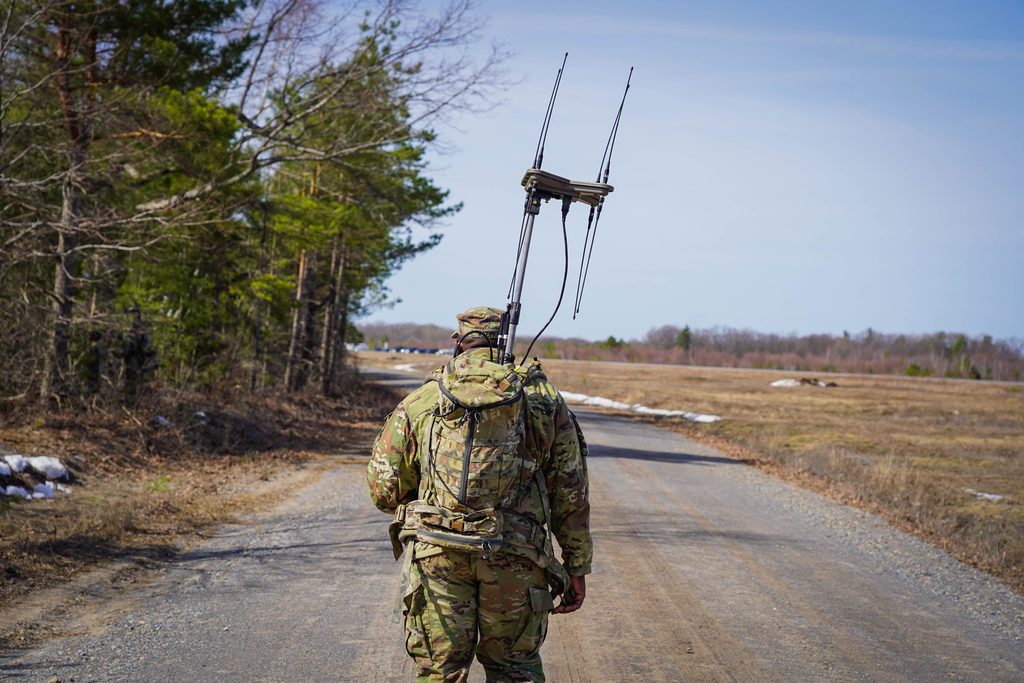
While the traditional armed forces of China—the PLA, the People’s Liberation Army Air Force (PLAAF), and the People’s Liberation Army Navy (PLAN)—have been investing in EW capabilities from various standpoints for a while, it is the new technologies, such as space, AI and cyber, which now seem to be the core focus.
Space has emerged as the most important arena for future EW operations, with China considering space-based systems as essential to creating an informatized PLA. The U.S. Department of War has noted with concern various technologies China is pursuing to enhance its EW capabilities in space, including satellite jamming, offensive cyber operations, and directed-energy weapons. In fact, China has been accused, on multiple occasions, of carrying out soft-kill attacks, or attacks that utilize capabilities such as lasers, EW, or cyber weapons, to threaten U.S. space systems, though attribution of such attacks is very challenging.
The Chinese scientific community has also recently published about having developed some path-breaking EW capabilities. A 2024 article in the Chinese academic journal Radio Communications Technology argued that Beijing has “… achieved seamless, wide bandwidth, real-time monitoring and analysis of the electromagnetic spectrum, leaving any enemy completely out in the open during a conflict.” If true, this would mean China can detect, lock onto, and decode the physical parameters of these incoming signals without compromising its own communications flow. Perhaps the most important technology China is likely developing for EW in space concerns interfering with Synthetic Aperture Radar (SAR) satellites to deny imagery generation. By providing images of maritime and ground-based military assets day and night, SAR satellites play a central role during a crisis; in a future conflict with the United States, for example, China could use its new capability to jam American SAR capability, cutting off its target recognition capabilities.
Beyond utilizing space-based assets, China’s EW capabilities also include AI. A paper recently published in the journal Command Control and Simulation highlighted how significantly China is investing in these new domains. It claimed that China seeks to follow and “integrate” a space to ground, civil-military collaborative architecture. By integrating AI into its EW domain, China seeks automation of classification in terms of “classify[ing] signals, identify[ing] hostile emissions, and deploy[ing] countermeasures without human intervention,” intended to improve response time and enhance survivability in complex electromagnetic environments
While it is difficult to tell how close China is to achieving these goals, the PLA on many occasions has urged its scientific community to provide an “AI-enabled communication monitoring system that might find and correlate enemy transmissions.” In fact, it has been argued that China seeks to develop a library of algorithms meant for communication interference and signal identification. If achieved, such a capability would hand China a significant battlefield advantage in future, especially against regional adversaries.
“Given that China has made both organizational and tactical changes, and is integrating emerging technologies, to further improve its EW footprint, it is imperative for India to match these developments in its own innovative ways.”
India’s Options
For India, dominating the EW domain is critical for its national security in a crisis with either of its adversarial neighbors. The May 2025 crisis with Pakistan revealed the criticality of EW, with high-ranked Indian military officials claiming China provided Pakistan with real-time intelligence on the deployments and movements of India’s defense forces. More importantly, both India and Pakistan are known to have extensively deploy EW systems along the border during that crisis.
To be sure, India has made concerted efforts over the last few years to augment its EW capabilities. The Indian Ministry of Defence’s 2025 Annual Report suggests that India has invested USD $451.9 million and USD $511.5 million through the Uttar Pradesh and Tamil Nadu Defence Industrial Corridors, respectively, for the development of various defense equipment, including for electronic warfare. In terms of indigenous capabilities, India has developed projects such as Samyukta for multiple jamming purposes, Himshakti for higher-altitude precision signal detection, and Shakti systems for interception, detection, classification, identification, and jamming of conventional and modern radars. Each of India’s three defence services has its own domestically-developed EW systems.
Furthermore, India is working to establish a tri-service spectrum command and conducts exercises such as TRISHUL combining electronic, cyber, drone, and counter-drone operations as well as ISR to strengthen integrated readiness across multiple domains. India has also developed electronic analysis software to “identify strategic locations of the enemy and electronic order of battle, track satellites and mobile phones and carry out AI-based intercept analysis of communications assets.”
Despite these developments, however, India is still lags on certain critical EW capabilities when compared to China. Cross-service coordination, particularly for real-time data fusion, is one such area. Another key concern, as highlighted by the Integrated Defence Staff itself, is the lack of coordination among space assets, cross-service requirements, and EW requirements. India’s priority should be to develop an integrated Command, Control, Communications, Computers, Intelligence, Surveillance, and Reconnaissance (C4ISR) systems to link domains and enable live data-sharing requirements.
Given the challenges New Delhi faces in the EW domain, from data analysis to data fusion, it is imperative that it take advantage of emerging technologies to bridge the gap. Commanders at the tactical level receive a plethora of information from existing EW assets. To better leverage that information and improve situational awareness, integrating AI into analysis will be a necessity. An AI-enabled ISR capability would not only provide a coherent battlespace picture, but also support EW missions.
Further, India needs to build more unmanned mobile systems, such as drones, to provide jamming capabilities. Given the line-of-sight advantage, this would provide India with a better capability to overcome persistent ISR threats from China, especially in high-altitude areas.
Beyond AI and drones, India needs to overcome its dependence on imported electronic warfare capabilities, since dependence on foreign suppliers for niche technologies creates a capability and psychological gap, especially during a high-tech crisis. Estimates suggest that by 2030, India’s overall arms imports would decline from the current 65 percent to less than 50 percent, but this should result in the tangible indigenization of technologies required for electronic warfare dominance.
EW is an evolving field that requires staying a step ahead of the adversary at all times. Given that China has made both organizational and tactical changes, and is integrating emerging technologies, to further improve its EW footprint, it is imperative for India to match these developments in its own innovative ways. For India, leveraging EW and denying the misuse of the spectrum is now a necessity for national interest.
Views expressed are the author’s own and do not necessarily reflect the positions of South Asian Voices, the Stimson Center, or our supporters.
Also Read: Taking Stock of India-China Relations: Structural Divergences and the Limits of Diplomacy
***
Image 1: The Kremlin via Wikimedia Commons
Image 2: Fort Drum via Flickr