The recently announced Saudi-Pakistan Strategic Mutual Defense Agreement (SMDA) came as a surprise to many observers. In India, this development was initially seen through a South Asia lens amidst talk of an embryonic “Islamic NATO,” or a collective military alliance of Muslim countries, that held serious to grave implications for New Delhi. This reading was in turn nuanced by seasoned West Asia watchers, experts, and diplomats who argued instead that the pact is Western-facing, triggered by Israel’s unprovoked strikes within Qatar, and has no bearing on Indian interests; they further pointed to the increasing closeness of New Delhi’s ties with Riyadh over the last two decades as evidence for this claim.
However, even with this understanding in place, there are valid reasons to expect the pact and closer Saudi-Pakistan security ties to have mild to moderate implications on broader India-Pakistan strategic competition, particularly for Indian efforts to de-hyphenate from Pakistan. This is due to Pakistan’s history of leveraging alliances beyond the immediate ambit of their agreements, present trends in the Middle East that exacerbate Saudi insecurities, and Pakistan’s continued strategic focus on India.
Pakistan’s Approach to Alliance-Building
As a weaker power arguably harboring revisionist goals and suffering a lack of strategic depth, Pakistan has long sought to leverage its relations with extra-regional great powers in order to address its asymmetries vis-à-vis India. For example, in the early stages of the Cold War, Pakistan entered into alliance relationships with the United States by offering its geographic advantages to serve the U.S. goal of Soviet containment. But anti-communism was merely the geopolitically expedient cover for Pakistan’s more abiding objective: the containment of Indian power in South Asia. During the Soviet-Afghan war, Islamabad leveraged similar dependency by the United States and Saudi Arabia in order to acquire modern weaponry as well as to pursue nuclearization with India in mind.
“There are valid reasons to expect the pact and closer Saudi-Pakistan security ties to have mild to moderate implications on broader India-Pakistan strategic competition, particularly for Indian efforts to de-hyphenate from Pakistan.”
As relations with Washington strained in the early 2000s, General Pervez Musharraf sought to appeal to Beijing by offering the Gwadar port as a new economic and potentially strategic hub, exploiting China’s need for access to the Indian Ocean in order to enlist it as a significant stakeholder in the project. Pakistani leaders made this offer with the expectation that it would pay dividends vis-à-vis India in the future. As Musharraf explained more than a decade later, “Gwadar was entirely my idea, not a Chinese idea. I was concerned only about Pakistan’s strategic interests,” referring to Pakistan’s long-standing fear of India blockading Karachi port. In his telling, Gwadar would potentially allow Pakistan to threaten India’s access to Middle Eastern oil and thereby enhance deterrence. Though initially skeptical, Chinese leaders were eventually persuaded of the project’s value, and over time, as scholar Daniel Markey highlights, the PLAN began appreciating the strategic benefits of the port. This sense of a shared security interest between Pakistan and China has grown over the years, amounting to what expert Sameer Lalwani rightly describes as a “threshold alliance.” India felt the effects of this increased security cooperation this year, with Pakistan’s use of Chinese-origin platforms in their four-day kinetic conflict in May.
A quarter-century later, India is once again watching as a strong economic partner chooses to lean on Pakistan to serve its core security interests. Even as Saudi Arabia sincerely seeks to convey to India that its interests will be safeguarded, there is an element of déjà vu emerging in New Delhi about Pakistan leveraging its deepening relationships in ways that may prove detrimental to Indian interests—especially in a future potential crisis.
Present Trends in the Middle East and Pakistan’s Fungibility
Tempting as it is for some in India to presume a South Asia-centric perspective of the drivers of the SMDA, it is crucial to place the pact within the context of geopolitics in the Middle East. For Riyadh, the sources of security anxiety are both strong as well as structural. It continues to be concerned by the Houthis in Yemen and Iran despite improving ties, Israel’s growing unpredictability, as well as Washington’s potentially fading security assurances amidst the partial unravelling of the U.S.-led security order in the region. The Trump White House, for its part, has focused on drawing down American commitments to conflict theatres abroad, including the Middle East, where small scale withdrawals of American military personnel and equipment are already underway.
In the long term, this predicament creates a rationale for the United States to support new regional architectures of Middle Eastern security, including those featuring Pakistan. This would, after all, be in line with global trends towards multipolarity—something India has notionally supported over the years. The U.S. last sought such “regional sheriff”-supporting innovations, or efforts to “pass the buck,” in the 1970s to avert imperial overstretch and enhance strategic flexibility. In an increasingly multipolar world, Pakistan’s more willing and capable military assets and personnel are being efficiently leveraged by Islamabad, and that can continue to happen in future.
Indeed, the Saudi-Pakistan SMDA represents the second instance of Islamabad featuring in the Middle East’s security architecture during crises: Prior to Israel’s Doha strikes, Pakistan Army Chief Field Marshal Asim Munir was among those leaders with whom U.S. President Trump discussed the 12-day Iran-Israel war during his White House visit in June. This occurred even as Iranian officials were claiming that Pakistan offered to protect Iran against nuclear attacks with its own nuclear arsenal—a claim that Pakistani lawmakers staunchly denied.

Additionally, Pakistan has also proven itself as a conduit for military knowledge across conflict theatres. Pakistan’s deep integration with arms and systems produced by states with mature defense industrial complexes, such as China and Turkey, allows it to channel such equipment and knowledge to third states that do not have comparable indigenous capabilities. Pakistan’s significant defense portfolio for states such as Azerbaijan, for example, allows it to replicate such a model with Saudi Arabia, whose indigenous capacity to produce advance defense platforms is yet nascent. Should this integration grow deeper, it would create an effective belt of cooperation for arms production and supply from China through Saudi Arabia and Azerbaijan, to Turkey.
In this context, an increasingly capable Pakistani military under initiative-seeking leadership is emerging as a Swiss army knife of security solutions—including the prospect of deploying Pakistani personnel in Gaza as part of President Trump’s proposed International Stabilization Force. Pakistan’s experience with and willingness to participate in security assistance missions abroad can meet fresh Arab security needs in the Middle East as well as mitigate Arab aversion to the risks that deploying their less experienced forces might incur. Such trends are unlikely to weaken easily or soon, implying stable and indeed increased Pakistani leverage vis-à-vis Riyadh. The means through which Pakistan brings this leverage to bear against India in a future conflict may be hard to determine in advance. Even so, the likely alliance maturation threatens to reverse India’s hard-won efforts over the last two decades to minimise Pakistan’s relevance in advancing ties with Riyadh and other Gulf states.
Pakistan’s Continued India Focus
Despite recent heightened focus on its Middle East forays, Islamabad’s central strategic concern seems to remain its ties with India. Since the end of the four-day conflict in May, Pakistan has arguably intensified its India-related diplomacy and military efforts out of a sense that conflict could recur; Pakistan’s defense minister recently stated that the “chances of war with India are real.”
Pakistan’s recent postural leadership at multilateral fora also indicates an India lens. For instance, the recent Doha summit in the wake of the Israeli attacks on Qatar seemed to be meant to draw a parallel between Israel’s actions against Qatar and that of India’s against Pakistan. In the latter case, Pakistan likely hopes, not unreasonably, that its demonstrative solidarity with Gulf and Arab states in the Israel case will be remembered when it speaks on the Kashmir issue; during a future India-Pakistan conflict; or if Pakistan responds to India’s potential breach of the Indus Waters Treaty (a course of action Islamabad deems an act of war).
In this context, India could see challenges to de-hyphenation re-emerge. New Delhi has placed great stock in shifts in the foreign policies of Arab countries towards India across the last decade, and treated such developments—most notably Riyadh’s acceptance of Delhi’s interpretation of the Kashmir dispute as a bilateral matter—as a marker of success for its de-hyphenation efforts.
“At the very least, India will be less assured of Gulf diplomatic neutrality or of Riyadh being understanding of New Delhi’s stance in the next India-Pakistan crisis or conflict.”
Now, a maturing SMDA could adversely impact Saudi Arabia’s position toward India on the regional stage. This would undermine Riyadh’s recent pivot from being historically partisan towards Pakistan to a more mediatory position on India-Pakistan crises. At the very least, India will be less assured of Gulf diplomatic neutrality or of Riyadh being understanding of New Delhi’s stance in the next India-Pakistan crisis or conflict.
What Should India Do?
The SMDA is less an instance of Riyadh overlooking New Delhi’s sensitivities and interests and more a case of Riyadh paying greater attention to its own worsening security environment closer to home. Neither does New Delhi have reason to resent Riyadh for pursuing its national interest, nor does Riyadh have an interest in worsening ties with a growing economy of 1.4 billion people with increasing energy needs; notably, India’s growing need to re-diversify away from Russian oil also points towards revived energy ties with Gulf states.
However, the improvement of India-Saudi ties occurred within a much more stable regional and international order. That order is now rapidly changing, and past assurances are no longer watertight guarantees. In the wake of recent developments, India will have to tread carefully to preserve the diplomatic and reputational gains it made in the 2010s and early 2020s.
Therefore, while India should see the pact as primarily Middle East-facing, it should remain alert to the prospect of heightened Pakistani leverage vis-à-vis increasingly insecure Gulf states over time, which may negatively affect Indian interests in a time of crisis. This requires New Delhi to invest in further strengthening its ties with Gulf states. This can include accelerated growth in economic ties, which have already proven its value as a driver for strategic partnerships with the Gulf, as well as cross-regional economic cooperation through projects such as the India Middle East Europe Economic Corridor, in order to create a buffer between the Saudi-Pakistan SMDA and Indian interests.
Views expressed are the author’s own and do not necessarily reflect the positions of South Asian Voices, the Stimson Center, or our supporters.
Also Read: Signed but Undefined: Contextualizing the Pak-Saudi Mutual Defense Agreement
***
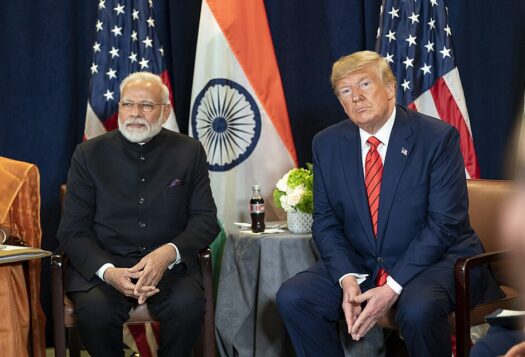
Image 1: Narendra Modi via X
Image 2: Shehbaz Sharif via X