Over the past year, South Asian security dynamics have evolved amid persistent interstate rivalries, domestic political turbulence, and the rapidly shifting global political landscape. On January 28, South Asian Voices spoke with Johann Chacko about the most important factors shaping regional security today, including the state of the India-Pakistan relationship and the role of external actors like the United States and China. Chacko is an experienced researcher, commentator, and teacher of politics and international affairs; currently, he is a doctoral researcher at the School of Oriental and African Studies, a research fellow with Knology, and the South Asia Columnist for The National News.
How would you characterize the evolution of U.S. policy toward South Asia, and Pakistan and India in particular, in 2025? How have these shifts impacted regional political and security dynamics in the region? How might you expect these key relationships to evolve in the year ahead?
To answer that, you first have to pull back and see how South Asia fits into U.S. security and foreign policy more generally, and how it’s done so over time. I would argue that South Asia has never been a “first-principles driver,” even if there have been times where it has been an area of significant focus or even been center stage.
In that sense, quite often the policy towards India and Pakistan is a reflection of what the United States wants in Afghanistan, or what it wants with China. So, because China and Afghanistan have been first-principles drivers, when those things change, then policy towards India and Pakistan changes: that’s the lever that’s moved.
The Trump administration came into office with a fairly good idea of what it wanted to do in the world. It sometimes seems opportunistic because events are emergent, but the priorities, I think, were already clear to them, and one of the big shifts was on China. You see it in the U.S. National Security Strategy (NSS) that was released in December, and now the U.S. National Defense Strategy that’s just been put out—and it’s a massive shift. It’s the first time in a decade where China isn’t being described as an ideological competitor or a threat to global stability. It’s seen as an actor whose trade and economic practices are threatening the vitality of the U.S. economy and therefore the foundations of U.S. power, but with whom competition is fundamentally economic. The U.S. strategic goals in Asia are about deterring conflict.
I think that shift has changed the role that Washington hopes for from India and Pakistan. On the whole, Pakistan read the room earlier than India. That’s part of the reason why we saw the aftermath of the 88-hour air war in May play out the way it did. Pakistan understood that U.S. interests had shifted. India took a little longer to figure it out—that in itself is interesting.
This is where Afghanistan ties in as well. What you might think of as the long “war on terror” did not begin after 9/11, it actually started after the East Africa embassy bombings in 1998. That’s when U.S. counterterrorism focus shifted to Afghanistan, where Osama bin Laden was based. That then required engaging with Pakistan. From that period until the U.S. withdrawal from Afghanistan in the summer of 2021, the dynamics between India, Pakistan, and the United States fundamentally shifted. From that point onwards, whenever India chose to confront Pakistan, usually over terrorist incidents taking place inside India, this ultimately benefited the United States because Indian pressure on Pakistan was useful to the United States as something they could leverage to get counterterrorism cooperation and institutional change within Pakistan.
But the moment that focus shifted—once the United States was no longer waging a major counterinsurgency inside Afghanistan, once Pakistan was no longer a major site of counterterrorism operations—then suddenly the way that India-Pakistan conflicts play out starts to look more like an earlier period, like say the early post-Cold War period, where the United States tends to play a much more even-handed role when crisis breaks out.
China also appears to be playing an increasingly influential role in regional affairs, from the continued deep partnership with Pakistan to inroads in Bangladesh and détente with India. In your view, how does China impact regional political and security dynamics? Moreover, how should we think about the interaction between Chinese and U.S. interests in South Asia, particularly amid shifts in U.S. policy toward the region?
Because the United States is no longer focused on strategic competition with China, this actually opens up space for countries like Pakistan and Bangladesh to continue to maintain a close military relationship with China without jeopardizing their relationship with the United States. That sort of relationship with China is not really a first-principles problem for the United States, because Pakistan has gone out of its way to support the new U.S. priorities like, for example, access to critical minerals. That’s something that actually, as far as the United States is concerned, undermines Chinese dominance in the economic sphere. So, the currencies of power that Washington is measuring things by are shifting and that’s going to have a significant influence.
But part of it is also the fact that, for example, although India sees China and Pakistan as increasingly integrated in terms of the threat landscape, there’s another way to see it. Washington is thinking about, “well, how do we deter major conflicts in Asia?” Pakistan doesn’t really seem to play any role in the question of when or how China might apply military coercion to Taiwan. So, those kinds of factors mean that China’s supply of military hardware to countries like Pakistan and Bangladesh, and for that matter, Thailand, is not a priori a problem.
“Because the United States is no longer focused on strategic competition with China, this actually opens up space for countries like Pakistan and Bangladesh to continue to maintain a close military relationship with China without jeopardizing their relationship with the United States.”
Now, the United States is extremely interested in maintaining open lines of communication through the Indian Ocean and to the South China Sea. So, those are areas in which it would welcome help from India and any other country in the region that wants to contribute. Those are the areas of security cooperation that the United States is going to prize now that it’s less concerned what goes on inside Afghanistan. So, for example, if India chooses to make big defense capital expenditures to boost its ability to project force into Pakistan, the United States might be happy that India is buying American munitions and platforms. But ultimately, the security contribution it’s looking for is not pressure on Pakistan, which no longer serves a purpose, but rather, that crucial maritime contribution, which is specifically about limiting China’s ability to threaten global trade and also the ability to apply pressure on sea lines of communication to mainland China, if necessary.
In the wake of the May 2025 conflict with Pakistan, Indian Prime Minister Narendra Modi articulated a “new normal” for Indian security policy toward its neighbor that would interpret any Pakistan-linked terror attack on Indian soil as justification for kinetic action against Pakistani military assets. In your view, how, if at all, might this new doctrine alter crisis dynamics in South Asia? How have recent developments, like the restrained Indian response to the Delhi blast in November, influenced your assessment?
The nature of the news cycle means that there isn’t much medium-term memory: this kind of retaliatory, escalatory rhetoric has actually been a core part of Prime Minister Modi’s message and, specifically, his National Security Advisor Ajit Doval’s message since 2014. Before Modi was elected, Doval, who was already on Modi’s team, laid out what people have called the “Doval Doctrine” in a speech in February 2014, where he essentially describes what he intended to do: move from a defensive posture in response to Pakistan to more of an offensive one, with both covert and overt retaliation inside Pakistan. In 2016, there was a huge media push to highlight the so-called “surgical strikes,” the cross-border special operations assaults on Pakistani positions. In 2019, you had Balakot, and then last year, of course, we saw Operation Sindoor. So, this is actually very consistent.
The response in November is the inconsistency here. And it’s not an accident that this came after the rift with the United States. As I pointed out, including in Trump’s first term, India was used to a context in which the United States found Indian pressure on Pakistan to be useful. But after the withdrawal from Afghanistan, the U.S. response to Indian escalatory conventional responses to terrorism was more problematic.
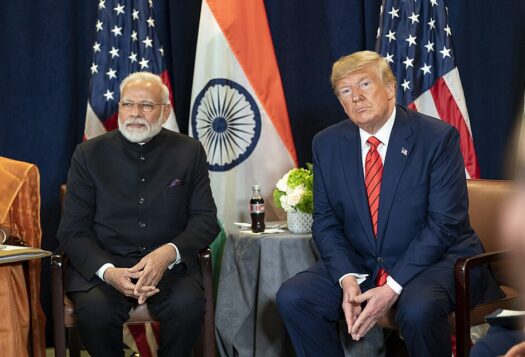
Furthermore, Trump has never stopped referencing what he describes as his mediation of the ceasefire between India and Pakistan—it’s even referenced in the recently released U.S. NSS. This is diplomatically and politically problematic for Modi, whose image, even domestically, is built on this idea of him as a world-bestriding colossus who meets figures like Trump and Putin as an equal. So, the idea that Trump told Asim Munir and Modi to knock it off is just untenable. In fact, that the already-negotiated U.S.-India trade deal fell apart had everything to do with the breakdown in communications between Trump and Modi; so, this has enormous financial consequences.
In other words, the calculus for escalation has completely changed. The political, diplomatic, and economic costs of pursuing a policy of overt escalation against Pakistan in retaliation—I’m not sure if it works anymore, at least as long as the current U.S. policy holds. Now, what I’m concerned about is whether the result will be an escalation in covert retaliation, because those kinds of dynamics could have much more unpredictable results. The nature of covert action means that outside observers, the general public in both countries, and even the political classes in both countries may not be aware of the fact that they’re on the pathway to crisis before that crisis literally explodes. It’s in India and Pakistan’s interests to think about how to manage that covert conflict.
For example, to make an analogy, you have the Directors General of Military Operations hotline, so that they can pick up the phone and discuss developments and avoid unnecessary escalation. I’ve not come across any indication of a similar level of communication between Inter-Services Intelligence and the Research & Analysis Wing. That’s essential if covert conflict is to be managed within levels that both countries can handle.
For a long time, I think, India has refused engagement; it spent years trying to get Pakistan to engage, then when Pakistan was willing to engage, India wasn’t. That kind of dynamic is not helpful to either country right now, because there are clearly benefits to both countries in being able to bilaterally manage this, and the covert conflict is a fundamental driver of relations between the two. It’s not clear that any third party is in a position to actually have a full picture of what’s going on.

Beyond the India-Pakistan rivalry, a number of important developments shaped regional affairs over the past year, including political uncertainty in Nepal and Bangladesh and increasing volatility on the Pakistan-Afghanistan border. How would you characterize the causes and consequences of this pattern of insecurity and political instability across South Asia? How have countries like India and Pakistan sought to manage these developments?
I’d separate those into two different categories. On the one hand, you have the escalating conflict between Pakistan and Afghanistan, and that is now increasingly entangled, as has often been in the case in the past, with India-Pakistan tensions. On the other hand, what you see in Nepal, Bangladesh, and Sri Lanka is something quite different, which is the intersection of the macroeconomic instability that has followed the Ukraine war and its impact on energy and food prices with enormous youth bulges—young people who feel that the social contract has been fundamentally broken, who have lost trust with the existing political order, and now are demanding fundamental changes. They are unwilling to allow things to go back to business as usual.
The reason that distinction is important to make is because these youth revolutions should not be put in the same geopolitical category as the problems of terrorism, counterterrorism, and cross-border support that we see in India, Pakistan, and Afghanistan. It’s very unhelpful when people, especially older people, tend to project the “foreign hand” as the reason that these political orders have suddenly collapsed. In some ways, it’s a sad commentary on the state of democracy that people find it so hard to believe that political action from below could ever achieve such dramatic results.
But that’s exactly what people want, and at moments of economic stress, when there is a collapse in government legitimacy, it’s not surprising that the armed forces in places like Sri Lanka or Nepal or Bangladesh would choose to stand aside and not have to turn their guns on the public and instead allow for some kind of realignment of the political system, for fresh faces to come in that might command more public support.
“[T]he intersection of the macroeconomic instability that has followed the Ukraine war and its impact on energy and food prices with enormous youth bulges—young people who feel that the social contract has been fundamentally broken, who have lost trust with the existing political order, and now are demanding fundamental changes.”
Of course, the fundamental economic problems are really significant. So, if you don’t see the right combination of support from the international community, including things like debt relief, if you don’t see technocratic competence and you don’t see at least a touch of populist sensibility, in terms of making it clear that there’s relief for ordinary people and that the rules apply to the rich and powerful, you will see a return to that cycle of instability. Of course, the countries that border these states don’t want to see instability spilling over, either, so that’s when you start to see the geopolitical element return.
India, for example, is deeply uneasy about the persecution of religious minorities in Bangladesh. They don’t want to see disorder spill across the borders or see refugee flows. Those kinds of conditions can create an impetus for at least some kind of political support for stability. These are difficult waters to navigate, but I think it’s important that governments across the region understand that these are forces from below, not from outside.
In the case of Pakistan and Afghanistan, unfortunately, I am fairly pessimistic. Part of it has to do with the essentially revolutionary nature of the Taliban. It’s not a question necessarily of Islamic extremism, but rather an armed revolutionary movement that has limited capacity for governance. So, you might say its default political logic for winning legitimacy isn’t the bread and butter issues—it’s defending the country against a foreign aggressor.
When it’s failing in governance terms, not meeting the needs and expectations of its citizens, then I think it finds it quite expedient to have an escalatory cycle with Pakistan. Unfortunately, I’m not sure that the Pakistani government quite grasps the fact that a combination of blockade and airstrikes, probably will not do anything to shift the Taliban’s logic of resistance. The Taliban is not really deterred by the idea of the suffering of the public; these things become then fuel for narratives of resistance, which is how the Taliban achieved power in the first place.
Secondly, the Taliban has many levers for escalation within Pakistan. It’s very striking that every single government in Kabul, since the early to mid-1970s, has ended up supporting violent separatism in both Balochistan and in the Pashtun areas of Pakistan. Whether royalist, nationalist, or democratic, and now Islamist, they seem to reach for the same policy levers. So, this is something of an enduring problem. Then, the other policy lever that they reach for when they find themselves facing Pakistan’s conventional superiority is to strengthen their relationship with New Delhi, and this, again, is what the Taliban has done. This is a spiral with no easy exits.
The second Trump administration heralded significant changes not only to U.S. policy toward South Asia but the broader U.S. approach to international politics, as evidenced by dramatic recent developments in the Western hemisphere and the North Atlantic. How will geopolitical uncertainty at the global level impact regional dynamics in South Asia? What opportunities and challenges are presented to India and Pakistan by the rapidly evolving international political order?
India and Pakistan have very different decision trees in this moment. That has to do with the fact that Trump does see things through an economic lens. There have been leaked drafts of alleged earlier versions of the NSS, and one of those proposed the idea of a “Core Five” grouping to replace the G7 as the primary informal global coordination mechanism. India was meant to be part of the Core Five alongside China, Russia, Japan, and the United States. So there is a kind of status there that the United States is willing to recognize, in terms of India’s growing slice of the global economic pie.
But that comes with a lot of costs. In some ways, the bigger the economy, the bigger the target, the bigger Trump’s expectations in terms of what they will give the United States, or how they might threaten U.S. preeminence in one area or another. What every major economic power, such as the European Union or China, has had to do is develop a suite of retaliatory mechanisms that allow them to negotiate with Trump. Trump doesn’t mind hardball negotiations; in fact, he seems to relish them, they seem to engender respect. China went through a period of intense policy review after the first trade war and identified a series of measures, including its control of rare earth elements. It deployed that and fundamentally changed the tenor of the U.S.-China relationship, both in terms of economics and more broadly. So, India is going to have to find its own set of economic levers that Trump respects to be able to capitalize on the space that is opening up as Trump seeks to reshape the world order.
As for Pakistan, we’ve already talked about how it has preemptively moved to demonstrate its alignment with Trump’s economic priorities, whether it’s critical minerals or rare earths. But Pakistan’s economic options are far more limited than India, so it’s going to be navigating these spaces very differently.
Views expressed are the interviewee’s own and do not necessarily reflect the positions of South Asian Voices, the Stimson Center, or our supporters.
Also Read: SAV Q&A with Srinath Raghavan: SCO, Tariffs, and India’s Approach to the United States and China
***
Image 1: Narendra Modi via X
Image 2: S. Jaishankar via X