The Stockholm International Peace Research Institute (SIPRI) Yearbook 2026 recently reported that India expanded its nuclear arsenal in 2025, increasing it from 180 to 190. But the starkest revelation was that India for the first time might be actively deploying some of them during peacetime. The report indicates, with what it notes as “considerable uncertainty,” that India may have deployed around 12 nuclear warheads on one of its nuclear-powered, ballistic missile submarines (SSBNs) as of January 2026. If this is indeed the case, this deployment would challenge the long-held assumption that India keeps its nuclear warheads demated from nuclear launchers during peacetime. Further, it would indicate that India may be shifting its operational nuclear posture—which concerns actual operational capabilities, deployment, and force structure—while its declaratory nuclear policy, which constitutes a state’s stated conditions for nuclear use, remains unchanged.
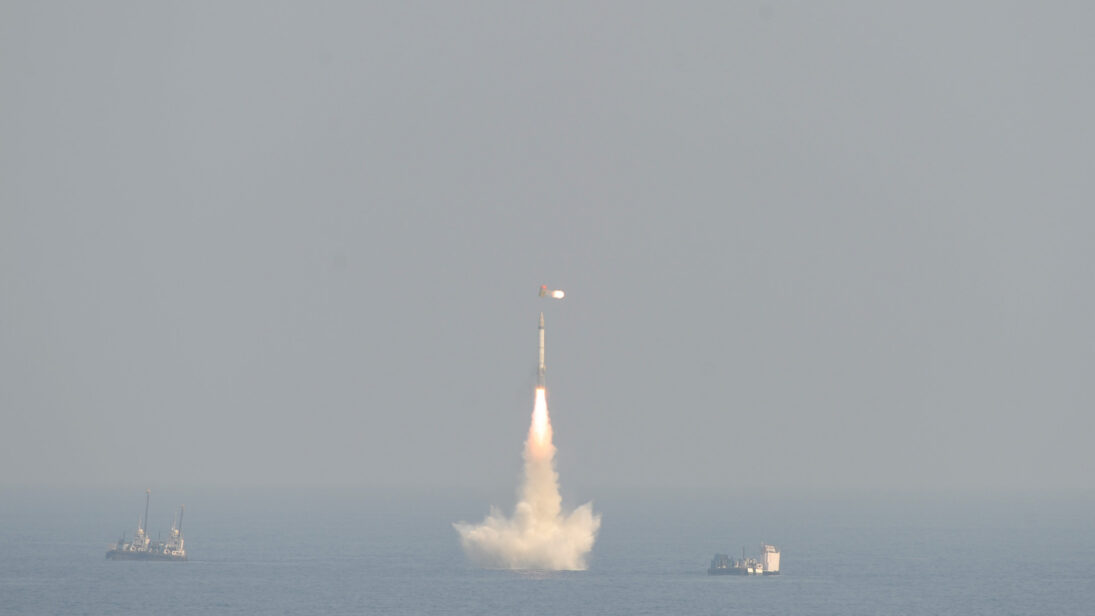
Though this nuclear deployment may be recent news, the overall change in India’s operational nuclear posture has been underway for over a decade. Still, this new reportage places new significance on India’s efforts to modernize its nuclear arsenal, develop canister missiles (which are pre-fueled, ready-to-launch sealed-tube systems that shorten launch time from hours to minutes), new kinds of nuclear delivery systems (including long-range and multiple-warhead missiles), and its conduct of sea-based deterrence patrols. India may not be alone in these efforts; SIPRI reports that China may also have deployed 34 nuclear warheads, on top of its rapid missile silo buildout and increasing deterrence at sea patrols with nuclear weapons onboard SSBNs.
These changes have not occurred in a vacuum: They are also indicative of the interlocking ‘strategic chain’ that connects the region’s nuclear powers and threatens regional strategic stability. The strategic chain frame captures how China’s growing nuclear capabilities, aimed at the United States, threaten India and drive it to improve its own nuclear readiness, which in turn prompts Pakistani efforts to modernize its nuclear capabilities. If the developments in this and other reports are true, they may also challenge how scholars understand nuclear command and control (NC2) systems in the region. This article, therefore, proposes a new theoretical type, called “Segmented-Delegative Assertive Control System,” to explain how states adapt to worsening external environments by introducing localized flexibility and add nuance to scholarly understanding of NC2 systems.
If the developments in this and other reports are true, they may also challenge how scholars understand nuclear command and control (NC2) systems in the region.
Strategic Drivers
India’s arms acquisition and capability development are primarily driven by the increasingly intertwined threats posed by each China and Pakistan, reifying a two-peer problem for India in deterrence and escalation dynamics. Operation Sindoor showcased how this problem has become increasingly entangled, with China reportedly having provided on-site technical support and shared live data on Indian assets and deployments with its all-weather partner.
In the case of China alone, the picture is growing more complex. China is not only conventionally superior to India, but it is also engaging in a rapid expansion of its nuclear arsenal. As of January 2026, China reportedly has a total of 620 nuclear warheads, an increase of 20 warheads from over the past year that is expected to continue over the upcoming years. The U.S. Department of Defense (DOD) notes a shift in China’s operational posture: It has deployed quick-launch, solid-fueled missiles in silos and has been developing a launch-on-warning (LOW) capability—a strategy in which a retaliatory nuclear strike is launched upon detecting an incoming enemy missile, while the enemy missile is yet to hit the target. Furthermore, the U.S. DOD noted that China consistently engages in sea deterrence patrols with nuclear weapons onboard the SSBNs, along with conducting “combat readiness duty” and “high alert duty” drills. This has made the United States increasingly skeptical about the credibility of China’s own long-held no-first-use (NFU) policy.
While these changes from China are aimed at deterring the United States, they nevertheless create a security dilemma for India. As such, New Delhi’s development of long-range and sea-based missiles is aimed at enhancing the combat readiness of its nuclear weapons and ensuring a second-strike capability vis-à-vis China. However, these moves inevitably alarm Pakistan, feeding into the region’s strategic chain dynamics.
Driven by this two-front threat perception, India’s shifting operational nuclear posture serves a dual purpose within this strategic chain: While primarily countering Chinese nuclear advancements, it also allows India to engage in “competition in risk-taking” with Pakistan during a nuclear crisis, ensuring it remains combat-ready in case of any aggression from Pakistan. Though Pakistan’s nuclear warheads remained stable at around 170 as of January 2026, Pakistan’s continued accumulation of fissile material and its development of new nuclear delivery systems are growing concerns for India. When it comes solely to conventional warfighting, the military balance tilts in India’s favor; hence, Pakistan has historically embraced a nuclear brinkmanship strategy to deter its conventionally superior rivals.
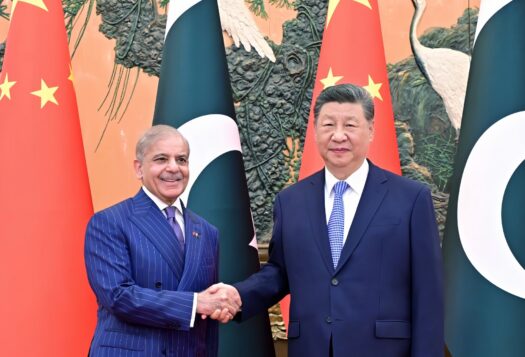
With its conventional strikes deep inside Pakistan in the May 2025 conflict, India showcased that a non-nuclear war can be fought between nuclear peers. However, the four-day conflict was not without the risk of inadvertent nuclear escalation: India reportedly struck Pakistani air and missile bases that were suspected of housing or supporting Pakistan’s nuclear weapons.This was followed by Pakistani Prime Minister Shehbaz Sharif’s call for a meeting of the National Command Authority (NCA), the body that oversees Pakistan’s nuclear arsenal. Should a future India-Pakistan crisis rapidly escalate to the nuclear level, India may well feel that it can no longer rely on a demated nuclear posture. The increased nuclear readiness of India and China, followed by Pakistan, further exacerbates the risks associated within the strategic chain in Southern Asia.

A New Reality?
To understand why this chain of escalating nuclear readiness poses such a profound risk to regional stability, it is important to examine how these states govern the deployment and potential use of their arsenals. In their chapter of Vipin Narang and Scott D. Sagan’s edited volume The Fragile Balance of Terror: Deterrence in the New Nuclear Age, Giles David Arceneaux and Peter D. Feaver classify NC2 into three types: delegative, conditional, and assertive control.
The delegative type concerns delegating lower-level military operators with nuclear use capability. They possess physical control of nuclear warheads and delivery platforms and can use nuclear weapons even without the higher authority’s approval; thus, there remains a persistent threat of unwanted nuclear use.
Conditional control systems delegate the ability to use nuclear weapons early in a crisis while centralizing administrative authority over nuclear use and physically dispersing nuclear components. However, this kind of control possesses several challenges. Early in a crisis, the assembling of nuclear weapons may send a malign signal to the adversary and increase the likelihood of inadvertent escalation. This delegation of nuclear use authority also weakens political control during a crisis, thereby complicating de-escalation. According to Arcenaux and Feaver, Pakistan employs a conditional command system that centralizes the oversight of nuclear use during peacetime while rapidly delegating nuclear use authority during a crisis. They note that technical teams on the Pakistani nuclear base can even bypass the permissive action link (PAL) necessary to launch nuclear warheads during a crisis period. This would fit in with Pakistan’s nuclear policy, which does not include an NFU pledge.
Finally, assertive control systems highly centralize administrative control over nuclear use and often physically de-mate and disperse nuclear weapons to ensure political control over nuclear decisions throughout a crisis. Arcenaux and Feaver classify China and India as having assertive control systems. Chinese political leaders have historically exercised highly assertive control over nuclear forces, including keeping nuclear warheads demated and geographically dispersed. India, likewise, has historically disassembled and demated its nuclear weapons.
While both China and India are committed to their respective NFU policies, changes over the past few years by the former and, more recently, the latter challenge this classification of NC2 systems in Southern Asia.
This more nuanced framework explains how a country can adapt operationally to a worsening external threat environment by maintaining combat readiness and credibility in carrying out nuclear threats, without fully triggering the destabilizing risks of a purely delegative system.
The Search for “Segmented” Flexibility
If these developments in India and China are indeed underway, then they effectively reveal the limitations of the Arceneaux-Feaver Framework. Instead, this article proposes a “Segmented-Delegative Assertive Control System” as a transition phase between purely assertive and delegative control types. This phase shows that while states remain highly assertive on nuclear use, in doctrinal and political terms, they introduce localized flexibility by giving some segments of their strategic forces a quasi-delegated authority or the physical ability to launch nuclear weapons should an adversary attempt a decapitation strike.
This more nuanced framework explains how a country can adapt operationally to a worsening external threat environment by maintaining combat readiness and credibility in carrying out nuclear threats, without fully triggering the destabilizing risks of a purely delegative system. This classification is in sync with China’s developing LOW capability, and India’s aspiration for “the arrangements for alternate chains of command for retaliatory nuclear strikes in all eventualities,” and an “effective and survivable” NC2 with “requisite flexibility and responsiveness.”
For instance, in the case of a first nuclear strike by an adversary, an SSBN with mated nuclear warheads must possess some pre-delegated authority or physical ability to launch nuclear weapons. China’s development of an “early warning counterstrike” capability would need to have pre-delegated some authority to lower-level military echelons in order to be seen as a credible threat. Nevertheless, both China and India may still retain political authority through PAL. Unlike the purely delegative control system, where lower echelons can launch nuclear weapons, those quasi-delegated segments may still need political approval for a possible nuclear launch.
There are two key caveats for this theory. Firstly, this type is largely based on the ongoing developments in the region; should India and China deploy all of their warheads during peacetime, their NC2 systems would be technically classified as delegative. Secondly, pressures rippling across the strategic chain may not always do so in a linear fashion.
Uncertain Trade-Offs
States always face an uncertain trade-off between increasing the readiness and credibility of their nuclear arsenals and avoiding inadvertent escalation. Those attempting to enhance the combat-readiness of their arsenal could incentivize similar efforts by adversaries. This could also further send destabilizing signals to the adversary in a crisis.
Though India aims at reinforcing its credible minimum deterrence, it cannot expect nuclear deterrence to help it against conventional skirmishes with China, most notably demonstrated by the 73-day military standoff at Doklam in 2017 and the deadly clashes in the Galwan Valley in 2020. India cannot use nuclear weapons against a loss of territory due to both its doctrinal position and the stability of the nuclear level. On the other hand, maintaining a highly ready nuclear deterrent can help New Delhi deter Islamabad, signaling that the former’s conventional capability would not be completely offset by any nuclear threats from the latter.
However, optimizing the credibility of such nuclear threats brings an element of inadvertent escalation across the strategic chain. As each China and India introduce localized flexibility, they simultaneously increase the risk of inadvertent escalation. Pakistan, for example, may feel pressured to delegate its nuclear weapons during peacetime, further decentralizing its command and control, heightening alert levels, and advancing its sea-based capabilities to prevent any perceived vulnerabilities.
To mitigate these dangers, Southern Asian nuclear powers ought to prioritize confidence-building measures (CBMs), expand existing bilateral agreements to include newer military domains, and add fuel to transparency dialogues. Traditional CBMS should be extended to cover pre-notification of missile flight tests, especially sea-based missiles. Establishing dedicated crisis-communication hotlines between states should be a priority. Furthermore, existing agreements should be revised to establish or agree on behavioral norms in newer domains, such as cyber, space, next-generation missiles, and autonomous systems, where conventional-nuclear entanglement could be gravest. Finally, adding significance to transparency dialogues through regular military-to-military exchanges will be essential to prevent misinterpretation and unintended escalation.
Views expressed are the author’s own and do not necessarily reflect the positions of South Asian Voices, the Stimson Center, or our supporters.
Also Read: Firebreak or Fuse? Pakistan’s Rocket Force and the Deterrence Dilemma in South Asia
***
Image 1: Indian Ministry of Defense via Wikimedia
Image 2: Acroterion via Wikimedia