Editor’s Note: This article is the first part of a two-part series on India’s Prototype Fast Breeder Reactor. Read the second part here.
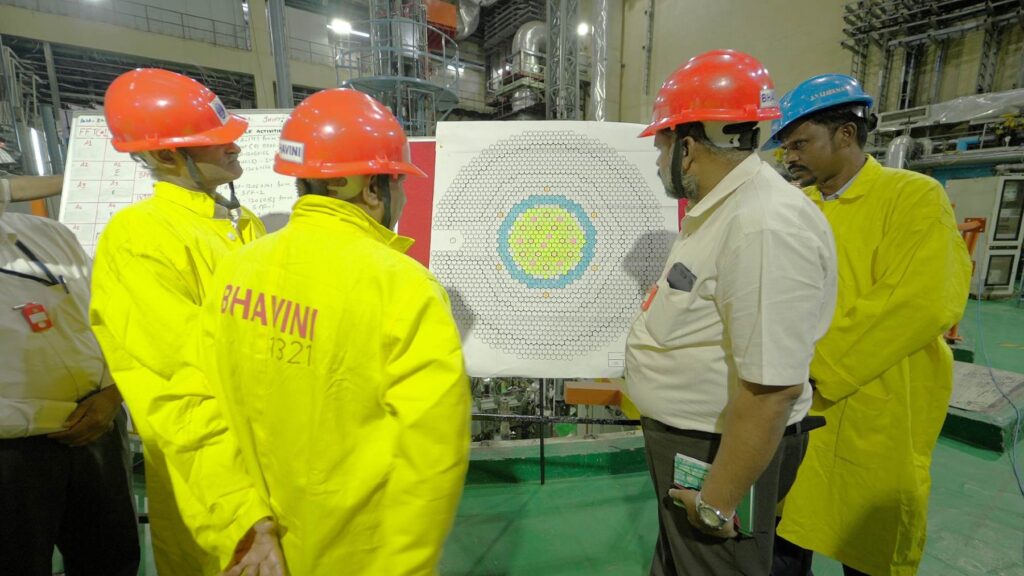
On April 6, India’s indigenous 500MWe Prototype Fast Breeder Reactor (PFBR) at Kalpakkam, Tamil Nadu, achieved first criticality—the point at which a controlled, self-sustaining nuclear fission chain reaction begins. This development represents a significant scientific feat and technological milestone for India, which has long-faced firsthand constraints in securing uranium, particularly during periods of sanctions and international isolation following the 1998 nuclear tests. More recently, overlapping global disruptions—from the Russia–Ukraine conflict and post-pandemic recovery to tensions in West Asia and the energy demands of the artificial intelligence (AI) boom—have underscored the urgency of reliable, independent, and long-term energy sources. This environment has set the stage for a global nuclear energy resurgence, driven by net-zero commitments and renewed investments. For India, these dynamics align with the broader ambition of achieving developed nation status by 2047, as it also opens up its civil nuclear sector for private participation.
The PFBR’s technical success will not singularly usher in these changes, but it does mark an important step forward. If they can eventually scale commercially, breeder reactors could be a pathway towards strengthening Indian energy security, though substantial technical, economic, and institutional challenges remain.
Unpacking PFBRs: What, How, and Why Now?
A Fast Breeder Reactor (FBR) is an advanced nuclear reactor designed specifically to generate more fissile material than it consumes while producing energy—in this case, plutonium-239. Unlike conventional thermal reactors that use enriched or natural uranium, the PFBR uses Uranium-Plutonium Mixed Oxide (MOX) as fuel. In operation, the reactor’s core (with the plutonium-based fuel) is surrounded by a blanket of natural or depleted uranium-238. The key breeding reaction involves uranium-238 absorbing a high energy-neutron from the plutonium fission and transforming into plutonium-239 through a series of decays. The fast neutrons from this fission both maintain the reaction and convert the blanket material into new fuel, therefore allowing the reactor to “breed” more fissile material than it uses. For such a reaction, a coolant that is not an efficient moderator, usually liquid sodium, is used to keep neutrons energetic and enable efficient conversion of fertile material into new fuel. In the longer term, such breeder blankets are intended to incorporate thorium, enabling the generation of uranium-233—a key pathway toward the third stage of India’s nuclear program.
The idea is to enable a closed fuel cycle that supports continual reuse of fissile material while comparatively reducing waste. If successful, this feature can also help address the politically contentious challenge of identifying long-term geological disposal sites for nuclear waste. If plutonium and other long-lived transuranic elements in spent fuel are largely fissioned, the remaining waste would consist predominantly of shorter-lived fission products, making its management and disposal significantly more feasible.
The Rise and Fall of FBRs
The concept of a plutonium-fueled nuclear reactor that could produce even more fuel emerged during World War II within the U.S. atomic bomb program. Since then, the Soviet Union, the United Kingdom, France, Germany, Japan, and India, alongside Belgium, Italy, and the Netherlands with French and German assistance, have variously undertaken efforts to develop national breeder reactor programs. Over time, however, as uranium resources proved to be more abundant than initial expectations indicated, such programs became less urgent. These initiatives also faced significant technical and economic challenges, alongside safety concerns and shifting non-proliferation policies. As a result, enthusiasm for deploying fast-neutron reactors for plutonium breeding declined, particularly across OECD countries. Today, Russia remains the only country with operational commercial-scale fast breeder reactors, notably the BN-600 and BN-800 units at the Beloyarsk Nuclear Power Station. China, meanwhile, has the CFR-600 fast reactor, which has achieved criticality and is moving toward full operation.
“The idea is to enable a closed fuel cycle that supports continual reuse of fissile material while comparatively reducing waste.”
Bhabha’s Atoms for Peace
For India, the FBR development comes as a part of the second stage of Dr. Homi Jehangir Bhabha’s long-envisioned three-stage nuclear program. In this plan, the first stage would rely on pressurized heavy water reactors (PHWRs) to efficiently use natural uranium and generate plutonium-239 suitable for reuse; the second stage would entail developing FBRs to use the same plutonium to breed more fissile material; and the third stage would then transition to thorium-based fuels. This strategy reflected India’s resource profile: limited uranium but abundant thorium.
The push to scale such efforts is thus not new, but because the Indian FBR project was static for decades, it had often been characterized by critics as a protracted endeavor marked by persistent delays and cost overruns, much like its testbed predecessor, the FBTR. Construction costs of the PFBR, which broke ground in 2004 with a planned 2010 commissioning date, rose from ₹3,492 crore (USD $361 million) to about ₹8,181 crore (USD $845 million), with associated infrastructure such as the FRFCF also repeatedly deferred. These setbacks reflect the broader global challenges surrounding fast breeder reactor reliability, safety, and economic viability.
Promise with Precautions?
Beyond the already well-documented timeline delays and cost overruns, as is the case with most new civil nuclear technologies, one key concern is the risk of Core Disruptive Accidents (CDAs). The use of liquid sodium as a primary coolant introduces additional complexity: Liquid sodium is opaque and highly reactive with both air and water, making potential leaks particularly hazardous. Global fast breeder reactor experience—from repeated sodium leaks in Russian and European reactors to the 1995 Monju fire in Japan—has long underscored persistent safety and reliability challenges associated with breeder technology.
In addition, the increased fissile material inventories generated by such reactors inherently heighten proliferation sensitivities, which arise from the combination of expanded plutonium availability, fuel-cycle configuration, and the politico-strategic conditions under which separation, storage, and reuse take place. These concerns may become more pronounced if the technology is eventually commercialized and involves wider institutional or private-sector participation, even if indirectly.
At the policy level, critics further argue that larger plutonium stocks are also seen as complicating future fissile material controls, particularly in the context of Fissile Material Cut-off Treaty (FMCT) negotiations and long-term breakout assessments.
Regional Concerns: More Than Meets the Eye?
Given the PFBR’s status outside International Atomic Energy Agency (IAEA) safeguards, several analysts from Pakistan have raised concerns about transparency. The inherent dual-use nature of breeder technology contributes to apprehensions surrounding latent capabilities and the potential expansion of a state’s future fissile-material options. In Islamabad’s reading, this concern is amplified by broader regional strategic trends, including India’s ongoing modernization of delivery systems, longer-range missile development, and gradual expansion of its nuclear infrastructure, which together make it difficult to entirely separate civilian breeder development from wider deterrence considerations.
Some analysts have posited that, depending on operational assumptions and fuel-use pathways, breeder deployment could increase India’s annual weapons-usable plutonium production potential from current estimates of roughly 24 to 26 kilograms to substantially higher levels. While such reprocessing and handling of plutonium are central to fast breeder operations and not unique to India, they may understandably amplify existing mistrust in a nuclearized neighborhood. Indeed, arguments in this vein often point toward a 2006 interview by Anil Kakodkar, the-then Secretary of DAE, who suggested that placing the fast breeder program under safeguards could constrain both energy security and India’s credible minimal deterrence posture. However, this argument may be more understood as a function of the technology itself, rather than intent: Subjecting a system in which reprocessing and reuse are integral to its economic and technical viability to external constraints limits strategic flexibility and complicates the reactor’s operational logic. Though experiences such as Japan’s Monju program demonstrate that advanced sodium-cooled breeder reactors and associated fuel-cycle facilities can, in principle, operate under technically credible and relatively non-intrusive safeguard arrangements, this does not necessarily invalidate the rationale underlying India’s position. At the present stage, India’s breeder program remains closely tied to the development and scaling of a closed fuel cycle intended to support future breeder deployment, fuel recycling, and eventual thorium utilization under the third stage of its nuclear program, all of which require sustained access to plutonium for experimentation, reprocessing, and fuel fabrication.
Additionally, while the dual-use nature of such material inevitably sustains concerns regarding potential weapons applicability, India already maintains an established nuclear deterrent and possesses alternative pathways for fissile material production, making additional breeder-derived plutonium, at least for the time being, not doctrinally essential to its credible minimum deterrence posture. In this light, the concern that Kakodkar articulated in 2006 appears to have been driven less by an immediate requirement for weapons expansion than by a desire to preserve flexibility over a still-maturing fuel-cycle architecture, whose primary priority at present remains addressing India’s long-standing energy security problem and reducing its technological dependence.
India’s decision to keep the PFBR outside International Atomic Energy Agency safeguards therefore reflects an attempt to preserve this autonomy within its long-term nuclear development program, rather than a wholesale rejection of global nonproliferation norms. First, as a non-signatory nuclear weapons state to the NPT, India is not bound to full-scope safeguards, and under the India–United States Civil Nuclear Agreement, it has already placed a significant portion of its civilian nuclear facilities under international oversight. Second, as is reflected in a suo motu declaration to the Separation Plan, New Delhi had explicitly stated that the fast breeder program would remain free of external constraints to avoid limiting control over fuel-cycles that would hinder sensitive technological pathways. Moreover, while this particular reactor remains outside safeguards, India has indicated that all future civilian thermal and fast breeder reactors could be placed under international oversight, reflective of its broader commitments. India has also pointed to its consistent cooperation with global regimes through safeguarded civilian reactors, and non-proliferation record with no history of illicit transfers.
For Islamabad, the issue may not be just the reactor itself, but the precedent it sets—where a major nuclear facility operates outside international monitoring while still receiving implicit global validation. For example, in a notable first, the PFBR development was publicly lauded by Rafael Mariano Grossi, Director General of the IAEA, despite the reactor not being under IAEA safeguards. This is significant because the Agency typically exercises caution in endorsing nuclear advances that fall outside its direct oversight. Grossi’s comments appear to reflect a broader perception shift in recognizing the role of advanced nuclear technologies in meeting global clean energy goals. From this perspective, the PFBR may be increasingly seen less as a proliferation concern globally and more as a complex but legitimate energy innovation. This divergence in reactions also underscores the broader tension between advancing nuclear energy and maintaining confidence in non-proliferation norms.
“India’s fast breeder program will be defined by the PFBR’s ability to transition from a first-of-a-kind success to a scalable and reliable fleet.”
The Road Ahead: From Milestone to Momentum
Looking ahead, India’s fast breeder program will be defined by the PFBR’s ability to transition from a first-of-a-kind success to a scalable and reliable fleet. The next phase will subsequently require achieving full capacity, followed by standardization, cost rationalization, and the gradual accumulation of operational data—areas where breeder technology has historically struggled. Equally critical will be advances in mixed oxide, metallic, and thorium fuel-cycle technologies, alongside building confidence in sodium coolant systems, which, despite their efficiency, have long raised safety concerns due to their reactivity and the operational challenges they pose. If the technology is eventually commercialized—with even limited private-sector participation, if at all—issues of oversight, material accountability, and proliferation risk will need to be carefully managed, particularly given the sensitive nature of plutonium handling within breeder cycles.
The broader significance of the PFBR, though, lies in enabling the long-envisioned third stage of India’s nuclear program, rooted in the utilization of thorium. Thorium molten salt reactors are widely viewed as a key third-stage option, potentially enabling sustained electricity generation, with PHWR-based thorium fuel strategies offering a pathway to scale up capacity over time. Yet, this trajectory is not linear. Fast breeder reactors are likely to remain, at least in the medium term, a strategic niche given their complexity, cost, and proliferation sensitivities. While the broader international appeal of such a pathway may remain limited, operational experience from India’s breeder program could still contribute to wider discussions on advanced reactor and closed fuel-cycle technologies. For India, then, their value lies in this very niche: as a bridge technology that underwrites long-term energy autonomy while keeping open the possibility of a thorium-based future.
Views expressed are the author’s own and do not necessarily reflect the positions of South Asian Voices, the Stimson Center, or our supporters.
Also Read: India’s Nuclear Inflection Point: Why Private Participation Demands Regulatory Reinvention
***
Image 1: DAE India via X
Image 2: DAE India via X