Editor’s Note: This article is part of South Asian Voices’ annual Year in Review series. Browse the full series page here.
Indian foreign policy in 2025 has had to navigate a complex external environment that threw up some of the most formidable challenges—particularly in executing its internal goals of economic growth and development towards the vision of Viksit Bharat (Developed India) by 2047. The linkages between foreign policy and domestic politics cannot be more profound for an India whose aspirations play a part in shaping an inclusive and stable world order and whose objective of sustaining its economic growth is tied to leveraging global technological advances and securing uninterrupted supply of energy.
In this context, the advent of the second Trump administration in Washington has had a significant impact for New Delhi. President Trump has reshaped the contours of international relations in ways not envisioned in any simulation exercise, throwing up may unforeseen challenges. The relationship with the United States this year has been a stress test for the practice of India’s strategic autonomy, as one of its most consequential partners has upended the terms of their bilateral engagement. Even as sectoral cooperation continued between the two countries, President Trump’s transactional style, the charged political rhetoric by U.S. officials on Indian policy decisions, and the U.S. imposition of 50 percent retaliatory tariffs on India has threatened to undo the habits of cooperation painstakingly built in the last 25 years.
This new low in Indo-U.S. ties also transpires at a time of great tumult in the world order. We are living through what is often called a “world adrift;” the old order having becoming passé, but a new one not in clear sight. By dint of its growing national power, India will be a major pole in any kind of order that will emerge out of this profound transition. However, New Delhi will also have to account for its power asymmetry relative to other powers in the international system who are more materially endowed than itself, and the constraints that would impose on its foreign policy. This might mean a change of pace in how New Delhi executes the terms and conditions of its external engagements, in 2026 and beyond.
[…] India will be a major pole in any kind of order that will emerge out of this profound transition. However, New Delhi will also have to account for its power asymmetry relative to other powers in the international system who are more materially endowed than itself, and the constraints that would impose on its foreign policy.
New Delhi in the Fast Lane
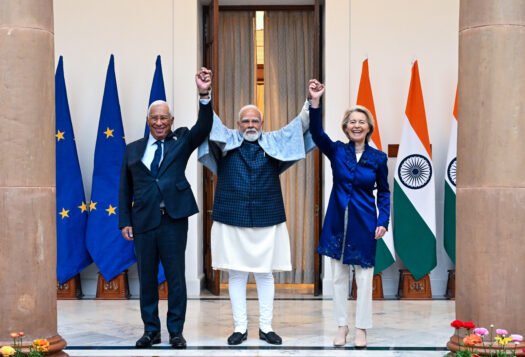
To be sure, India had already sensed it needed to change strategies in an uncertain world of shifting alignments, as evidenced by its efforts to diversify its economic partnerships in 2025. The signing of the India-United Kingdom Free Trade Agreement (FTA) in July and fast-forwarding the negotiations for the India-European Union (EU) FTA as seen through the December dialogue indicate a New Delhi that recognizes the new faultlines that the Trump administration’s tariff measures have exposed. Moreover, President Trump’s flip-flop on Washington’s great power relations with China and Russia has made New Delhi rewrite its own playbook vis-à-vis Beijing and Moscow. On the one hand, the administration’s inconsistent mix of attempts at economic coercion and political accommodation of China and its new “G2” signaling have produced a propensity in New Delhi to revisit bilateral communication with Beijing despite persistent structural challenges. On the other hand, President Trump’s own engagement of Moscow to resolve the Ukraine war and stabilize U.S.-Russia relations while also targeting India’s energy and defense ties with Russia has infused a new urgency and strategic logic to the India-Russia partnership.
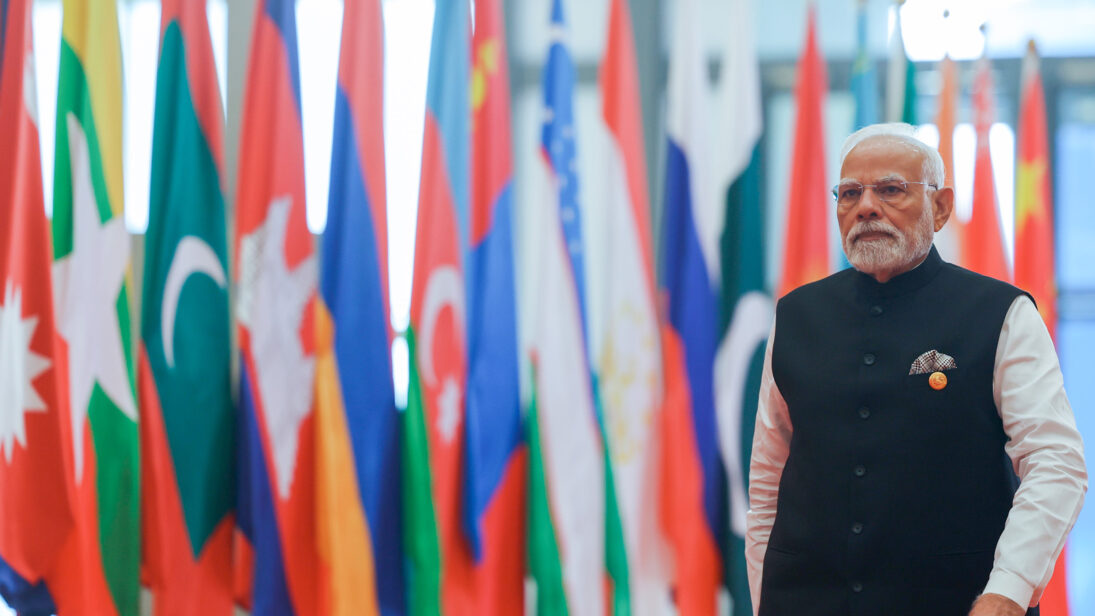
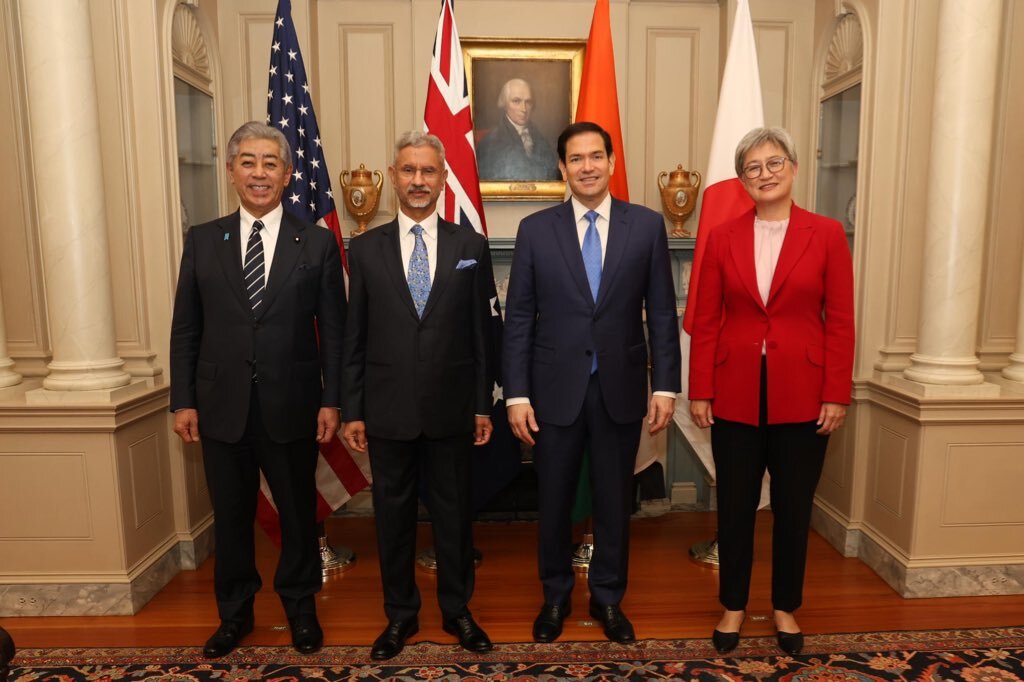
In this context, Prime Minister Narendra Modi’s show of camaraderie with President Vladimir Putin and President Xi Jinping at the Shanghai Cooperation Organization (SCO) summit in Tianjin in September and the recently concluded 23rd Annual Summit between India and Russia in early December are signs of New Delhi doubling down on its multialignment strategy. This comes at a time when the Quad Leaders’ Summit, which was scheduled to happen in New Delhi this year, has failed to materialize, putting more ammunition into the hands of those who would like to see the Quad disappear like “sea foam.” There is growing confusion over how the second Trump administration has been approaching the Indo-Pacific region, which in recent years has been a geopolitical region of priority for India in concert with the United States, Japan, and Australia. Worryingly for New Delhi, with the Trump administration’s freshly released National Security Strategy NSS pronouncing a Trump corollary to the Monroe Doctrine in the Western hemisphere, the Indo-Pacific might fall further off the U.S. strategic radar screen.
This weakening of the Quad is also happening when India is set to take up the BRICS presidency, in which South-South cooperation, and more specifically, the dynamics between India, Russia, and China will take precedence. Thus, 2026 will be a crucial test for India’s maintenance of its varied, issue-based minilateral ventures, and how it manages to navigate the bookends of the West and the East, or the North and the South, and maximizes its gains, while minimizing its losses.
The Rebalancing Imperative
Fissures in the transatlantic alliance or what is called the “West” is a development that will require India to rebalance its economic and security strategies. The European Union itself is on a quest for a new vision and independence in its foreign policy, which requires a marriage of convergence with India. But this suits India well when it aims to diversity its economic ties amid a downturn in ties with Washington to create redundancies and have alternatives in the European and Asian markets. New Delhi will also have to navigate a complex network of synergistic and antagonistic defense industrial conclaves, as it attempts to diversify partners for “co-development and co-production,” find buyers for its own defense exports, and look for reliable partners who are willing to share advanced technologies. This shift will be structural, because defense partnerships will no longer be transactional but embedded in longer-term industrial and strategic ecosystems.
Developments closer to home in India’s immediate neighborhood also reflect a churn, necessitating a policy rethink from New Delhi. The past few years have seen a trend of polities in the subcontinent rising in resistance to dislodge regimes in power, seeking to hold them to account for longstanding political, socio-economic, and governance missteps. This intersection of mass resistance and public accountability has also led to an internal reassessment of regional politics and policy in these countries, generating an anti-India sentiment in some instances. Thus, the political outcomes of impending elections in Nepal, Bangladesh and Myanmar would likely require a reboot of India’s terms of engagement with those countries. While the influence of other extra-regional stakeholders such as China and the United States is significant, India will continue to play an oversized role in the sub-region just by the logic of geography and history. This exposure also carries its own structural risks, however. In the coming months there is a task ahead for Indian foreign policy decisionmakers to stay ahead of the curve on developments in New Delhi’s vicinity. They would have to prepare to navigate the complex political storm that is brewing, whose outcomes, among others, are likely to reshape Indian calculations on the return on investments from projects driving sub-regional connectivity and growth.
It is clear that India intends to resist binary alignments, even in adverse circumstances, and prefers to take hits from the practice of strategic autonomy, rather than picking sides.
Strategic Autonomy’s Renewed Value
Rather than becoming irrelevant, India’s long-enduring foreign policy practice of strategic autonomy has acquired a renewed salience in current times, when everything from tariffs to immigration has been weaponized. It is clear that India intends to resist binary alignments, even in adverse circumstances, and prefers to take hits from the practice of strategic autonomy, rather than picking sides.
Global systemic uncertainties, as witnessed sharply in 2025, seem to have reinforced India’s independent choices in foreign policy, even as it rebalances ties with both adversaries and partners for economic and security gains. New Delhi’s decision to double down on its partnership with Moscow, and undertake cautious engagement with China, reflects this calculated strategic logic. The priorities of mitigating supply chain risks, gaining uninterrupted supply to traditional and new sources of energy, and exploring the best possible options for access to new technologies for both military and civilian use will continue to drive India, motivated as it is to create an externally conducive environment for achieving its domestic targets.
The relative success of India’s grand strategy will depend not only on an appreciation of its rising national power but also of its deficiencies. International relations will continue to play out in comparative terms, and an acute sense of its power differential vis-à-vis the great powers will prepare India better for achieving its internal and external balancing goals. Geopolitics in 2025 have revealed a naked realism, a trend that is more likely to continue rather than ease out in 2026. A more unabashed employment of national power will most likely shape the navigation of interstate political and economic negotiation. This situation makes it an imperative for New Delhi to pragmatically and assiduously negotiate new terms of engagement with a diverse set of partners, in order to future-proof its domestic growth and development from geopolitical and geoeconomic upheavals.
Views expressed are the author’s own and do not necessarily reflect the positions of South Asian Voices, the Stimson Center, or our supporters.
Also Read: Quo Vadis, Indian Foreign Policy? The Perks and Perils of India’s Multialignment
***
Image 1: PMIndia.Gov.In
Image 2: Dr. S. Jaishankar via X